Situational Leadership in action

For the background and theory behind situational leadership click here.

Situational Leadership in practice:

In 2023 I was working in my first role within CI and had one direct report within my charge. It was part of my job to help Jodie develop in to a position where she could eventually take over my role as CI manager.

It was 11am and my boss, the site director, came to ask whether I could host a factory tour for the regional IT director who was due to arrive on site in 1 hours time.

I had an important meeting starting at 11:30 so wasn’t available to be the host so I asked Jodie if she wouldn’t mind doing it instead. She looked at me wide-eyed and said that she’d never hosted a factory tour before and was worried she’d get it wrong. In this case, she pretty much skipped development stage D1 (High confidence, Low competence) and went straight to development stage D2 (Low confidence, Low competence).

Don’t ignore concerns:

This situation is pivotal and can really help or hinder trust and thus your working relationship if not handled correctly.

Because I was asking Jodie to carry out a task that she hadn’t done before and with very little time to prepare, I needed to show her that she had my fully support ahead of performing the task.

This situation and the task were key development opportunities for her and I really wanted it to go well because it would grow her self-confidence.

I told her that I had 30 minutes until my next meeting and would spend every minute helping her to prepare for the visit.

Development stages:

Each time a task is performed, a person will be in 1 of 4 development stages. It is important to know what stage your direct report is in so that you can tailor your leadership style to that.

Because Jodie had no experience in the task and was more fearful than excited about the prospect of doing it, she was in development stage 2 (Low confidence, Low competence).
Now that I knew what development stage she was in for this task, I could tailor what I did next to help her progress at least to D3 before she hosted the VIP.

In stage D2, the corresponding leadership style (S2) is high support and high direction with entails giving specific actions (direction) and boosting confidence (support).

I went through each of her concerns one by one and broke each down for her to illustrate that she already had all of the information she needed to complete the task and do it well. At this point she just needed help to organise her thoughts which would reduce overwhelm and move her from panic in to action.

When faced with this situation I have seen managers default to acting as though their direct report is in D4 (High confidence, High competence) and just tell them to get on with it.

Personally I don’t believe in that sink or swim style because I feel that people succeed in spite of and not because of it. This leads some to believe that this method helps to “weed out” those who wouldn’t be good enough anyway but by doing so, you are rejecting a huge percentage of people who would have been excellent at a task and who are highly coachable which drastically reduces your talent pool.

Moving from D2 to D3:

Step 1: Explain the purpose of the visit

Context is important and helps put all other things in to perspective. Here I explained to her what the VIP was here to do (Gain a basic understanding of the process, what technology we used, the common issues we experienced as a site and what we would need in order to have better results).

Step 2: Ask about their concerns and go through each in turn

Concern 1: “I have no idea what route to take

My question: What route would seem the most obvious to you?

Her answer: To follow the process through from start to end

Concern 2: “I haven’t done this before and I am afraid I might look stupid in front of our visitor

My proposal: Manage his expectations and tell him how you feel and about your level of experience when you first meet. Being humble in this way breaks the ice, helps him will understand your level of experience and makes you feel more relaxed in the process because you aren’t worrying about pretending to be highly competent for the sake of appearances.

Concern 3: “I don’t have intimate knowledge of our systems and the issues we face”

My question: Do you know anyone who does?

Her answer: The shift supervisors do, so I could be there to make introductions and tell the visitor to direct any questions he has about the area to them.

Concern 4: “I don’t know what size PPE to get or where to get it from”

My response: I will get the sizes for you

Concern 5: “I don’t know where to get all of the PPE required”

My question: Do you know someone who does?

Her answer: Yes! I can give the sizes to Andy and he can get that for me

Step 3: Ask how they feel about the task now

Following the interaction above (this took about 10 minutes in total) I asked Jodie how she now felt about carrying out the task. She said she felt confident in everything that needed doing. Boom! Now she was in stage D3!

In the end….

Jodie came back in to the office after the visit BEAMING! She was so pleased with herself for completing the visit and she was given great feedback from the visitor. Mission accomplished as far as I can tell!

In the end all it took was a little support and direction to be given for her to have a bigger chance of success.

Motivation comes from trying something and seeing results and that’s exactly what happened that day. Jodie was put at the edge of her comfort zone and had a great experience which gave her more confidence in herself and made her more motivated to take on new, harder tasks in the future.

The sink or swim approach for new tasks doesn’t work, and even though some people may manage to swim to safety, you have also given them a lifelong fear of the water.

When you next delegate a task to your direct report, watch for their reactions, ask questions to try and understand what development stage they are at and adapt your leadership style to what they most need at that time and you will help them grow and develop like never before.
Task management – the DILO

You can’t manage time, you can actually only manage what you do during that time”

David Allen, Productivity Consultant.

If you have ever told someone else that you are bad at time management, or someone on your team has told that to you, then this page is for you!

In my experience, people who “don’t have time” may have one or several of these things happening:

  • The business priorities aren’t clear to them
  • They don’t know how to prioritise effectively
  • They spend time on low-value-added tasks at the expense of higher-value tasks
  • They don’t know how to say “no” to a request
  • They are inefficient in task completion

If you hear your team say this to you, then it is your job as the line manager to ensure that:

  • They know what the business priorities are
  • They understand how to classify tasks according to the urgent / important matrix
  • They know how to plan their time effectively
  • They don’t have tasks from other people on their to-do list

If you hear yourself say that to your line manager, then you may need help with the above as well.

The DILO (Day In the Life Of)

The DILO is a simple yet effective tool to map the tasks that are being conducted and what percentage of time is taken up by each task. I have described how to conduct the task for your direct report but if you realise that you need help to prioritise from your line manager then carry out the task for yourself and then meet with them to discuss.

The principle is simple:

Download the DILO template (see above) and fill in the top left boxes (time intervals / hr, Start time, Contracted hours) before sitting down with your direct report and asking them to fill it in over the next week.

Get them to add any recurring meetings or tasks to the DILO before they start.

Ask your direct report to set an alarm every 15 or 20 minutes (depending on your chosen time interval) of the day for an entire week. Each time the alarm goes off, they write down what they are currently doing.

At the end of the week, book in a meeting together and ask them to bring the DILO so you can go through it together and put each task in to the urgent / important matrix.

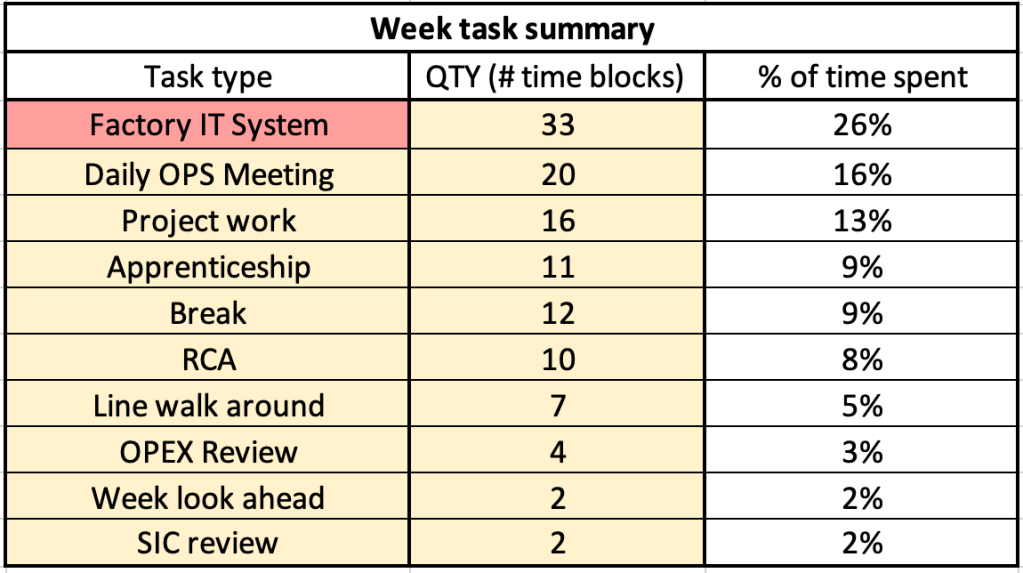
Go through the DILO and split the weekly tasks in to headings (meetings, personal development, lunch, break, own work etc) and put them in the week task summary table on the right hand side. Then count the number of each task type being performed and put it in the QTY column of that table.

This will now tell you what tasks are being conducted and what % of their contracted hours is taken up by each task type.

At the end of the meeting it should be clear to your direct report what tasks are the most important. It is also an opportunity for you to remove tasks from them, to understand where they might need more support, delegate less important tasks to others or push back tasks to other departments.

Real life example:

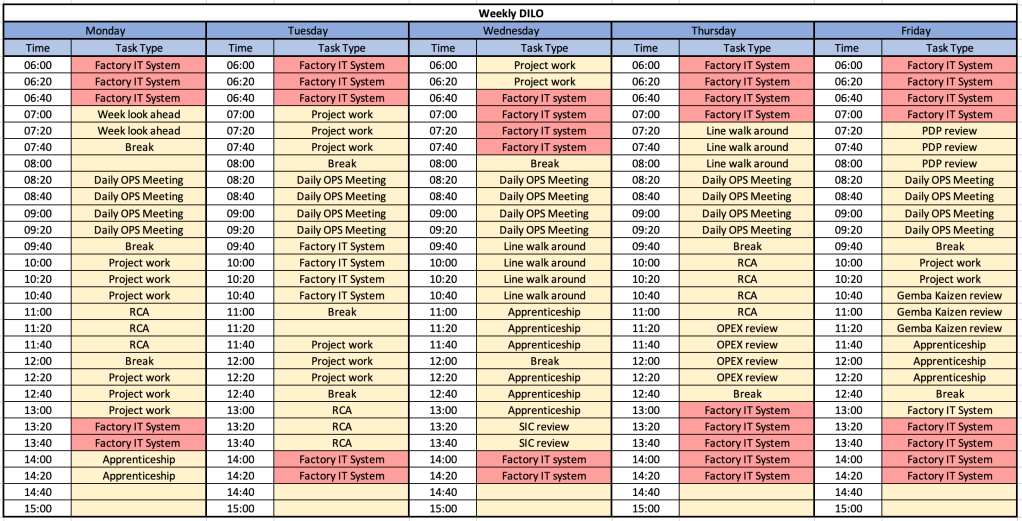
Below is the DILO for one of my direct reports that I asked her to do shortly after I joined the business. I wanted to get an idea of what tasks she was completing on a weekly basis.

I have highlighted all of the tasks in Red that I wanted her to stop doing, as they no longer fell under the remit of my team to carry out. Those tasks were given to her by the operations manager and were still required to be completed (just not by anyone on my team).

This is the summary of the table above by task and corresponding time taken over the week on that specific task.

As you can see, the time spent on the Factory IT System was 26% of her week and this task had nothing to do with my teams objectives.

So I took both tables to the Operations manager to show him just how much time this task was taking for my team member. This allowed the conversation to centre around the facts and gave him clear information that he needed to allocate that work (and thus that time) to someone else.

In the end, we agreed that my team would continue to carry out those tasks for the next 4 weeks while another person was trained and became competent in performing those tasks and my team member got about a quarter of her time back to focus on other work.

Performance Improvement Plan (PIP):

Useful files / templates:

Introduction:

The PIP process can be immensely effective in helping direct reports recover their performance back to meeting the expectations of their role and thus is a key skill in any line managers toolkit.

Of the 5 PIPs I have done for my teams, 1x put in no effort to improve and left the business, 1x returned to comfortably meeting expectations and 3x not only returned to meeting expectations but became some of my best performing team members!

I myself was put on a PIP while on the Mars Engineering Graduate program and it was the best thing that ever happened to me. It turned out that my poor performance was based on poor planning and prioritisation which, once remedied, brought me back to comfortably meeting expectations.

What is the PIP for?

The PIP is designed to support under-performing team members and bring them back to meeting expectations.

The aim of any PIP should always be to bring performance back to meeting expectations. Let me say that again:

THE AIM OF ANY PIP SHOULD ALWAYS BE TO BRING PERFORMANCE BACK TO MEETING EXPECTATIONS!

If it isn’t done with this in mind, your direct report will see right through it and will likely tell others on the team which could then cause the rest of your team to lose trust in you and reduce their engagement.

What is the process?

The PIP process is very similar to the PDP process but in a more concentrated form. A PDP objective can last anywhere from 3 months to a year with infrequent reviews but the PIP is usually done over 12 weeks with reviews every 4 weeks.

Step 1: Log performance of your team members

Identifying areas of poor performance can come from many different areas but as the line manager, it is usually clear who is and who isn’t performing.

As a line manager, I keep a running log of the performance (both positive and negative) of my team members. The notes in the log have more impact if they are specific and I won’t put anything in the log without first discussing it with my the team member it relates to. This forces me to verbally give them the positive or negative feedback. Hiding it and bringing it up during an appraisal feels secretive and breaks the social contract between you and your direct report.

When making notes in the log, be sure to note the following: The date, the situation, the behaviour or outcome of the work, the impact, when you feedback to your team member, any mitigating circumstances and any actions agreed for next time (see below for a template you can use).

Step 2: Decide whether a PIP is the best next step

Generally speaking if I had to give negative feedback to someone on the same or similar issue 3 times, I would consider kicking off the PIP process.

It wouldn’t be fair or relevant to put someone one a PIP for 1 mistake, this would take up a lot of time and most issues can be dealt with through working together to identify possible root causes and agreeing on a few actions to take next time.

Here are the steps that lead to a PIP, broken down in to occurrences of mistakes / under-performance and what I would do:

1st occurrence: Feedback to the team member, work together to identify possible causes, agree on actions to avoid a repeat of the issue.

2nd occurrence: Feedback to the team member, discuss causes, discuss whether previously agreed actions were implemented, tweak if required.

3rd occurrence: Feedback to team member, discuss causes, book in pre-PIP conversation.

Inform your HR team of the decision to put your direct report on a PIP and forward them the evidence.

Step 3.1: The PIP kick off meeting

The aim of the kick off meeting is to inform your direct report that they are under-performing and that they will be put on a PIP as a structured and supported way for them to improve their performance.

This is probably where the most care should be taken in the entire PIP process. How you act, what you say, your verbal and none-verbal cues can shape how your direct report views the whole PIP process. Done correctly and fairly, and you will have a higher chance of your direct report viewing the process as a positive one. Be clear with them that this isn’t a punishment but a way of agreeing roles, responsibilities and actions for you both to take to support the improvement in their performance.

Remember this is a partnership, they will have to do 90% of the work but you may have to do a few things as well to further help and support them.

When to hold the conversation: Book it late in the first half of someone’s last shift before a break. If someone works Monday to Friday, I might book it for 11am on a Friday morning for example.

The reasons for this are as follows:

  1. It gives you plenty of time to discuss the feedback, the ins and outs of the PIP process and take any questions without risking going over someone’s shift.
  2. Once the conversation is over, I usually let people take the rest of the day off paid, so they don’t have to feel the pressure of putting on a brave face in front of colleagues should they take the news particularly badly (so far no one has taken the idea of a PIP well, and I cried when I was told I was going to be put on one).
  3. It gives them the week end to be away from work, to discuss with their family / friends and to reflect on the conversation

What to bring: Bring the evidence you have gathered in your performance log, a copy of the blank PIP document and 2x copies of the PIP policy of your organisation.

What to discuss: Take your direct report through each piece of evidence and ask them if there is anything else they feel they are struggling with.

Then go through the PIP policy for the organisation to fully explain the process and the expectations. Take any questions that they may have at this stage.

Agree when you will sit down to actually write the PIP (ideally early the following week / shift cycle – say Monday or Tuesday).

Step 3.2: Writing the PIP

The aim of this meeting is to write the initial draft of the PIP document whereby you will discuss specific areas of under-performance, write SMART objectives with clear deliverables and due dates, agree on the PIP timeline (usually 12 weeks minimum) and the action review dates (usually every 4 weeks).

This document should be co-authored, not something that you write and then give to them. Involving them in the process helps with their commitment and engagement with it as they have some control over what they will have to do.

What to discuss: Ask them about their reflections over the week end and to ask any further questions that they have at this stage.

Go back over the feedback you presented in the kick off meeting, and ask if there is anything else they’d like your help and support with.

Filling in the PIP template:

Your organisation may have a PIP template already but most of the organisations I have worked in don’t have one so I have included one at the top of this post.

Go through the PIP template and complete each section. Remember to be as specific as possible and ensure all of the goals are SMART; if you can’t think of a way for the colleague to provide clear evidence of an action being taken, then that action needs to be changed in to a format they can prove.

At the end of this meeting, print out a copy for your direct report to take away with them and agree that you will sit down later that week / shift cycle to go over any further questions, make tweaks as required and for both of you to sign the PIP to kick it off. I would book this meeting in for late on Thursday or Friday.

Send a copy of the draft to your HR department and book in a 1:1 conversation with them before you next meet with your direct report. The role of HR here is to ensure consistency in the process and that your actions and deliverables are fair.

Step 3.3: PIP sign off and commencement

This should be a relatively short meeting where you ask if they have any further questions and if they’d like to make any minor changes to the PIP document at this stage.

All being well, there shouldn’t be much else to discuss and you both sign off the PIP as being live. You take away a signed copy to scan and send to HR and give them a signed copy as well.

Step 4: The PIP reviews

As discussed in the PIP, your direct report has to organise and invite you to the reviews to update you on their progress.

Here you will go through each action and deliverable due for that review number, discuss how they found it, anything they have learnt and whether they need any further support.

Add both your and their comments to the PIP under the relevant summary section of the PIP document.

Step 5: Final review

If they are now meeting expectations: All being well the final review should look a lot like the other reviews and your direct report is now back to performing at an acceptable level.

Congratulate them on their efforts and results.

You must go back through the PIP policy for your organisation and inform them of next steps from here. Usually they will have to sustain this level of performance for at least 12 months or risk going back on to the PIP.

If they have shown improvement but aren’t quite there yet: congratulate them on their effort thus far and explain that you’d like to extend the PIP (by say another 4 weeks).

Agree the new final review date and what you’d like to see by then.

If they haven’t shown much if any effort or improvement: This should be discussed with HR ahead of time and next stages agreed with them. This might mean going through the disciplinary process and restarting the PIP from scratch. Explain the next steps to your direct report.

Situational Leadership

As a team member and a line manager it is important to understand situational leadership as it forms a common language that you can both use to very quickly understand where you are and what you need from each other.

For the team member, it means that you are better able to communicate what your level of proficiency is in carrying out a task and are thus better able to communicate to your line manager what you need.

For the line manager it means being able to offer the right level of support for your direct reports.

Where did situational leadership come from?

Situational Leadership was developed by leadership experts Paul Hersey and Ken Blanchard and was (put to the audience) in their 1969 best-selling book, “Management of Organizational Behaviour: Utilizing Human Resources”.

It was one of the first models I learnt when I became a line manager.

The situational leadership model:

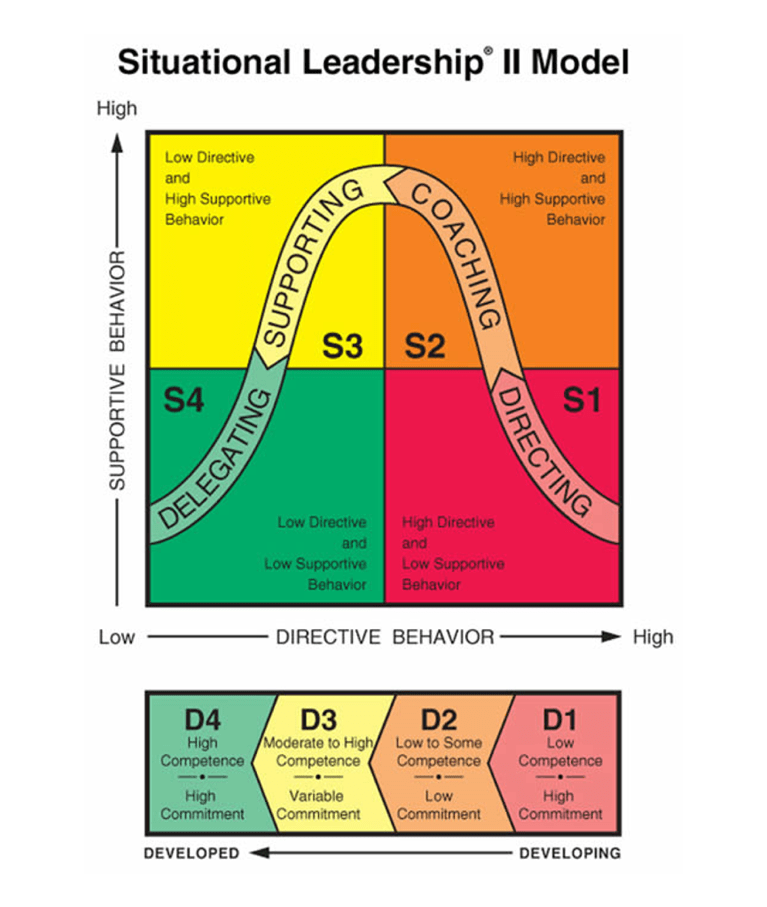
The image below shows the following things at once:

The development levels of the direct report (D1 to D4) and the corresponding leadership styles (S1 to S4) that are best suited to each of those development levels.

This is how it works:

D1: The direct report is new to the task and thus (generally) has high enthusiasm (High commitment) but low knowledge (Low competence) on how to conduct the task. They are excited to start something new but don’t know what they don’t know.

S1: To get the best out of your direct report, you will need to be highly directive; that is very prescriptive in the process steps that they need to take to begin the task (High direction) but you won’t need to give them lots of energy to get going (Low support).

D2: Now the direct report has begun the task, they realise that it’s perhaps harder than they had originally anticipated and they now understand just how much there is to learn / do in order to become proficient at this task. As a result their energy drops (Low commitment) and they also still don’t really know how to perform the task (Low / Some competence).

S2: The leader now needs to encourage the direct report more (High support) while still being very descriptive about the tasks that need doing in order to complete the task (High direction).

D3: The direct report now has some knowledge on how to complete the taks, they have grasped more than just the basics. They will now have some idea on how to conduct the task (Moderate to high competence) but their level of confidence in themselves will waiver; sometimes they will have good confidence, but other times this may dip (Variable commitment).

S3: Here the leader won’t necessarily have to give the direct report much in the way of direction (Low direction) but as a result of their wavering levels of confidence, they will need more energy and encouragement from the line manager (High support).

D4: The direct report has done the task and many other like it before, they know what they are doing (High competence) and they are confident in their abilities to get it done to a high standard (High commitment).

S4: The leader now adopts a Low support & Low direction approach, and can now just delegate the tasks to the direct report knowing that they won’t need much from them and the job will be done to a high standard.

The Dunning-Kruger Effect:

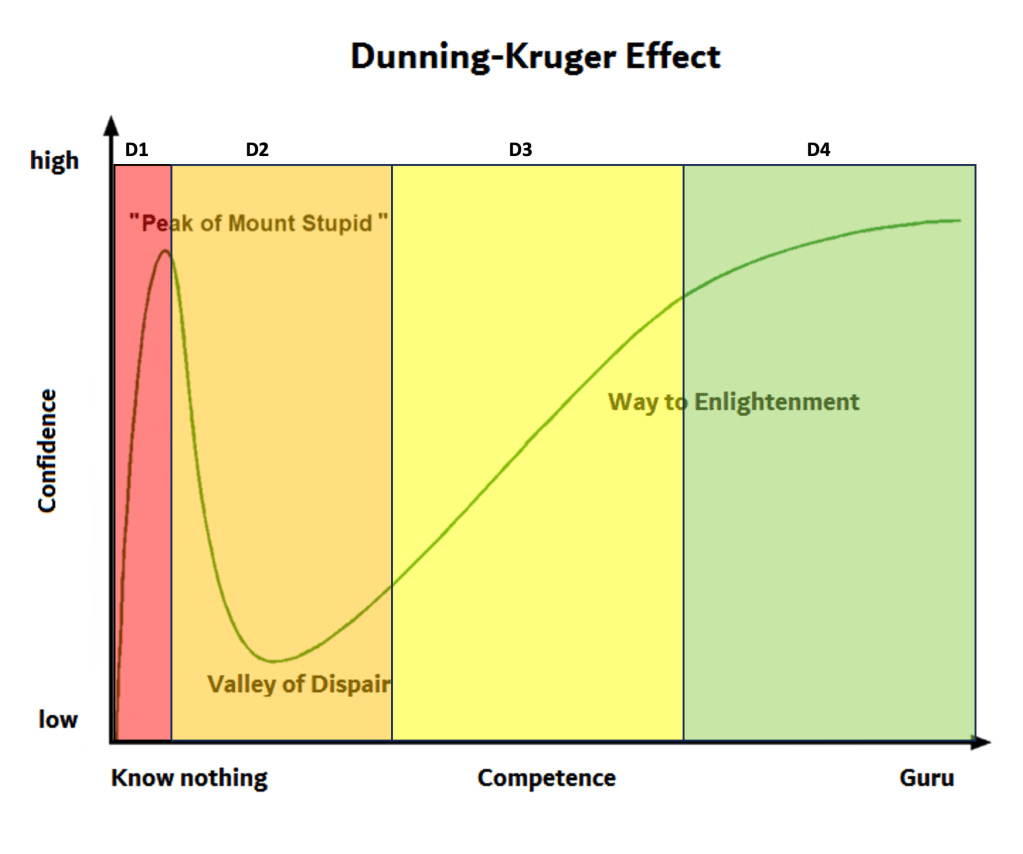
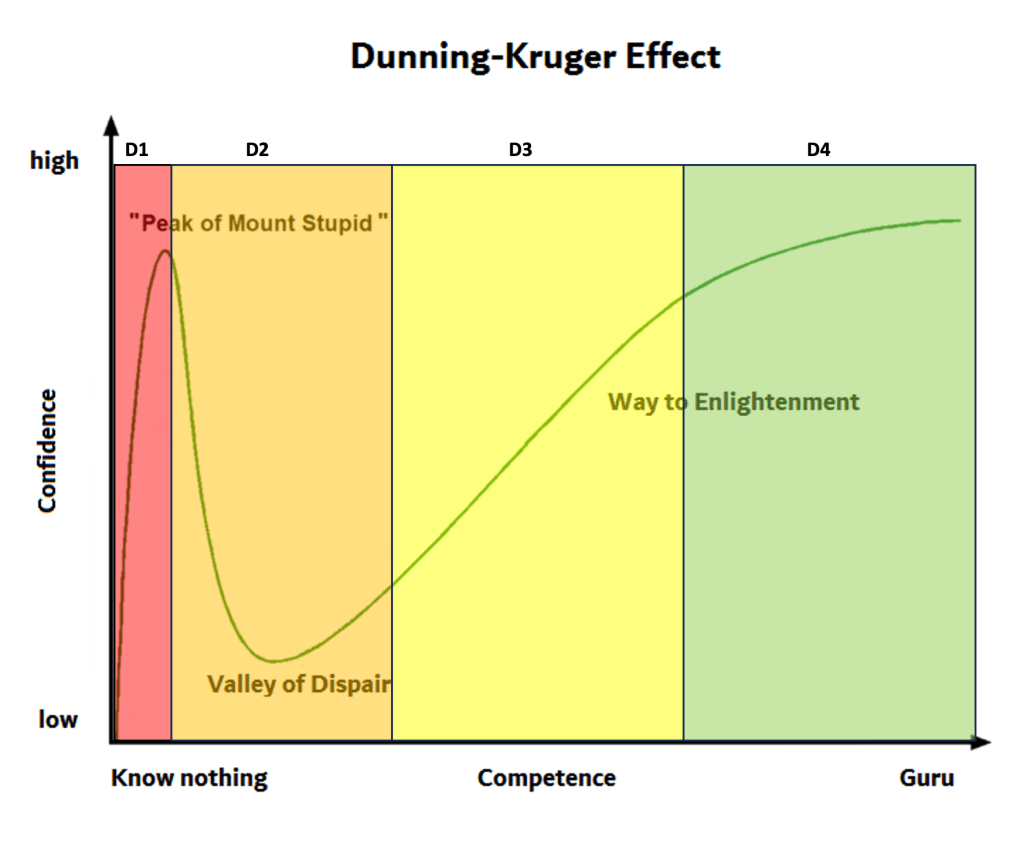
The Dunning-Kruger effect shows how a persons confidence and competence vary over time when faced with a new task.

The D-K effect can broadly be split in to four stages:

Stage 1: High confidence, Low competence

Stage 2: Low confidence, Low competence

Stage 3: Moderate confidence, Moderate competence

Stage 4: High confidence, High competence

You may remember that these stages perfectly match the stages in the situational leadership model (D1 to D4).

This is what the D-K effect looks like once we overlay the development stages from the situational leadership model:

This combined model of the D-K effect and situational leadership shows just how someone goes through the various stages of D1 to D4 and broadly shows how long each stage lasts relative to the others.

It is important to remember that the direct report may start back at a D1 level if the task they are performing is different in some way to ones they have done in the past. Think of an experienced football coach for early years now coaching individuals in their late teens. The task (coach kids football) is basically the same but the difference will be in the needs of the kids and thus it is technically a totally different task. As such they may still go through all of the development levels from D1 to D4 but the process may be sped up as they can draw on previous experience.

Image sourced from: https://situationalandcontingencyleadership.weebly.com/situational-leadership-theory.html on 30th Nov 2023.

A Simple Way to Co-Write a Kick-Ass PDP With Your Direct Reports

When I first became a line manager while working for Mars Petcare, I was introduced to the idea of co-writing my teams PDPs (Personal Development Plans) in such a way that it would align the work they do every day with their long-term aspirations.

This concept makes total sense right?

If you align work you do daily to your long-term aspirations then the time and energy you spend in your job becomes immeasurably more meaningful, you improve your engagement and are more willing to deal with difficult or stressful situations because you can plainly see why it is worth it.

Although the “Why” behind this was instantly clear to me, the “How” was never all that well explained…

I recently finished a book by Kim Scott called “Radical Candor” and absolutely LOVED IT!

Here is a link to the Radical Candor website where there is some great content and further links to videos and articles which you might find useful: https://www.radicalcandor.com/the-book/

There is even a Radical Candor Podcast though I have never listened to it myself.

The book has so many really helpful tips for current and aspiring line managers as well as team members but my favourite part was all about how to co-write a kick ass PDP with your direct reports.

I have transcribed the method below but urge anyone reading this post to pick up the book because there will definitely be other parts of it that you need to read. The contents of the book will help you to become the line manager you always wanted for yourself.

This method is done across 3 meetings (I booked 90 minute meetings for these as I wanted to really take the time to do this properly) that must be at least one week apart and ideally no more than 2 weeks apart.

Below are the 3 steps broadly as described in the book. If you are an experienced line manager some of these conversations may be somewhat familiar and easy enough to guide your direct report through.. for you newbies, don’t worry if it feels a little forced / clunky, it’s a great way to practice your listening skills!

Step 1: Find their values

Book the first meeting in with your direct report, explain to them the concept of life-aligned PDPs and that the purpose of the first meeting is to find out what their personal values are.

This can be quite an in-depth and personal conversation so make sure you don’t pressure them to answering anything they don’t want to.

Broadly, you are looking to have a two-way conversation where you, the line manager, remain endlessly curious about what drove the key decisions your direct repot made throughout their lives.

The decisions they made are clues to what is important to them, so the key is to understand WHY they made the decisions that they did.

The Line Managers Role:

Your role as the line manager is to help guide the conversation, ask clarifying questions and listen intently and purposefully to what is being said.

The Method:

Sit down with your direct report and ask them the following question: Starting with Kindergarten, tell me about your life.

As your direct report talks about their lives, ask clarifying questions to gain further insight in to the reasons behind the choices that they made.

Make notes on everything you think is important and look for how animated your direct report becomes when they talk about their experiences. Stories that hold particularly strong emotions are likely to be important times when parts of their personality and values were shaped.

At the end of the session, sum up the things that are important to your direct report in a concise way, consisting of a list of values about how they learn, what type of things they enjoy in life and at work and what guides their decisions.

Go through the list of values you have created with your direct report to double check that what you have written strikes a chord with them.

Step 2: Uncover Their Dream Life

So one to two weeks after the first meeting, book in the second one.

This second meeting is to find out what their life aspirations are. 

The results of this and the previous meeting are used to set up the final meeting which is where you will align their current job responsibilities to their values and set out a clear 18 month plan to get them closer to being able to achieve their life goals. 

The Line Managers Role:

Your role as the line manager is to help guide the conversation, ask clarifying questions and listen intently and purposefully to what is being said. 

This meeting will be a little more abstract than the previous one so it may need some out of the box thinking to guide your direct report to think about what their dream life would look like.

The Method:

Once again sit with your direct report, explain the “WHY” behind this session and clarify what the goal is (aim to list 3 to 5 dreams for their future).

Kick off the conversation by asking the following questions:

-What you want to achieve at the apex of your career
-What does your best life look like (the whole thing)?

Once you get the dreams noted down:
-Make a spreadsheet with 3 to 5 columns and label each with those dreams
-List required skills for those dreams as rows
-Rate the importance of that skill to that dream
-Label how good they are at that skill right now

Note:

If your DR doesn’t know what they want in the long term (as the question of life dreams / aspirations is loaded with expectations) you can focus on what they believe their next step in their career is and go from there OR if they are very early on in their career, focus on building career capital (thanks Stephen Bartlett for teaching me this term – see “Happy Sexy Millionaire” for more on this).

Career capital encompasses key transferrable skills, reputation, people you know etc which can help you no matter what career you eventually choose. At the start of your career it can be hard to know what you want to do for the long term so feel free to focus on the near term.

Then…. 
-Look at how you can start to build these skills in to their PDP
-Verify these dreams vs the values that were picked up in meeting 1
-Talk about them if they don’t match becuase it will help further infrom the values and the dream

Step 3: Create an 18 month plan

This is the final step in creating that kick-ass PDP for your direct report.

The purpose of this session is to specify what gaps need to be closed to get your direct report closer to achieving their life goals. 

The Line Managers Role:

Here is where you can get really creative and help your direct report come up with a specific list of skills they need to learn in order to get them closer to achieving their life goals. 

You can then help them find opportunities within their current role to develop those skills! This is how you align your direct reports life goals to their values and to the work they currently do. 

The Method:
Get your direct report to ask themselves the following questions:
-What do I need to learn to move in the direction of my dreams?
-How should I prioritise the things I need to learn?
-Who can I learn from?
-How can I change my role to learn it?

Discuss the answers to these questions between you and then…
-Co-create a list of how their role can change to learn the required skills to reach each dream

Be specific and note down…
-Who can they learn from?
-What classes could they take / books they could read?

And finally….
-Note against each item, actions for both you and them to close their development gaps over the next 18 months

Good luck and let me know how you get on!

One final note:

If this is useful for you then please let me know by commenting on my Linkedin post and if you have any questions please don’t hesitate to get in touch and ask. 

I am learning new things all the time and am very new to this method myself so it would give us an opportunity to learn together.