Spend more time at the Gemba!

Gemba: Japanese word meaning “the actual place”. For a business, the Gemba is where the work happens to drive the economic engine of the organisation. For a factory, it’s the shop floor and for a sales team it’s on the sales call or the office of those who buy from you.

Seniority vs. improvement

The position you hold in you organisation should determine how much of your time you spend focussing on maintaining or improving standards.

This graphic broadly represents where you should put your focus for each stage of seniority within a company hierarchy.

Take a look at where you are, and think about how much you adhere to this model.

Figure 1: Seniority vs. improvement focus (Graphic taken from Gemba Kaizen by Masaaki Imai)
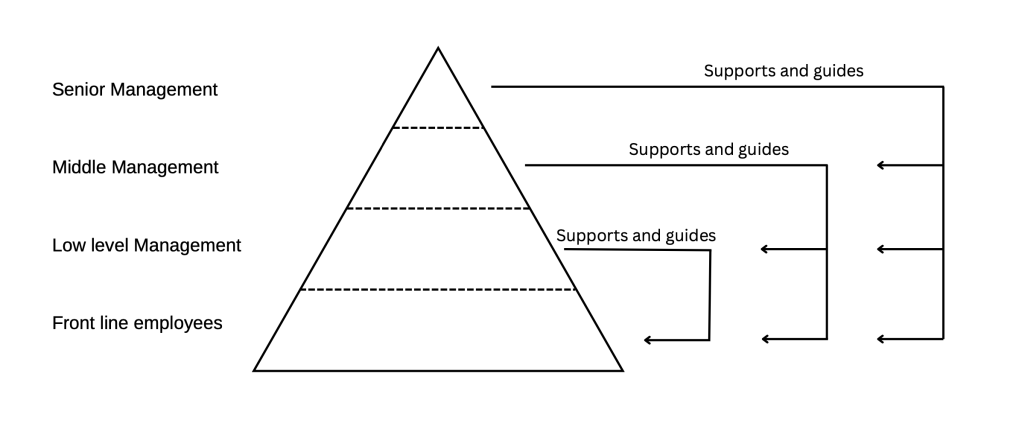
I believe that the above graphic should be used with this one in mind. Managers at each level need to spend time at each Gemba at the lower levels.

Figure 2: Seniority vs. support

There are a lot more front line employees than there are managers and each level of management should support and guide all levels below them. Ultimately, the culture of the organisation is built through a lot of factors including (but not limited to):

  • The minimum acceptable standard at each level of leadership
  • The self-discipline of employees
  • The standards that are set and how well they are adhered to
  • Attitude of managers at every level

As a leader you are responsible for setting an example for those who work within your area of responsibility. The more senior the manager, the more people fall within their area of responsibility and thus the more accountable they should be for the standards set within their area.

Iceberg of ignorance:

The iceberg or ignorance illustrates the problem that most organisations face when trying to drive improvements.

Figure 3: Iceberg of ignorance – sourced form https://kathleenallen.net/insights/the-iceberg-of-ignorance/

Only a tiny percentage of problems faced by organisations are known to senior level managers because of the over reliance on hard data filtered upwards from performance tracking.

In order for organisations to get the best results and work as per figures 1 & 2, more time needs to be spent at the gemba.

Front line employees:

Maintaining standards for front line employees is critical as they tend to be the ones who have the most contact with the product or the customer and thus have a huge impact on the quality and consistency of the product or service you provide.

The next thing to consider are the safety implications of not maintaining standards. Many front line employees in construction, agriculture or manufacturing, use or are exposed to machinery or work environments which, if not treat correctly, can lead to serious injury or death.

The aim of the front line employees should be to spend 95% to 99% of their working time maintaining current standards. The remainder of their time should be spent working with all of the support functions and managers to highlight areas where improvements in standards are required.

At the level of the front line employees there needs to be focus on addressing all of the small inefficiencies at the gemba that together build up to cause serious performance impact on the whole organisation.

Low level management:

The low level management team are responsible for ensuring the correct standards are in place and that they are followed by the front line employees. This is arguably one of the hardest areas of management unless your organisation truly understands and applies the concepts in Figures 1 & 2.

The Low level managers should open up communication pathways with their teams, outside of the daily performance meetings to highlight minor inefficiencies to them. Once these managers are aware of these issues, they can empower their them (and give them the time) to make improvements themselves on a smaller scale before rolling out the new standard to the rest of the front line workers or garner support from other functions to improve the standards.

My recommendation here would be for the low level managers to purposefully spend time, walking around their gemba, speaking to members of their team to understand what they need further support or help with that will improve conditions and standards.

Middle level management:

The overall vision and purpose of the organisation should come from the top levels and this direction should help prioritise the work that is required at the lower levels. The best organisations not only put focus on the big projects that will help improve performance (Driven mainly from the top) but also on all of the small inefficiencies in the work of the front line employees.

This is where the middle level management come in.

Their focus should be supporting the lower level management and the front line employees to drive improvements based on information they gather from walk arounds, coaching sessions and the system of daily performance meetings common in most organisations.

In my experience, where most companies get it wrong is that they rely solely on the data they get from the daily performance meetings but nothing beats performing walk arounds and speaking to the front line employees to understand directly from them what they need further support with.

My recommendation would be for Low and Mid level managers to perform walk arounds and speak to front line employees at the gemba minimum 3 times a week (outside of the daily performance meetings). Then each manager can put focus on solving one problem for the front line employees, very quickly you will see a huge uplift in engagement and performance often with little to no spend.

Senior level management:

Senior managers set the direction, vision and purpose for the site / organisation. They tend to use top level information delivered through the various performance meetings of the company to make decisions.

Although making decisions in this way can be very efficient, it becomes more likely to miss a lot of the key information and context behind the numbers that will help make the right decision.

Once again nothing beats spending time at the Gemba.

I have seen senior level managers spend millions of dollars on huge projects to improve performance to only see a small shift in the bottom line.

The devil is in the detail as they say and sifting through pure data at a high level only gives you part of the picture. You can get the top level view of where you need to improve by looking at the top level numbers, but the people at the lowest levels are the ones who work to make poorly made decisions and poorly designed systems deliver an saleable output.

The best organisations use hard data from numerous and the data they gather in person at the gemba to make the best decisions on where to spend money AND time to improve performance.
How to live your best life

“The meaning of life is to have a meaningful life” – Steven Bartlett

What is a meaningful life anyway? And how do I get one?

Initially I thought it an odd question… because I had never really asked myself what a “meaningful life” would look like to me and had always just gone with what social media and my parents had told me: “Make as much money as I can, buy a big house, at some point get married and have kids and try retire with as much money as possible”.

You see in the quote above, money comes up twice, having something which costs a lot of money (the big house) is also in there but there is nothing about being happy…

When I thought about this a little more, I realised that I didn’t want the money, I just wanted to be happy. Yes, I mean having money is better than not having it, and stresses that come with having to be really careful with money make life harder but money is not what life is all about.

Asking yourself the tough questions

I believe that one of the reasons we seem to chase the above is because it’s easier than having to go through the discomfort of actually figuring out what we want for ourselves.

A lot of us, to a more or lesser extent, just keep our heads down and run in broadly the same direction and we feel like we are making progress (and we might be) but what is the point of progressing towards something that we don’t truly want and that won’t make us happy?

“What is the point of progression towards something that we don’t truly want and that won’t make us happy?”

In oder to figure out what it is that you want for yourself, you have to face up to the fact that your current reality and the things that you have been working on haven’t helped you progress towards the thing(s) you really want.

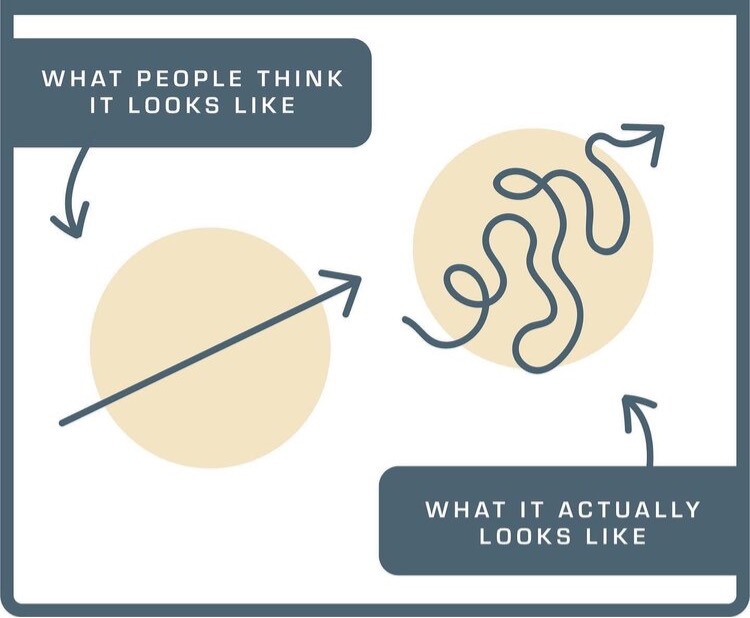
It might feel like it’s all been a huge waste of time but progress isn’t linear, it comes with setbacks, twists and turns. If you have a sense of where you are going, you can more easily determine whether a move or a change will broadly take you in the right direction.

What progress actually looks like:

This is a great representation of what progress actually looks like. In the end you make it to where you want to be, and as much as we might like it to go straight up and to the right, it doesn’t.

The meandering, the twists and turns and the pivots all help you learn more about yourself and what you truly want and ultimately makes you better.

Even if you totally pivot and choose to go on a totally different path than before, the lessons you learnt to get you where you are will still be useful.

Life isn’t a race, it’s a journey that we only make once. So why not be sure to enjoy the scenery on the way?

Image sourced from: https://www.aimnutritioncoaching.com/members-only-blog/pv9ip1vaqxnozxlv8u3b5lype5iloe

The rest of my life:

I used this tool for myself a few years ago I was earning way more than I am now and yet I was miserable…I didn’t enjoy where I was living, the job I had or the people I worked with and money definitely didn’t make up for that whatsoever.

My inspiration for this came from a friend of mine who, after his wife left him and he los this job, sat himself down in front of a blank word document entitled “The rest of my life” and proceeded to write a roadmap for what he wanted for himself. This process allowed him to close the previous chapter, knowing that his life wouldn’t ever be the same….but it could in fact be even better!

The process:

Below are all of the questions that I asked myself to determine what I wanted my life to look like. I figured that if I lived somewhere I liked, enjoyed my job, spent quality time with friends + family, had a great romantic relationship and had enough money to do the things I enjoy, I should be pretty close to living my best life? Either way, it couldn’t get much worse than what I was already living at the time.

This can be an iterative process where you go through each part in turn and then go through it all again to ensure it all stacks up and makes sense. There may be conflicting elements to what you write and in this case you will have to decide which is more important to you and thus which one takes precedent over the other.

For example, you may want to be within 30 minutes of your family and a large city for work, but this may not be possible. Thus you will have to decide which is more important to you and then amend the less important one to fit within the rest of the criteria.

Note: It can be easier to ask someone you are close to if they will help you with this by asking you the questions and making notes on your answers; they may also help by being a sounding board for any ideas that come your way.

Job:

The aim here is to identify the type of job(s) you want and have in mind what the gaps are to achieving that so you can work towards it.

  • What job sector do you want to work in? (marketing, sales, operations, quality, engineering etc)
  • What kind of job role do you want? (team member, line manager, etc)
  • Number of direct reports (if you want to be a line manager)
  • Working days and hours
  • Remote work / hybrid / on site
  • What things have you liked about your current job / previous jobs that you’d like to have in the next job?
  • What things have you disliked about your current job / previous jobs that you’d like to avoid in the next job?
  • What job roles could fit the above criteria? – If you aren’t sure, call 3x recruiters for the sector you are looking at, talk them through the above and your experience to date and they should be able to throw out some suggestions
  • What gaps do you have in your current experience to get the role you have identified above? If you aren’t sure, speak to 3x recruiters and ask them where your obvious gaps are to the role you desire.

Hobbies:

The aim here is to determine what hobbies you’d like (or would like to keep) and what the criteria are.

  • List out each of the hobbies you’d like to do (or would like to keep doing)
  • (For each hobby) – What is the frequency at which you’d like to do it?
  • (For each hobby) – How far (in minutes) are you willing to travel to do your hobby?
  • (For each hobby) – What is the cost of the hobby? (weekly, monthly, yearly)

Location:

The aim here is to come up with a number of criteria that describe the ideal place you’d like to live.

  • How far (in minutes) are you willing to commute to and from work?
  • Would you like to live closer to a city or in a more rural area?
  • How far (in minutes) are you willing to travel to get to a green space / countryside?
  • How far (in minutes) are you willing to travel in to town?
  • How often would you like to see close friends?
  • How far (in minutes) are you willing to travel to see friends at the above frequency?
  • How often would you like to see close family?
  • How far (in minutes) are you willing to make that journey to see them at the above frequency?

Romantic relationships:

The aim here is to understand what a good romantic relationship would look like. It won’t be a list of specific physical attributes, but more about character traits and communication styles.

  • What are the elements you have valued the most in previous romantic relationships?
  • What character traits are the most important to you?
  • Do you portray these traits?
  • What are the elements that you have valued the least in previous romantic relationships?
  • What character traits do you want to avoid in a romantic partner?
  • Do you portray these traits?
  • Do you understand what things you need as part of that relationship (the list below is for illustrative purposes only and isn’t exhaustive)
    • Time alone
    • Time with friends
    • Your own hobbies & interests

Note: I struggled with romantic relationships over a 10 year period and only managed to find one that I am really happy with after going to relationship therapy. Therapy of this kind can be really useful to understand how your own views, fears, beliefs about yourself etc can affect your current partner or can drive you to chose partners that aren’t right for you.

Salary:

The aim here is to determine what you NEED to make to fulfil all of the above. Then you can check whether the jobs you are looking at will match that criteria. If not, you may have to revise your expenses to bring them in line with the jobs or look at jobs that may be less desirable overall but that pay better.

Note: if you don’t know some of the elements below, then you will have to go back through your bank statements over the last few months and come up with estimates for the below.

  • How much do you want to put in to savings each month?
  • What are your monthly fixed costs? (Car payments, phone payments, food & household purchases, fuel, rent / mortgage, council tax, hobbies etc)
  • What are your yearly fixed costs? (Car insurance, car tax, car MOT, car servicing etc)
  • What do you spend on “fun” each month?
  • Any other spending?
  • What is the total of your monthly costs?
  • What do you need to earn as a gross yearly salary to cover these monthly costs?

Summary:

Answering the above set of questions might take you several days or weeks of iteration to get to something that you are happy with.

Many people will tell you that something is a “great opportunity for you!” but if it doesn’t bring you closer to the life you want for yourself, then it isn’t an opportunity, it’s just an option that isn’t right for you.

Hopefully you now have a list of things that you can use to easily appraise whether an “opportunity” fits with what you are looking for or whether it is an option that should be discarded.

Become the most curious person in the room

The Oxford English Dictionary defines curiosity as: “A strong desire to know or learn something”

If you develop curiosity in your day to day and your work life, your learning speed, ability to deal with ambiguity and your creativity will all increase.

You can develop your curiosity simply by questioning things that you are told, by asking “why?” because context matters. Understanding the context as to why things are done the way that they are is critical to gaining a fuller understanding of a process. You will discover that sometimes accepted norms made sense in times gone by, when the context was different but may not actually make sense in the current context.

Here are a few stories that truly illustrate why curiosity is so important.

How do you thaw your frozen turkey for thanksgiving?

It is November 22nd and Jenny is preparing her first thanksgiving dinner. All of her close friends and relatives will be arriving the following day to enjoy this yearly tradition together. As she wants everything to run smoothly on the 23rd, she makes sure to do as much prep as she can ahead of time. She takes the frozen turkey out of the fridge and puts it in the sink to let it finish thawing overnight. After carefully placing the large semi-frozen bird in the sink, she is careful to remember to put a dish rack over the top.

Her husband walks into the kitchen and sees the turkey in the sink and asks her what the dish rack is for.

She tells him that her mother had always done that when thawing the turkey in the sink.

The following morning, Jenny’s mother arrives early to help with the final dinner preparations for the day and asks her daughter how things are going.

Jenny says, “Fine mum; I have everything ready to go in the oven. I even remembered to put the rack over the turkey last night.” 

Her mother looks back at her, a confused look on her face. “What are you talking about?” she asked.

Jenny replied “You always made sure to put the dish rack over the turkey when it was thawing in the sink so I did the same

Her mother laughs and says “Yes but honey, we had cats!”

So you can see how norms and practices that once made sense within the original context in which they were made, but when removed from that context, make no sense at all. In today’s world, where progress and change are happening at ever increasing speeds, norms formed by the contexts of todays world will soon become irrelevant as well.

This is obviously a light hearted example where the cost of low curiosity has little impact, however there are times where low curiosity can cost people their lives or make someone a Billionaire!

I think you should start washing your hands:

Ignaz Philipp Semmelweis was born in Hungary on July 1st 1818. Semmelweis received his Medical Degree from Vienna in 1844 and became the maternity ward assistant at the local Hospital.

Although at the time many mothers delivered at home, one in 4 of those who had to come to the hospital to deliver due to complications, poverty of illegitimacy lost their lives to a condition known as childbed fever.

He found this mortality rate deeply unsettling as the hospital was the place where people were supposed to come to be healed by doctors trained in the latest medical practices of the time.

The experienced doctors and indeed the chief medical officer at the hospital seemed unperturbed by the high mortality rates of the new mothers because they believed that the disease was unpreventable.

Semmelweis, unsatisfied by what he was being told, took it upon himself to investigate the deaths even after receiving strong objections from the chief medical officer.

He observed a huge difference between the mortality rates of mothers delivered by the doctors versus those delivered by the midwives. He conjectured that the doctors must be doing something differently than the midwives during delivery but he observed broadly the same practices.

During his investigation, he scrutinised everything he could think of in an attempt to explain the difference but none yielded a definitive answer.

It wasn’t until the death of a fellow doctor, who died of what appeared to be childbed fever that he found what he was looking for. The doctor had cut himself on a scalpel he was using to dissect a woman who had died of childbed fever. This lead Semmelweis to realise that it was the doctors themselves who were infecting the patients as they would conduct autopsies in the mornings and then deliver babies in the afternoons, often without washing their hands or changing their clothes.

At the time bacteria were unknown but Semmelweis theorised that the doctors must be carrying invisible particles of decaying organic matter on their hands from the mornings autopsies. He immediately required that anyone coming to examine the women on his ward wash their hands with chlorinated lime before doing so.

This simple solution reduced the mortality rate to under 2% on his ward.

Unfortunately his solution was met with a lot of resistance because it implied that the doctors were themselves killing the patients.

This story highlights the importance of staying curious and using experiments and data to learn more about the current situation in order to derive theories about what might be a better way of doing things.

An experiment born of Curiosity sold for $1.2 Billion

In 1999, Nick Swinmurn was shopping at a San Francisco shopping centre looking for a pair of brown Airwalk Desert Chukka boots. One shop had the right style, but not the right colour, another had the right colour, but not the right size. After spending hours searching for the pair he wanted, Nick went home empty-handed and frustrated.

Nick’s frustration at not being able to easily and efficiently buy the shoes he wanted turned to curiosity as he wondered whether it would be possible to purchase the shoes online (it wasn’t). Realised that there may be an opportunity here to give customers like him what they wanted (to save time and energy finding shoes).

At the time, online shopping was in its infancy and people told him that no one would want to buy shoes on the internet. So Nick set out to test that theory.

He went in to local shoe shops and asked whether he could take photographs of the shoes they had, with the promise that if the shoe sold online, he would return at a later date and purchase the shoes at full price from that shop.

Many of the shop owners agreed and he proceeded to test whether people would indeed like to buy shoes online. Shoesite.com was born and in 2006 was acquired by Amazon.com for $1.2 Billion.

Now that is a huge return on curiosity!

Develop your own curiosity

So curiosity and the desire to not accept the norms of the time are critical to the improvement of any system or practice.

Sometimes you can get the answers that you seek by asking one or several people and sometimes you need to dig deep and perform simple experiments that test assumptions.

My rule of thumb is that before accepting something as being true or a constant, make sure you ask enough questions (and conduct enough tests where required) to learn enough about it so that you not only understand what is done, but also why it is done. Armed with this knowledge, you can then go on to make it better than it was before.

Task management – the DILO

You can’t manage time, you can actually only manage what you do during that time”

David Allen, Productivity Consultant.

If you have ever told someone else that you are bad at time management, or someone on your team has told that to you, then this page is for you!

In my experience, people who “don’t have time” may have one or several of these things happening:

  • The business priorities aren’t clear to them
  • They don’t know how to prioritise effectively
  • They spend time on low-value-added tasks at the expense of higher-value tasks
  • They don’t know how to say “no” to a request
  • They are inefficient in task completion

If you hear your team say this to you, then it is your job as the line manager to ensure that:

  • They know what the business priorities are
  • They understand how to classify tasks according to the urgent / important matrix
  • They know how to plan their time effectively
  • They don’t have tasks from other people on their to-do list

If you hear yourself say that to your line manager, then you may need help with the above as well.

The DILO (Day In the Life Of)

The DILO is a simple yet effective tool to map the tasks that are being conducted and what percentage of time is taken up by each task. I have described how to conduct the task for your direct report but if you realise that you need help to prioritise from your line manager then carry out the task for yourself and then meet with them to discuss.

The principle is simple:

Download the DILO template (see above) and fill in the top left boxes (time intervals / hr, Start time, Contracted hours) before sitting down with your direct report and asking them to fill it in over the next week.

Get them to add any recurring meetings or tasks to the DILO before they start.

Ask your direct report to set an alarm every 15 or 20 minutes (depending on your chosen time interval) of the day for an entire week. Each time the alarm goes off, they write down what they are currently doing.

At the end of the week, book in a meeting together and ask them to bring the DILO so you can go through it together and put each task in to the urgent / important matrix.

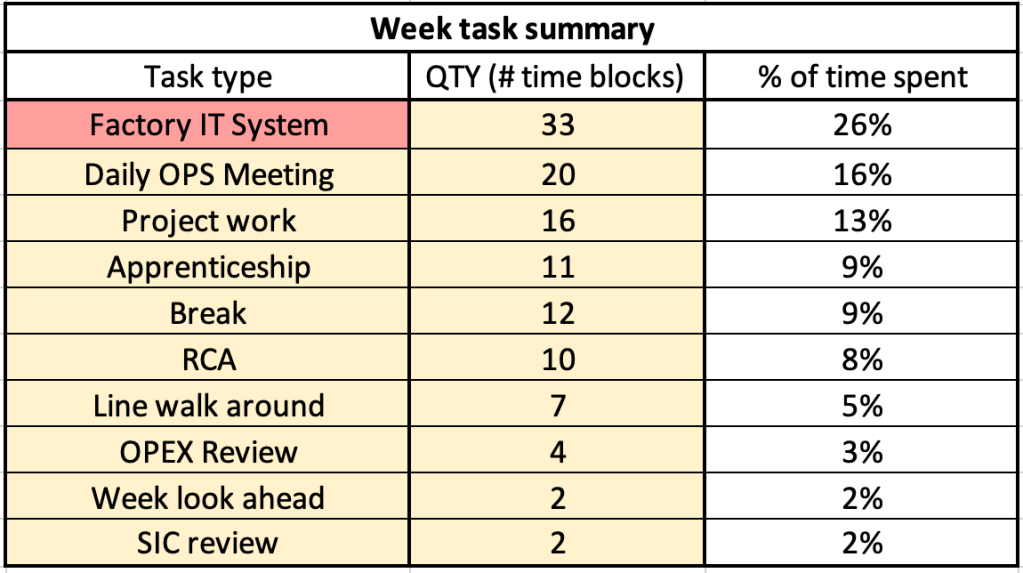
Go through the DILO and split the weekly tasks in to headings (meetings, personal development, lunch, break, own work etc) and put them in the week task summary table on the right hand side. Then count the number of each task type being performed and put it in the QTY column of that table.

This will now tell you what tasks are being conducted and what % of their contracted hours is taken up by each task type.

At the end of the meeting it should be clear to your direct report what tasks are the most important. It is also an opportunity for you to remove tasks from them, to understand where they might need more support, delegate less important tasks to others or push back tasks to other departments.

Real life example:

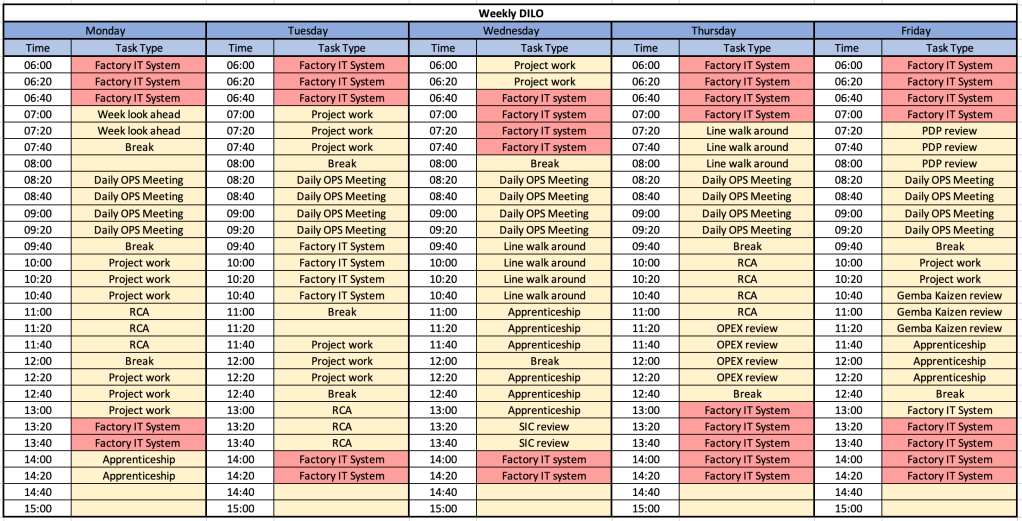
Below is the DILO for one of my direct reports that I asked her to do shortly after I joined the business. I wanted to get an idea of what tasks she was completing on a weekly basis.

I have highlighted all of the tasks in Red that I wanted her to stop doing, as they no longer fell under the remit of my team to carry out. Those tasks were given to her by the operations manager and were still required to be completed (just not by anyone on my team).

This is the summary of the table above by task and corresponding time taken over the week on that specific task.

As you can see, the time spent on the Factory IT System was 26% of her week and this task had nothing to do with my teams objectives.

So I took both tables to the Operations manager to show him just how much time this task was taking for my team member. This allowed the conversation to centre around the facts and gave him clear information that he needed to allocate that work (and thus that time) to someone else.

In the end, we agreed that my team would continue to carry out those tasks for the next 4 weeks while another person was trained and became competent in performing those tasks and my team member got about a quarter of her time back to focus on other work.

How to run an effective brainstorming session

Brainstorming sessions can be a very powerful tool to gain deeper understanding of problems and finding solutions but only if they are done in the right way.

Many of the brainstorming sessions I have attended follow a similar format:

  • The leader stands up and lays out the agenda and what problems we are going to disucss
  • They tell you they have spent time thinking about it
  • They voice their opinion on what the issue is and what to do about it but want your opinion as well
  • The floor is given to anyone who wants to stand up and raise an issue
  • Those issues raised are usually in line with the opinions of the leader
  • The leader believes there is consensus in the room as to what needs doing
  • Actions are taken based on the leaders original thoughts opinions

There are many issues with this format as it is open to bias in two key areas:

  1. Extrovert bias
    • Extroverts will more readily speak up and share their opinion than introverts
  2. Speaker seniority bias
    • Seniority of those voicing opinions can sway opinions in the room
    • The opinion of the leader can have the biggest sway on opinions in the room

Why is it important to remove bias?

Bias in any data set means that the results (and thus how you interpret those results for decision making) are skewed one way or the other.

This is a challenge when collecting any sort of data and efforts must be made to eliminate or reduce bias as much as possible.

Let’s say you wanted to uncover the most important issues faced by people in your country, but you only asked middle-aged, male, white collar workers in leadership positions within food manufacturing companies, then your results would only reflect the opinions of those individuals (who aren’t likely to have a very diverse view of the world).

The same goes for any team or brainstorming discussion, you have to be aware of how the chosen methods can bias the answers and opinions you get towards a subset of the people.

Extrovert bias:

Generally speaking, those with a preference for extraversion will be more comfortable and are more likely to voice their opinions out loud during a brainstorming session. Conversely, those with a preference for introversion are less likely to speak up during a group discussion.

In any group discussion we can only discuss the points that are raised by those in the room. If those who feel comfortable enough to talk aloud are the only ones to raise discussion points (generally those with a preference for extroversion) then your ideas and discussion points will be biased towards their perspective.

What you then have is a situation where those who raised points felt listened to and like their opinions mattered and those who didn’t feel comfortable raising points out loud

Thus to ensure everyone in the session has a voice, it is important to run the session in a way that isn’t biassed towards those who talk the most or the loudest.

Seniority level of any speaker:

Hierarchy plays a significant role in what elements are discussed and ultimately the direction which is taken by the team during a brainstorming session. If the leader voices their opinion before everyone else, then you will generally get consensus around that opinion. This may seem on the surface like everyone is on the same page but in actual fact you won’t be addressing any of the blindspots of the leader.

As much as many businesses say that they don’t have a hierarchical structure, the structure still exists and where you sit on that hierarchy drastically affects how you perceive it. It is easy for the CEO, who has the most control over their time and what others do to believe that there is a flat hierarchical structure, but do you think that the least senior person feels the same way?

Often we believe that there is a good reason why someone was promoted to a leadership position, that they know things and see things that we don’t; so if they haven’t talked about a specific point, it is probably because they thought about it and disregarded it because they know more than we do. So what do we do? We say nothing and miss out on an opportunity to learn and an opportunity to come at the problem from a wider perspective.

It took me a while to learn this but now I will ALWAYS ask the “stupid question”, the thing that seems obvious to me because either way I will learn.

  1. If my question is very basic and has already been considered, then I can learn more about why it was disregarded.
  2. If my question was a good one, generally others may have been thinking of it but weren’t comfortable in raising it (for all of the reasons discussed above).

So in any team brainstorming session, it is important to remove the effects of seniority bias.

How to conduct a great brainstorming session:

To recap, we need to run our brainstorming session so that everyone has a voice, feels comfortable to contribute and that eliminates bias from the senior members in the room.

Step 1: Give everyone 5 post-it notes

Step 2: Take 5 to 10 minutes of quiet contemplation for everyone to write one thing on each of their post-it notes

Step 3: Ask one person to read what they have put on one of their post-it notes and then ask them to stick it on the wall (If they aren’t comfortable talking aloud then they can give one post-it note to someone else to read aloud)

Step 4: Everyone who has the same post-it note, gets up and sticks their’s to the original one

Step 5: Move on to the next person and repeat steps 3 & 4 until there are no post-it notes left

Step 6: Senior team members can now stick their post-it notes to those on the wall (they go last to minimise influence on others in the room)

Step 7: Count how many post-its are in each cluster and write this number on a flip chart

It will now be clear to see which are the top issues that most people face and can easily pick the top 3 to put more focus behind.

The next stage depends on the complexity of the things you are facing but one good way forward would be to have small cross-functional teams use a PDCA to solve each of the top problems highlighted by the team.

Performance Improvement Plan (PIP):

Useful files / templates:

Introduction:

The PIP process can be immensely effective in helping direct reports recover their performance back to meeting the expectations of their role and thus is a key skill in any line managers toolkit.

Of the 5 PIPs I have done for my teams, 1x put in no effort to improve and left the business, 1x returned to comfortably meeting expectations and 3x not only returned to meeting expectations but became some of my best performing team members!

I myself was put on a PIP while on the Mars Engineering Graduate program and it was the best thing that ever happened to me. It turned out that my poor performance was based on poor planning and prioritisation which, once remedied, brought me back to comfortably meeting expectations.

What is the PIP for?

The PIP is designed to support under-performing team members and bring them back to meeting expectations.

The aim of any PIP should always be to bring performance back to meeting expectations. Let me say that again:

THE AIM OF ANY PIP SHOULD ALWAYS BE TO BRING PERFORMANCE BACK TO MEETING EXPECTATIONS!

If it isn’t done with this in mind, your direct report will see right through it and will likely tell others on the team which could then cause the rest of your team to lose trust in you and reduce their engagement.

What is the process?

The PIP process is very similar to the PDP process but in a more concentrated form. A PDP objective can last anywhere from 3 months to a year with infrequent reviews but the PIP is usually done over 12 weeks with reviews every 4 weeks.

Step 1: Log performance of your team members

Identifying areas of poor performance can come from many different areas but as the line manager, it is usually clear who is and who isn’t performing.

As a line manager, I keep a running log of the performance (both positive and negative) of my team members. The notes in the log have more impact if they are specific and I won’t put anything in the log without first discussing it with my the team member it relates to. This forces me to verbally give them the positive or negative feedback. Hiding it and bringing it up during an appraisal feels secretive and breaks the social contract between you and your direct report.

When making notes in the log, be sure to note the following: The date, the situation, the behaviour or outcome of the work, the impact, when you feedback to your team member, any mitigating circumstances and any actions agreed for next time (see below for a template you can use).

Step 2: Decide whether a PIP is the best next step

Generally speaking if I had to give negative feedback to someone on the same or similar issue 3 times, I would consider kicking off the PIP process.

It wouldn’t be fair or relevant to put someone one a PIP for 1 mistake, this would take up a lot of time and most issues can be dealt with through working together to identify possible root causes and agreeing on a few actions to take next time.

Here are the steps that lead to a PIP, broken down in to occurrences of mistakes / under-performance and what I would do:

1st occurrence: Feedback to the team member, work together to identify possible causes, agree on actions to avoid a repeat of the issue.

2nd occurrence: Feedback to the team member, discuss causes, discuss whether previously agreed actions were implemented, tweak if required.

3rd occurrence: Feedback to team member, discuss causes, book in pre-PIP conversation.

Inform your HR team of the decision to put your direct report on a PIP and forward them the evidence.

Step 3.1: The PIP kick off meeting

The aim of the kick off meeting is to inform your direct report that they are under-performing and that they will be put on a PIP as a structured and supported way for them to improve their performance.

This is probably where the most care should be taken in the entire PIP process. How you act, what you say, your verbal and none-verbal cues can shape how your direct report views the whole PIP process. Done correctly and fairly, and you will have a higher chance of your direct report viewing the process as a positive one. Be clear with them that this isn’t a punishment but a way of agreeing roles, responsibilities and actions for you both to take to support the improvement in their performance.

Remember this is a partnership, they will have to do 90% of the work but you may have to do a few things as well to further help and support them.

When to hold the conversation: Book it late in the first half of someone’s last shift before a break. If someone works Monday to Friday, I might book it for 11am on a Friday morning for example.

The reasons for this are as follows:

  1. It gives you plenty of time to discuss the feedback, the ins and outs of the PIP process and take any questions without risking going over someone’s shift.
  2. Once the conversation is over, I usually let people take the rest of the day off paid, so they don’t have to feel the pressure of putting on a brave face in front of colleagues should they take the news particularly badly (so far no one has taken the idea of a PIP well, and I cried when I was told I was going to be put on one).
  3. It gives them the week end to be away from work, to discuss with their family / friends and to reflect on the conversation

What to bring: Bring the evidence you have gathered in your performance log, a copy of the blank PIP document and 2x copies of the PIP policy of your organisation.

What to discuss: Take your direct report through each piece of evidence and ask them if there is anything else they feel they are struggling with.

Then go through the PIP policy for the organisation to fully explain the process and the expectations. Take any questions that they may have at this stage.

Agree when you will sit down to actually write the PIP (ideally early the following week / shift cycle – say Monday or Tuesday).

Step 3.2: Writing the PIP

The aim of this meeting is to write the initial draft of the PIP document whereby you will discuss specific areas of under-performance, write SMART objectives with clear deliverables and due dates, agree on the PIP timeline (usually 12 weeks minimum) and the action review dates (usually every 4 weeks).

This document should be co-authored, not something that you write and then give to them. Involving them in the process helps with their commitment and engagement with it as they have some control over what they will have to do.

What to discuss: Ask them about their reflections over the week end and to ask any further questions that they have at this stage.

Go back over the feedback you presented in the kick off meeting, and ask if there is anything else they’d like your help and support with.

Filling in the PIP template:

Your organisation may have a PIP template already but most of the organisations I have worked in don’t have one so I have included one at the top of this post.

Go through the PIP template and complete each section. Remember to be as specific as possible and ensure all of the goals are SMART; if you can’t think of a way for the colleague to provide clear evidence of an action being taken, then that action needs to be changed in to a format they can prove.

At the end of this meeting, print out a copy for your direct report to take away with them and agree that you will sit down later that week / shift cycle to go over any further questions, make tweaks as required and for both of you to sign the PIP to kick it off. I would book this meeting in for late on Thursday or Friday.

Send a copy of the draft to your HR department and book in a 1:1 conversation with them before you next meet with your direct report. The role of HR here is to ensure consistency in the process and that your actions and deliverables are fair.

Step 3.3: PIP sign off and commencement

This should be a relatively short meeting where you ask if they have any further questions and if they’d like to make any minor changes to the PIP document at this stage.

All being well, there shouldn’t be much else to discuss and you both sign off the PIP as being live. You take away a signed copy to scan and send to HR and give them a signed copy as well.

Step 4: The PIP reviews

As discussed in the PIP, your direct report has to organise and invite you to the reviews to update you on their progress.

Here you will go through each action and deliverable due for that review number, discuss how they found it, anything they have learnt and whether they need any further support.

Add both your and their comments to the PIP under the relevant summary section of the PIP document.

Step 5: Final review

If they are now meeting expectations: All being well the final review should look a lot like the other reviews and your direct report is now back to performing at an acceptable level.

Congratulate them on their efforts and results.

You must go back through the PIP policy for your organisation and inform them of next steps from here. Usually they will have to sustain this level of performance for at least 12 months or risk going back on to the PIP.

If they have shown improvement but aren’t quite there yet: congratulate them on their effort thus far and explain that you’d like to extend the PIP (by say another 4 weeks).

Agree the new final review date and what you’d like to see by then.

If they haven’t shown much if any effort or improvement: This should be discussed with HR ahead of time and next stages agreed with them. This might mean going through the disciplinary process and restarting the PIP from scratch. Explain the next steps to your direct report.

Situational Leadership

As a team member and a line manager it is important to understand situational leadership as it forms a common language that you can both use to very quickly understand where you are and what you need from each other.

For the team member, it means that you are better able to communicate what your level of proficiency is in carrying out a task and are thus better able to communicate to your line manager what you need.

For the line manager it means being able to offer the right level of support for your direct reports.

Where did situational leadership come from?

Situational Leadership was developed by leadership experts Paul Hersey and Ken Blanchard and was (put to the audience) in their 1969 best-selling book, “Management of Organizational Behaviour: Utilizing Human Resources”.

It was one of the first models I learnt when I became a line manager.

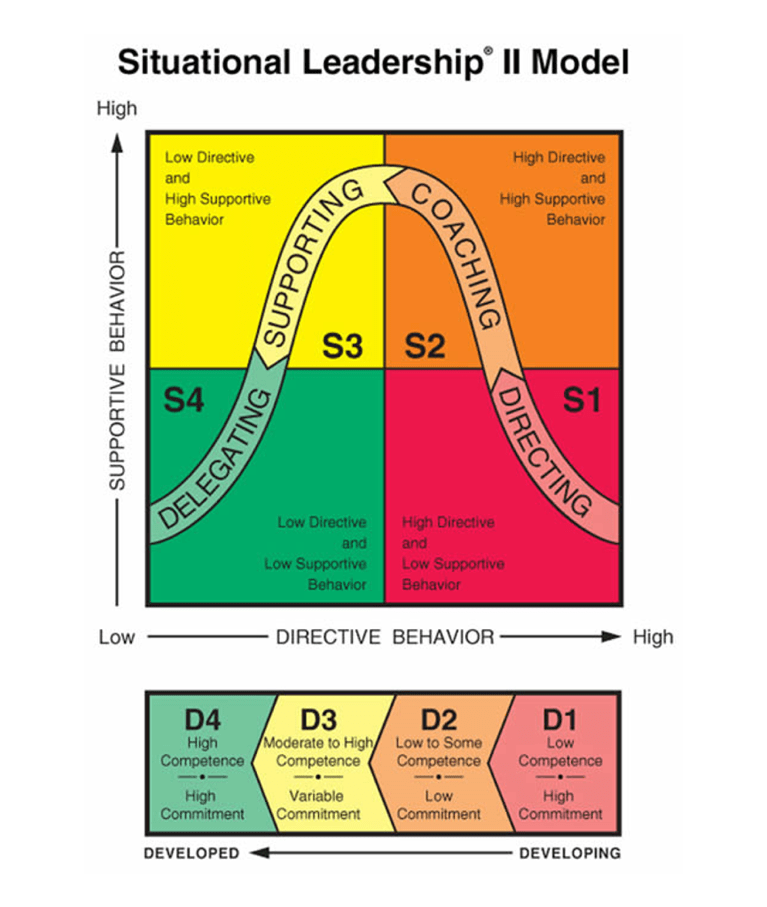
The situational leadership model:

The image below shows the following things at once:

The development levels of the direct report (D1 to D4) and the corresponding leadership styles (S1 to S4) that are best suited to each of those development levels.

This is how it works:

D1: The direct report is new to the task and thus (generally) has high enthusiasm (High commitment) but low knowledge (Low competence) on how to conduct the task. They are excited to start something new but don’t know what they don’t know.

S1: To get the best out of your direct report, you will need to be highly directive; that is very prescriptive in the process steps that they need to take to begin the task (High direction) but you won’t need to give them lots of energy to get going (Low support).

D2: Now the direct report has begun the task, they realise that it’s perhaps harder than they had originally anticipated and they now understand just how much there is to learn / do in order to become proficient at this task. As a result their energy drops (Low commitment) and they also still don’t really know how to perform the task (Low / Some competence).

S2: The leader now needs to encourage the direct report more (High support) while still being very descriptive about the tasks that need doing in order to complete the task (High direction).

D3: The direct report now has some knowledge on how to complete the taks, they have grasped more than just the basics. They will now have some idea on how to conduct the task (Moderate to high competence) but their level of confidence in themselves will waiver; sometimes they will have good confidence, but other times this may dip (Variable commitment).

S3: Here the leader won’t necessarily have to give the direct report much in the way of direction (Low direction) but as a result of their wavering levels of confidence, they will need more energy and encouragement from the line manager (High support).

D4: The direct report has done the task and many other like it before, they know what they are doing (High competence) and they are confident in their abilities to get it done to a high standard (High commitment).

S4: The leader now adopts a Low support & Low direction approach, and can now just delegate the tasks to the direct report knowing that they won’t need much from them and the job will be done to a high standard.

The Dunning-Kruger Effect:

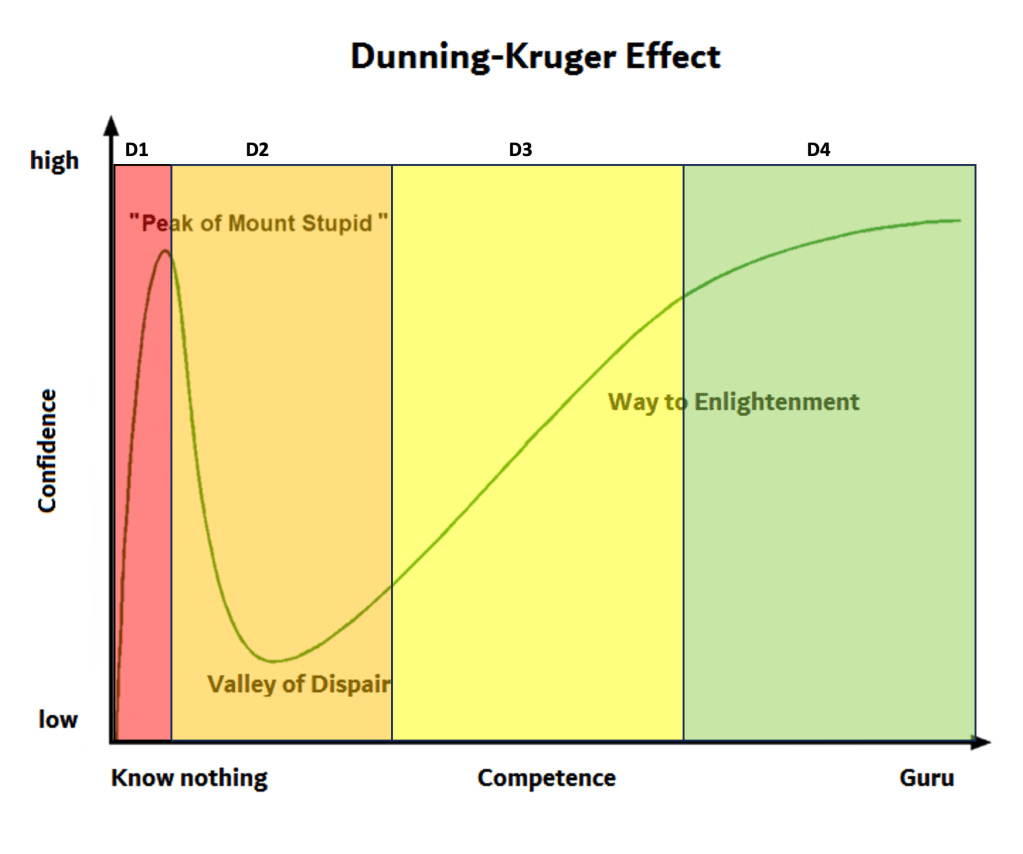
The Dunning-Kruger effect shows how a persons confidence and competence vary over time when faced with a new task.

The D-K effect can broadly be split in to four stages:

Stage 1: High confidence, Low competence

Stage 2: Low confidence, Low competence

Stage 3: Moderate confidence, Moderate competence

Stage 4: High confidence, High competence

You may remember that these stages perfectly match the stages in the situational leadership model (D1 to D4).

This is what the D-K effect looks like once we overlay the development stages from the situational leadership model:

This combined model of the D-K effect and situational leadership shows just how someone goes through the various stages of D1 to D4 and broadly shows how long each stage lasts relative to the others.

It is important to remember that the direct report may start back at a D1 level if the task they are performing is different in some way to ones they have done in the past. Think of an experienced football coach for early years now coaching individuals in their late teens. The task (coach kids football) is basically the same but the difference will be in the needs of the kids and thus it is technically a totally different task. As such they may still go through all of the development levels from D1 to D4 but the process may be sped up as they can draw on previous experience.

Image sourced from: https://situationalandcontingencyleadership.weebly.com/situational-leadership-theory.html on 30th Nov 2023.

PDCA your way to your perfect life…

People try to find their perfect life by reading books or speaking to other people who seem to “have it figured out” only to be told things that don’t resonate with them (buy a house, have kids, get married etc) – but those are their truths and not yours.

One of my coaching clients found herself in this exact situation (and I must admit to have found myself there a few years ago). During our conversation, she said she’d read a lot of books to try and find “the answer” to having a perfect life but so far hadn’t found “the secret”.

I don’t think there is a “secret” except that you need to find a way to discover what works for you in your own life (this sounds scary to a lot of people because it’s far easier to be told what to do than it is to search for yourself but this WILL pay dividends in the long term).

I realised that this is why a lot of people “follow the crowd” when it comes to deciding what to do with their lives; we are told to buy a house, get married and have kids… not because you necessarily want to, but because you are told to do these things in order to lead a happy life.

(as a rule for myself, whenever someone tells me I “should” do something, it sets off alarm bells and I take it as a sign that I need to sit down and figure out what my true feelings are on the matter, trying hard to take my fear or pre-conceived ideas out of it).

There isn’t a universal “best way” to do something because the ideal solution for me may not be the ideal solution for you. After giving this statement some thought, I found what I figured to be one way to get there through iteration.

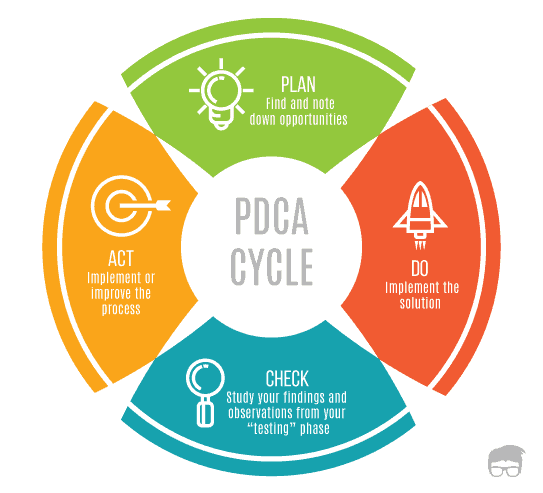
In continuous improvement, there is a tool called the PDCA (Plan, Do, Check, Act) cycle which is used as a way to find the root cause and then the solution to a complex problem.

Below are the details to each step:

Plan:

Spend some time thinking about what you want to achieve and ways in which you might achieve it. Create a plan of what you are going to try based on information you can gather at this stage.

Say you want to pick up a hobby, but aren’t sure where to start. Think of things you have enjoyed doing in the past, think about what specifically made those things enjoyable and create a list, then look for hobbies that fit some or all of your listed criteria.

Once you have your list of potentials, make a plan to try out one a week for several weeks.

(If you still aren’t sure where to start, pick up a copy of “How to be comfortable with being uncomfortable” by Ben Aldridge, he has plenty of ideas to get you started)

Do

Execute the plan.

Check

Check the results you achieved.

Did you enjoy the hobbies you had listed? If so, great! If not, you haven’t failed you just got different results to the ones you had planned on. Think about reasons why you may or may not have gotten the desired results.

Act

If the results were the ones you wanted, then stick at it. If they are totally wrong or not quite there, then go back through the cycle using your new found information and use it to make a more effective plan.

Stick at it

This is an iterative process, meaning that you may have to go around the cycle several times in order to find the solution you are looking for.

Put simply, all you really need to do is to try something, see if you like it and if it adds to your overall life / sense of happiness, and if it does, keep doing it. and if it doesn’t try something else.

If you never try then you will never know. Sure some stuff you do may put you out of your comfort zone, and force you to face up to some of your long held beliefs about yourself (which is scary) but it will absolutely be worth it!

For me, I decided that my life needed more adventure and mental challenge, so I decided to cycle the 20 miles to and from work twice a week (no matter the weather) and that for 6 months I would only get a hot shower once a week (yep the rest were on full cold!). I found that doing these things gave me more mental strength and resilience and I started to feel better about myself.

I ended up going out more, quitting my job, planning a whole new life for myself with my new partner and am happier and healthier than I have ever been.

Good luck and trust the process!

Oh and here is that book I was talking about:

Happy reading!

There are no shortcuts…

(So stop looking for them).

I recently picked up Steven Bartletts book “Happy Sexy Millionaire” and I must say I am thoroughly enjoying it; I am finding it refreshing, original and stands against a lot of what is considered conventional wisdom when it comes to happiness and fulfilment.

One section really stood out for me about the fact that a lot of us are looking for the “shortcuts” because we live in a world full of instant gratification. Shortcuts are so appealing because so much of what we get today (though very little of it meaningful at all), we get with such little effort, persistence and perseverance.

The truth is… there are no shortcuts.

And that’s it really…

Steven describes what he thought when he was asked what his top 3 secrets were for becoming a great public speaker…his mind told him that to get to where he is took him a combination of:

  • A decade of hard work
  • Failure
  • Luck 
  • Timing
  • Nature / nurture
  • Persistence

Anything worth having is worth working at and waiting for.

So stop wasting time on the supposed “shortcuts” because they distract you from the long-cut work you should be doing… you end up changing from shortcut to shortcut every 3 to 6 months and then 10 years down the line you realise you are always just at the stat of something new, and not well on your way be something truly fulfilling.

So… what to do now..?

  • Reach out to your network (or extended network) and try to reach someone who does what you want to do and ask them what you need to do to get you started.
  • Ask for low-cost ways to get an introduction to the subject
  • Ask what books you can read
  • Ask about how to get involved so you can start learning and gaining exposure
  • Ask for what courses you could take

And then… do it and stick to it.

The problem is that there is just so much choice… how do I know that this thing is going to be THE thing that ends up becoming this great thing that will make me happy?

Well… the truth is… you don’t.

However if you work at it and make sure to build up your career capital (Transferrable skills, Connections, Qualifications and your Reputation) then you may not have to start all over again if you decide that the path you originally chose is not exactly the right one for you.

Here is an example of how things worked out for me to help illustrate the points I have made.

My career story so far:

I chose to study Engineering because I was good at Maths & the Sciences and my Dad was an Engineer. (Nature / Nurture)

I became and Engineer because that’s all I thought I could do with my degree.

I had always wanted to help others, problem solve and lead others and didn’t feel like project Engineering was the right fit for me.

2 years in, I wasn’t performing in Projects and had been on and off a Personal Improvement Plan (Failure); but my Line Manager saw something in me that he liked and tried to find something that might be more suitable. He gave me the opportunity to go on shift to manage a team of reactive maintenance technicians (So using the Engineering skills I had gained over the previous 3 years along with the environment to learn Leadership Skills). I didn’t know this at the time but the role I had was only meant to exist for the next 12 months so neither he nor I had much to lose if I didn’t perform in that role (Luck + Timing).

This was to be the last placement on my Engineering grad scheme and the year I started reading books on Leadership, Business, Continuous Improvement, Failure and Mindset. As I couldn’t sign off my grad scheme in the role I was in, they failed me (Failure) but said I could apply internally to take a promotion to being a Shift Manager leading a team of factory operators.

It was around this time (at the age of 24) that I started reading books on Leadership, Mindset, Failure and Continuous Improvement as I learnt so much that I could apply to my life to be better at work and improve my quality of life (Better mindset, better sleep, lower stress etc)

I became an Operations Shift Manager at the age of 25 and thought that I was well on my way to being fast-tracked through the business to becoming a GM before my 32nd birthday.

Fast forward 3 years and I was still in that job, I lived in a part of the country I hated, I had spent 6 months in therapy to try and get my life back together after a string of awful relationships (therapy was the single best thing I ever did for myself) and my boss had just told me that he wanted to put me on a PIP for underperformance but failed to clearly articulate why. (Failure).

Oh and in the meantime I decided that Manufacturing wasn’t where I wanted to be so I “invested” over £20K of my savings in trying to start a property investment company which ultimately failed because I only wanted it for the money and not because I had much of an interest (or skills) in property investing as a career. (Failure)

I quit that job with no other work to go to and spent 6 months as an agency worker in a factory that made industrial printer heads. It took me 4 weeks from setting foot in the door to becoming their best performing operator and I was bored and unfulfilled. Taking this time away to work in a boring job allowed me to lick my wounds, mend my pride and create a plan of action for the following 2 years to get from where I was to landing my dream job.

(I did however meet the woman who is now my Fiancé 3 months prior to quitting my job so a definite win there).

I applied for multiple roles in Continuous Improvement because I had an feeling that that’s what I really wanted to do and would leverage all of my previous skills in to one neat role that was pretty much made just for me…

But it didn’t happen, I got some interviews but no one offered me a job.

I decided not to give up and to buy books on continuous improvement theories and to take an entry level course in Lean / Six Sigma as this was often a minimum requirement for the kind of jobs I wanted (Perseverance and hard work)

I managed to get another job on shift as a contractor for another large food company but it meant that I was working away from my partner and back to doing night shifts which wasn’t fun. However I met someone there who saw me working hard so he took me under his wing and taught me more in those 6 months than I had learnt from any line manager I had previously had (Luck & Hard work).

Those 6 months enabled me to save enough money to then spend the following 4 months travelling around Europe and another 2 months on a private game reserve in South Africa learning to be a wildlife nature guide with my soon to be fiancé (I planned the proposal while we were on our trip and proposed shortly after we got back).

Half way through our trip I got a call from a recruiter telling me she had just the job for me (I know they all say that but this time it was true!). They wanted someone with some CI experience and a lot of experience managing factory teams to be their head of operational excellence, reporting to the site manager. They were right, the job was right for me.

The interview was the easiest I had ever had and was more a conversation about what I had been doing over the 6 months I was travelling. I even asked if he wanted to ask about my CV at all and he said he trusted me and could clearly see from the little time we did spend talking about work that I knew what I was talking about. He said he would be happy to offer me the job based on that 30 minute conversation.

At the age of 30 I finally got the job I had actually wanted for over a decade and all it took was all of the things that Steven listed above.

Although luck and timing can influence the position you find yourself in, if you aren’t ready to take advantage of luck or timing then those things are meaningless. There are also ways to create your own luck by being involved, being curious, working hard and asking for advice from others. People will see this as your motivation to grow and learn which is incredibly valuable.

In addition, when you do fail, don’t use it as confirmation of your inadequacy but instead think of it as an opportunity to learn and grow from it. Sometimes you aren’t in the right place at the right time and you aren’t the right fit for the environment (something I felt in the 2 years before I left Mars).

Don’t be afraid to take a step back to re-evaluate your position and create a plan for the future. Spending 6 months in that boring job where overall I was just covering my expenses was a great, low stress way to take stock and had literally zero impact on my career prospects.

Lastly I am so grateful to have taken 6 months off to travel with my partner as it really put my life in to perspective and is definitely something we will be doing again. You can do a lot in 6 months when you aren’t working but how much do you really achieve, grow, learn and experience when you spend 6 months in your current life routine? That 6 month break taught me a lot about what I truly value in life and again had no negative impact whatsoever on my career (in fact I would say it had a positive impact because when I did get another job I had seemingly boundless energy to give to the work and to others thanks to the extended break).

So to become the person I am today and to be ready to take on this role that I had wanted for a long time I had to:

  • Work hard for about a decade (University included)
  • Fail repeatedly at many things and many jobs along the way (but each failure taught me something about myself)
  • Get a stroke of luck every now and again (but was ready to take advantage of it)
  • Be at the right place at the right time (again was ready to take advantage of that)
  • Benefit from both nature and nurture
  • Be persistent and never stop learning (So far I have read over 110 books spanning 1 month, 12 days, 2 hours and 14 minutes of total reading time)

The great thing about there not being any shortcuts is that you learn so much more along the way and you can improve not just on one aspect of your life but many things. There is no easy way around this… but if you work hard, keep learning and stay humble, you are likely to end up falling on your feet in the end.

As always I hope you enjoyed this and got some value from it. Any feedback would be greatly appreciated as I want to put out content that helps people.