“The meaning of life is to have a meaningful life” – Steven Bartlett
What is a meaningful life anyway? And how do I get one?
Initially I thought it an odd question… because I had never really asked myself what a “meaningful life” would look like to me and had always just gone with what social media and my parents had told me: “Make as much money as I can, buy a big house, at some point get married and have kids and try retire with as much money as possible”.
You see in the quote above, money comes up twice, having something which costs a lot of money (the big house) is also in there but there is nothing about being happy…
When I thought about this a little more, I realised that I didn’t want the money, I just wanted to be happy. Yes, I mean having money is better than not having it, and stresses that come with having to be really careful with money make life harder but money is not what life is all about.
Asking yourself the tough questions
I believe that one of the reasons we seem to chase the above is because it’s easier than having to go through the discomfort of actually figuring out what we want for ourselves.
A lot of us, to a more or lesser extent, just keep our heads down and run in broadly the same direction and we feel like we are making progress (and we might be) but what is the point of progressing towards something that we don’t truly want and that won’t make us happy?
“What is the point of progression towards something that we don’t truly want and that won’t make us happy?”
In oder to figure out what it is that you want for yourself, you have to face up to the fact that your current reality and the things that you have been working on haven’t helped you progress towards the thing(s) you really want.
It might feel like it’s all been a huge waste of time but progress isn’t linear, it comes with setbacks, twists and turns. If you have a sense of where you are going, you can more easily determine whether a move or a change will broadly take you in the right direction.
What progress actually looks like:
This is a great representation of what progress actually looks like. In the end you make it to where you want to be, and as much as we might like it to go straight up and to the right, it doesn’t.
The meandering, the twists and turns and the pivots all help you learn more about yourself and what you truly want and ultimately makes you better.
Even if you totally pivot and choose to go on a totally different path than before, the lessons you learnt to get you where you are will still be useful.
Life isn’t a race, it’s a journey that we only make once. So why not be sure to enjoy the scenery on the way?
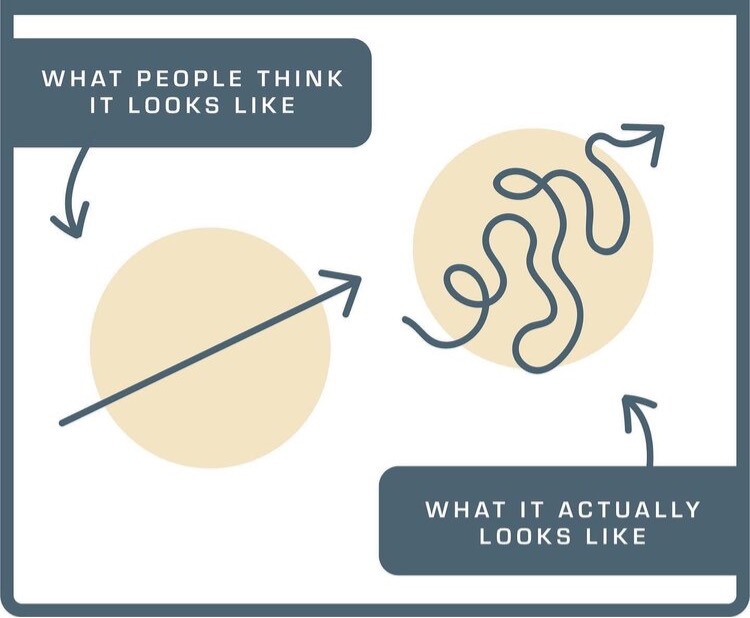
Image sourced from: https://www.aimnutritioncoaching.com/members-only-blog/pv9ip1vaqxnozxlv8u3b5lype5iloe
The rest of my life:
I used this tool for myself a few years ago I was earning way more than I am now and yet I was miserable…I didn’t enjoy where I was living, the job I had or the people I worked with and money definitely didn’t make up for that whatsoever.
My inspiration for this came from a friend of mine who, after his wife left him and he los this job, sat himself down in front of a blank word document entitled “The rest of my life” and proceeded to write a roadmap for what he wanted for himself. This process allowed him to close the previous chapter, knowing that his life wouldn’t ever be the same….but it could in fact be even better!
The process:
Below are all of the questions that I asked myself to determine what I wanted my life to look like. I figured that if I lived somewhere I liked, enjoyed my job, spent quality time with friends + family, had a great romantic relationship and had enough money to do the things I enjoy, I should be pretty close to living my best life? Either way, it couldn’t get much worse than what I was already living at the time.
This can be an iterative process where you go through each part in turn and then go through it all again to ensure it all stacks up and makes sense. There may be conflicting elements to what you write and in this case you will have to decide which is more important to you and thus which one takes precedent over the other.
For example, you may want to be within 30 minutes of your family and a large city for work, but this may not be possible. Thus you will have to decide which is more important to you and then amend the less important one to fit within the rest of the criteria.
Note: It can be easier to ask someone you are close to if they will help you with this by asking you the questions and making notes on your answers; they may also help by being a sounding board for any ideas that come your way.
Job:
The aim here is to identify the type of job(s) you want and have in mind what the gaps are to achieving that so you can work towards it.
- What job sector do you want to work in? (marketing, sales, operations, quality, engineering etc)
- What kind of job role do you want? (team member, line manager, etc)
- Number of direct reports (if you want to be a line manager)
- Working days and hours
- Remote work / hybrid / on site
- What things have you liked about your current job / previous jobs that you’d like to have in the next job?
- What things have you disliked about your current job / previous jobs that you’d like to avoid in the next job?
- What job roles could fit the above criteria? – If you aren’t sure, call 3x recruiters for the sector you are looking at, talk them through the above and your experience to date and they should be able to throw out some suggestions
- What gaps do you have in your current experience to get the role you have identified above? If you aren’t sure, speak to 3x recruiters and ask them where your obvious gaps are to the role you desire.
Hobbies:
The aim here is to determine what hobbies you’d like (or would like to keep) and what the criteria are.
- List out each of the hobbies you’d like to do (or would like to keep doing)
- (For each hobby) – What is the frequency at which you’d like to do it?
- (For each hobby) – How far (in minutes) are you willing to travel to do your hobby?
- (For each hobby) – What is the cost of the hobby? (weekly, monthly, yearly)
Location:
The aim here is to come up with a number of criteria that describe the ideal place you’d like to live.
- How far (in minutes) are you willing to commute to and from work?
- Would you like to live closer to a city or in a more rural area?
- How far (in minutes) are you willing to travel to get to a green space / countryside?
- How far (in minutes) are you willing to travel in to town?
- How often would you like to see close friends?
- How far (in minutes) are you willing to travel to see friends at the above frequency?
- How often would you like to see close family?
- How far (in minutes) are you willing to make that journey to see them at the above frequency?
Romantic relationships:
The aim here is to understand what a good romantic relationship would look like. It won’t be a list of specific physical attributes, but more about character traits and communication styles.
- What are the elements you have valued the most in previous romantic relationships?
- What character traits are the most important to you?
- Do you portray these traits?
- What are the elements that you have valued the least in previous romantic relationships?
- What character traits do you want to avoid in a romantic partner?
- Do you portray these traits?
- Do you understand what things you need as part of that relationship (the list below is for illustrative purposes only and isn’t exhaustive)
- Time alone
- Time with friends
- Your own hobbies & interests
Note: I struggled with romantic relationships over a 10 year period and only managed to find one that I am really happy with after going to relationship therapy. Therapy of this kind can be really useful to understand how your own views, fears, beliefs about yourself etc can affect your current partner or can drive you to chose partners that aren’t right for you.
Salary:
The aim here is to determine what you NEED to make to fulfil all of the above. Then you can check whether the jobs you are looking at will match that criteria. If not, you may have to revise your expenses to bring them in line with the jobs or look at jobs that may be less desirable overall but that pay better.
Note: if you don’t know some of the elements below, then you will have to go back through your bank statements over the last few months and come up with estimates for the below.
- How much do you want to put in to savings each month?
- What are your monthly fixed costs? (Car payments, phone payments, food & household purchases, fuel, rent / mortgage, council tax, hobbies etc)
- What are your yearly fixed costs? (Car insurance, car tax, car MOT, car servicing etc)
- What do you spend on “fun” each month?
- Any other spending?
- What is the total of your monthly costs?
- What do you need to earn as a gross yearly salary to cover these monthly costs?
Summary:
Answering the above set of questions might take you several days or weeks of iteration to get to something that you are happy with.
Many people will tell you that something is a “great opportunity for you!” but if it doesn’t bring you closer to the life you want for yourself, then it isn’t an opportunity, it’s just an option that isn’t right for you.
Hopefully you now have a list of things that you can use to easily appraise whether an “opportunity” fits with what you are looking for or whether it is an option that should be discarded.
 Alex Devereux