Becoming a truly great leader doesn’t happen by accident; I believe that you have to become a student of leadership which is why I created this recommended reading section on the topic.
I’d encourage you to read all of the books below but my all-time favourite book is Out of the Crisis – by W.Edwards Deming
Out of the Crisis
By W.Edwards Deming
Summary:
The best leaders I’ve worked for believe and do very specific things that create a truly great business and I’d never been able to articulate what they all were until I read this book.
The leadership philosophy laid out in this book centres around achieving long-term success through the continuous improvement of Quality.
At the core this philosophy stands Deming’s 14 points of leadership which, if implemented systematically and methodically will transform your business.
In this book you’ll learn how to turn around a business by:
- Aligning everyone behind a common purpose
- Training and empowering your people to make the right decisions
- Gaining an understanding of systems thinking
- Understanding value from a customers perspective
- Using statistical methods to understand variation in your results
Key take-aways:
- Deming’s 14 points of leadership
- 90% of the variation in your results comes from the system (which is owned and designed by leadership) and not the people in your organisation
- Focus on removing variation and improving quality
- Your people are your greatest asset

For Your Improvement
By Michael M Lombardo & Robert W Eichinger
Summary:
This should be the first book you buy when you become a line manager. It is a brilliant resource to discover what the development needs are for your direct reports and comes with recommendations on how to develop on those much needed skills.
The book is split in to 4 – 5 page paragraphs, each focussed on a specific development need. Read the index and pick out a top 5 for your direct report and ask them to do the same. Then come together and agree a top 3 between you and add this to their PDP.
Key take-aways:
- Personal development plans (PDPs) need to be specific to the needs of the individuall
- The PDP is something that you build together with your direct reports

Radical Candor
By Kim Scott
Summary:
Promoting a culture where people give and receive feedback openly is key to creating a high performing environment. Kim Scott’s book comes with many great stories, examples and recommendations as to what you can do with your team to create such a culture.
Key take-aways:
- Being open with your colleagues helps everyone grow
- You can’t have a high performing team where people aren’t able to discuss how they feel with each other and be vulnerable
- Feedback is a gift but only if it’s given in the right way
- Linking your team members current work with their life goals really puts what they do in to context and can drive performance

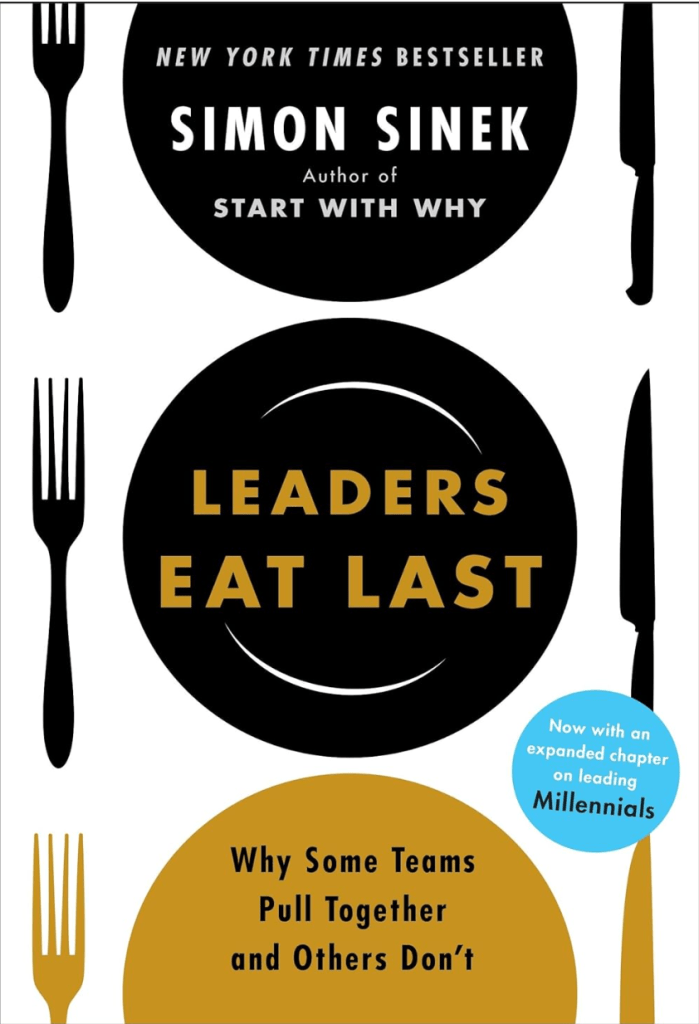
Leaders Eat Last
By Simon Sinek
Summary:
Another one on the list of all-time favourite books by Simon Sinek. In this insightful book Simon explores how the leaders mindset literally makes or breaks a team. This book is very well written, is easy to read and easy to absorb and pass on the learnings to others.
A must-read for anyone in leadership or considering leadership.
Key take-aways:
- Leadership is not about being in charge but about taking care of those in your charge
- Your primary role as a leader is to help, support and develop those whom you lead
- Leadership doesn’t have to be a formal title, teachers, coaches, parents, friends can all be leaders
The Infinite Game
By Simon Sinek
Summary:
The length of the horizon on which you operate has a huge impact on the decisions you make today and the outcomes you get tomorrow (or later).
This book highlights the positives (both personal and professional) of looking towards an endless horizon, to serve a much bigger purpose than what is immediately in front of us.
I haven’t read another book that I found was so closely aligned to my own way of thinking and was great to see it put in to words.
Key take-aways:
- Don’t compromise on long-term goals for short-term gain
- Businesses would fare much better, last much longer and do more good if they adopted a more infinite mindset
- The infinite mindset also applies to our personal lives and we may be happier if more of us took that approach

Invisible Women – Exposing data bias in a world designed for men
By Caroline Criado Perez
Summary:
This book is a MUST READ for everyone. For those of you who aren’t women, I’d suggest reading (or listening to) with a woman who you care about so you can discuss topics in the book and learn both from her and from the author.
Caroline Criado Perez explores how much of the data used to make decisions about anything from public policy, to education, to health policy and even to the design of our cars is predominantly male biased. This means that the we are designing a world which predominantly caters for men.
It is essential that we all recognise that this bias exists so that we can all worth together to develop a world which caters for the needs of all.
Key take-aways:
- Women are often seen as “the anomaly” even though they represent circa 50% of the population
- This data gap goes back decades and is a lasting consequence of a system whereby most of the decisions were made by non-gender diverse teams (basically teams of just men)
- Diversity in lived experience within teams is critical to making decisions which take multiple different viewpoints in to consideration
- It won’t be easy to expand the data to further include women but it is something that we must do

Turn the ship around
By L.David Marquet
Summary:
L.David Marquet was put in charge of the worst performing submarine & crew in the U.S Navy and wasn’t able to give good direction to his team because he knew nothing about that particular submarine.
When he let go of the strict hierarchical structure, taught his teams to find solutions to problems and then empowered them to make decisions and take action without having to wait for orders they became best in class and passed inspection with the highest grade ever awarded.
This framework can improve the results of your team and your organisation by giving people the knowledge and freedom to make better decisions witch will dramatically increase both he amount and quality of work delivered.
Key take-aways:
- Teach people how to make better decisions by teaching them how to ask the right questions
- If someone comes to you for decisions, take the time to teach them how to assess, then vocalise the options before asking them for a recommendation on what course of action to take
- The more people who are able to make good decisions at every level, the more efficient and proactive your organisation will be

 Alex Devereux