Avoid saying “Yes” to everything

Many people can get themselves stuck by taking on too much work because they are uncomfortable saying “no”.

Saying “Yes” is the easiest way to deal with the anxiety many of us feel when we think about turning down a request. Saying “Yes” to things reduces your own anxiety but can create an unsustainable work or life conditions.

Some people will go the opposite way and just give people a flat “no” without giving any reason or context behind their response. This reduces your own anxiety, can raise the anxiety of the person making the request and also reduces trust in the process.

No…but maybe yes?

It is easier for you and the other party if a “no” is given with an explanation but the issue here is that we don’t always have that reason fully formed and ready to go.

The key is buying yourself time to thoroughly think about the request and then respond by using the “No but maybe yes” formula.

How this works:

Someone comes to you with a request and this goes through your mind:

  • Your gut feeling is that the answer is “no” but you can’t quite articulate why that is
  • You want to give an explanation with your “no” but don’t have that explanation fully formed
  • Ideally you need more time to fully think about it
  • With time to think, the answer may well be “Yes” but at least you know that you can stick to that answer.

So what should you do…?

You tell them what’s on your mind!

It’s as simple as that!

I have found on many occasions that taking someone through my thought process is the best way to clarify the dilemmas that you are having. This not only gives someone insight in to what you are thinking but also makes you relatable and demonstrates humility.

Step 1: Manage expectations – My gut feeling is that the answer will be “no”….

Step 2: Tell them you haven’t got a full reason as to why – …however I can’t tell you for certain why the answer is “no”.

Step 3: Give yourself time to think – Can I come back to you by the end of today / first thing tomorrow once I have had time to fully think about this?

Step 4: Explain why you’d like more time – I’d like some time to properly think about your request so I can give you a definitive answer one way or the other.

Step 5: Explain the possible outcomes – I may, upon reflection, realise that I can say “yes” to your request which would be good for you but if the answer is “no” then I will be able to fully explain why not.

The outcome:

Overall I’d say that about 60% of the time the answer is consistent with my gut feeling (no) and the rest of the time I am able to give someone a favourable response.

The great thing about doing things in this way is that it helps to build trust by showing humility and openness to taking the time to properly consider the options.

You may also come up with a “Yes but..” and then give them the choice to decide what they want to do.

This approach works just as well with anyone who comes to you with a request be it from one of your team, your peers, your line manager or your family.

Using this to manage upwards:

When it comes to managing upwards to your line manager, you may come back to them with options for them to decide what you do. If you can’t fulfil their request without compromising on other work, then you have time to think about the options and you come back to them with a “yes but”.

That “yes but” can come with a recommendation on what work you can delay or if you aren’t sure, then lay the options in front of them so they can decide on what is most important.
Task management – the DILO

You can’t manage time, you can actually only manage what you do during that time”

David Allen, Productivity Consultant.

If you have ever told someone else that you are bad at time management, or someone on your team has told that to you, then this page is for you!

In my experience, people who “don’t have time” may have one or several of these things happening:

  • The business priorities aren’t clear to them
  • They don’t know how to prioritise effectively
  • They spend time on low-value-added tasks at the expense of higher-value tasks
  • They don’t know how to say “no” to a request
  • They are inefficient in task completion

If you hear your team say this to you, then it is your job as the line manager to ensure that:

  • They know what the business priorities are
  • They understand how to classify tasks according to the urgent / important matrix
  • They know how to plan their time effectively
  • They don’t have tasks from other people on their to-do list

If you hear yourself say that to your line manager, then you may need help with the above as well.

The DILO (Day In the Life Of)

The DILO is a simple yet effective tool to map the tasks that are being conducted and what percentage of time is taken up by each task. I have described how to conduct the task for your direct report but if you realise that you need help to prioritise from your line manager then carry out the task for yourself and then meet with them to discuss.

The principle is simple:

Download the DILO template (see above) and fill in the top left boxes (time intervals / hr, Start time, Contracted hours) before sitting down with your direct report and asking them to fill it in over the next week.

Get them to add any recurring meetings or tasks to the DILO before they start.

Ask your direct report to set an alarm every 15 or 20 minutes (depending on your chosen time interval) of the day for an entire week. Each time the alarm goes off, they write down what they are currently doing.

At the end of the week, book in a meeting together and ask them to bring the DILO so you can go through it together and put each task in to the urgent / important matrix.

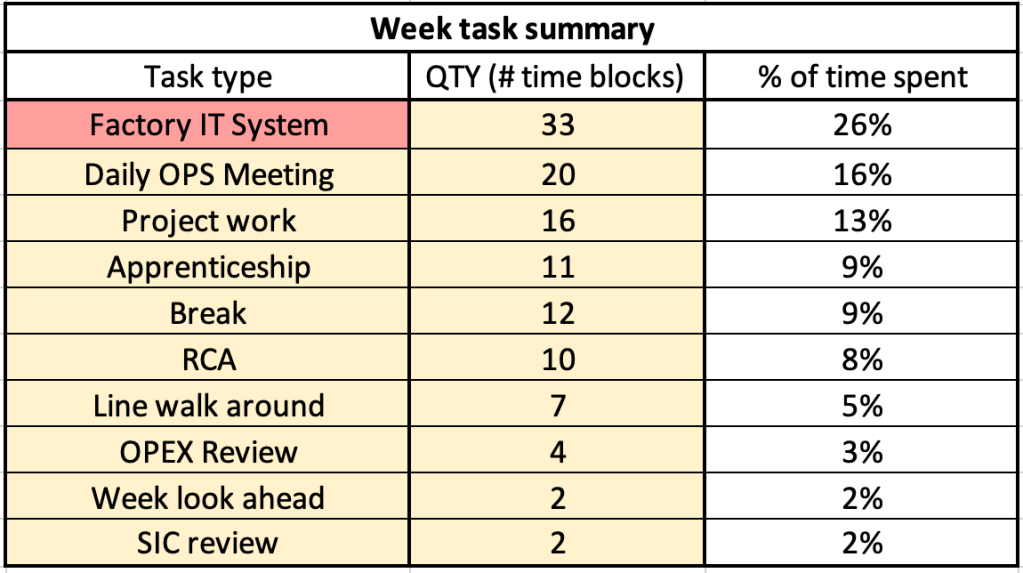
Go through the DILO and split the weekly tasks in to headings (meetings, personal development, lunch, break, own work etc) and put them in the week task summary table on the right hand side. Then count the number of each task type being performed and put it in the QTY column of that table.

This will now tell you what tasks are being conducted and what % of their contracted hours is taken up by each task type.

At the end of the meeting it should be clear to your direct report what tasks are the most important. It is also an opportunity for you to remove tasks from them, to understand where they might need more support, delegate less important tasks to others or push back tasks to other departments.

Real life example:

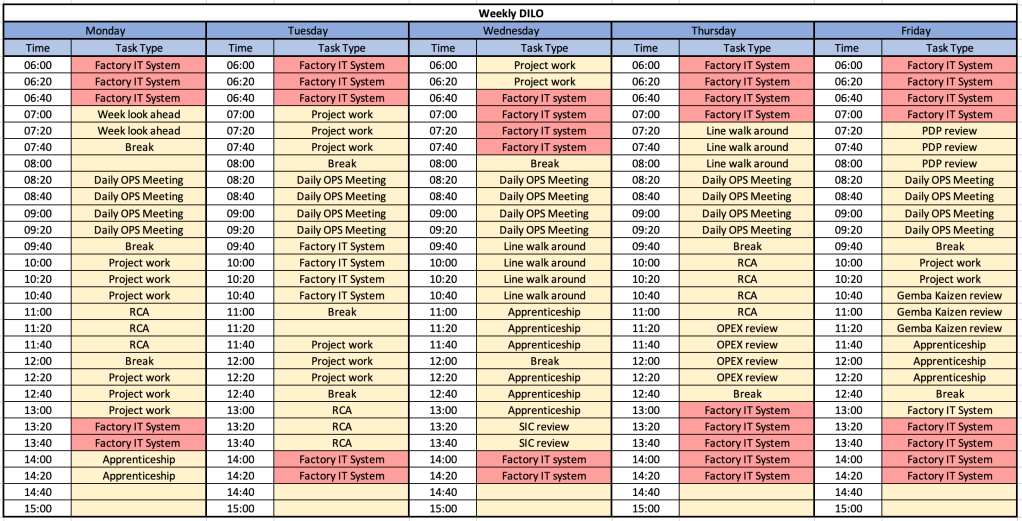
Below is the DILO for one of my direct reports that I asked her to do shortly after I joined the business. I wanted to get an idea of what tasks she was completing on a weekly basis.

I have highlighted all of the tasks in Red that I wanted her to stop doing, as they no longer fell under the remit of my team to carry out. Those tasks were given to her by the operations manager and were still required to be completed (just not by anyone on my team).

This is the summary of the table above by task and corresponding time taken over the week on that specific task.

As you can see, the time spent on the Factory IT System was 26% of her week and this task had nothing to do with my teams objectives.

So I took both tables to the Operations manager to show him just how much time this task was taking for my team member. This allowed the conversation to centre around the facts and gave him clear information that he needed to allocate that work (and thus that time) to someone else.

In the end, we agreed that my team would continue to carry out those tasks for the next 4 weeks while another person was trained and became competent in performing those tasks and my team member got about a quarter of her time back to focus on other work.