How to live your best life

“The meaning of life is to have a meaningful life” – Steven Bartlett

What is a meaningful life anyway? And how do I get one?

Initially I thought it an odd question… because I had never really asked myself what a “meaningful life” would look like to me and had always just gone with what social media and my parents had told me: “Make as much money as I can, buy a big house, at some point get married and have kids and try retire with as much money as possible”.

You see in the quote above, money comes up twice, having something which costs a lot of money (the big house) is also in there but there is nothing about being happy…

When I thought about this a little more, I realised that I didn’t want the money, I just wanted to be happy. Yes, I mean having money is better than not having it, and stresses that come with having to be really careful with money make life harder but money is not what life is all about.

Asking yourself the tough questions

I believe that one of the reasons we seem to chase the above is because it’s easier than having to go through the discomfort of actually figuring out what we want for ourselves.

A lot of us, to a more or lesser extent, just keep our heads down and run in broadly the same direction and we feel like we are making progress (and we might be) but what is the point of progressing towards something that we don’t truly want and that won’t make us happy?

“What is the point of progression towards something that we don’t truly want and that won’t make us happy?”

In oder to figure out what it is that you want for yourself, you have to face up to the fact that your current reality and the things that you have been working on haven’t helped you progress towards the thing(s) you really want.

It might feel like it’s all been a huge waste of time but progress isn’t linear, it comes with setbacks, twists and turns. If you have a sense of where you are going, you can more easily determine whether a move or a change will broadly take you in the right direction.

What progress actually looks like:

This is a great representation of what progress actually looks like. In the end you make it to where you want to be, and as much as we might like it to go straight up and to the right, it doesn’t.

The meandering, the twists and turns and the pivots all help you learn more about yourself and what you truly want and ultimately makes you better.

Even if you totally pivot and choose to go on a totally different path than before, the lessons you learnt to get you where you are will still be useful.

Life isn’t a race, it’s a journey that we only make once. So why not be sure to enjoy the scenery on the way?
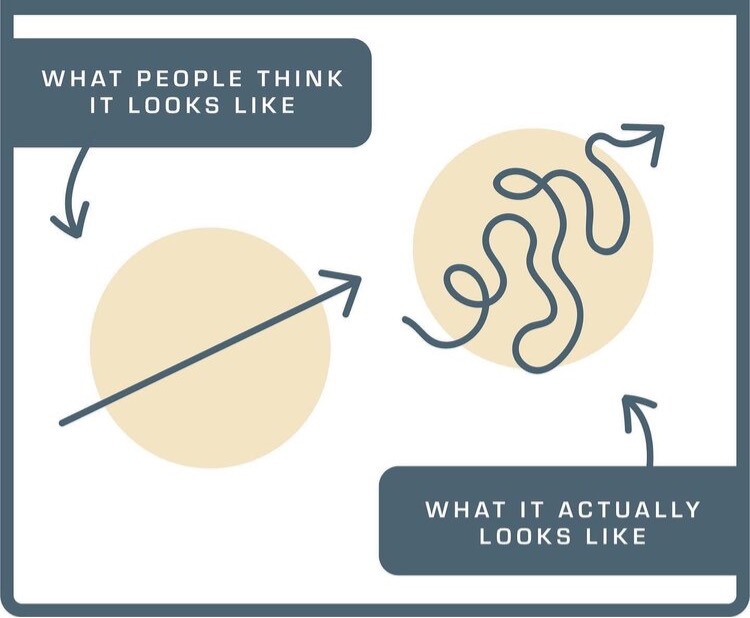
Image sourced from: https://www.aimnutritioncoaching.com/members-only-blog/pv9ip1vaqxnozxlv8u3b5lype5iloe

The rest of my life:

I used this tool for myself a few years ago I was earning way more than I am now and yet I was miserable…I didn’t enjoy where I was living, the job I had or the people I worked with and money definitely didn’t make up for that whatsoever.

My inspiration for this came from a friend of mine who, after his wife left him and he los this job, sat himself down in front of a blank word document entitled “The rest of my life” and proceeded to write a roadmap for what he wanted for himself. This process allowed him to close the previous chapter, knowing that his life wouldn’t ever be the same….but it could in fact be even better!

The process:

Below are all of the questions that I asked myself to determine what I wanted my life to look like. I figured that if I lived somewhere I liked, enjoyed my job, spent quality time with friends + family, had a great romantic relationship and had enough money to do the things I enjoy, I should be pretty close to living my best life? Either way, it couldn’t get much worse than what I was already living at the time.

This can be an iterative process where you go through each part in turn and then go through it all again to ensure it all stacks up and makes sense. There may be conflicting elements to what you write and in this case you will have to decide which is more important to you and thus which one takes precedent over the other.

For example, you may want to be within 30 minutes of your family and a large city for work, but this may not be possible. Thus you will have to decide which is more important to you and then amend the less important one to fit within the rest of the criteria.

Note: It can be easier to ask someone you are close to if they will help you with this by asking you the questions and making notes on your answers; they may also help by being a sounding board for any ideas that come your way.

Job:

The aim here is to identify the type of job(s) you want and have in mind what the gaps are to achieving that so you can work towards it.

  • What job sector do you want to work in? (marketing, sales, operations, quality, engineering etc)
  • What kind of job role do you want? (team member, line manager, etc)
  • Number of direct reports (if you want to be a line manager)
  • Working days and hours
  • Remote work / hybrid / on site
  • What things have you liked about your current job / previous jobs that you’d like to have in the next job?
  • What things have you disliked about your current job / previous jobs that you’d like to avoid in the next job?
  • What job roles could fit the above criteria? – If you aren’t sure, call 3x recruiters for the sector you are looking at, talk them through the above and your experience to date and they should be able to throw out some suggestions
  • What gaps do you have in your current experience to get the role you have identified above? If you aren’t sure, speak to 3x recruiters and ask them where your obvious gaps are to the role you desire.

Hobbies:

The aim here is to determine what hobbies you’d like (or would like to keep) and what the criteria are.

  • List out each of the hobbies you’d like to do (or would like to keep doing)
  • (For each hobby) – What is the frequency at which you’d like to do it?
  • (For each hobby) – How far (in minutes) are you willing to travel to do your hobby?
  • (For each hobby) – What is the cost of the hobby? (weekly, monthly, yearly)

Location:

The aim here is to come up with a number of criteria that describe the ideal place you’d like to live.

  • How far (in minutes) are you willing to commute to and from work?
  • Would you like to live closer to a city or in a more rural area?
  • How far (in minutes) are you willing to travel to get to a green space / countryside?
  • How far (in minutes) are you willing to travel in to town?
  • How often would you like to see close friends?
  • How far (in minutes) are you willing to travel to see friends at the above frequency?
  • How often would you like to see close family?
  • How far (in minutes) are you willing to make that journey to see them at the above frequency?

Romantic relationships:

The aim here is to understand what a good romantic relationship would look like. It won’t be a list of specific physical attributes, but more about character traits and communication styles.

  • What are the elements you have valued the most in previous romantic relationships?
  • What character traits are the most important to you?
  • Do you portray these traits?
  • What are the elements that you have valued the least in previous romantic relationships?
  • What character traits do you want to avoid in a romantic partner?
  • Do you portray these traits?
  • Do you understand what things you need as part of that relationship (the list below is for illustrative purposes only and isn’t exhaustive)
    • Time alone
    • Time with friends
    • Your own hobbies & interests

Note: I struggled with romantic relationships over a 10 year period and only managed to find one that I am really happy with after going to relationship therapy. Therapy of this kind can be really useful to understand how your own views, fears, beliefs about yourself etc can affect your current partner or can drive you to chose partners that aren’t right for you.

Salary:

The aim here is to determine what you NEED to make to fulfil all of the above. Then you can check whether the jobs you are looking at will match that criteria. If not, you may have to revise your expenses to bring them in line with the jobs or look at jobs that may be less desirable overall but that pay better.

Note: if you don’t know some of the elements below, then you will have to go back through your bank statements over the last few months and come up with estimates for the below.

  • How much do you want to put in to savings each month?
  • What are your monthly fixed costs? (Car payments, phone payments, food & household purchases, fuel, rent / mortgage, council tax, hobbies etc)
  • What are your yearly fixed costs? (Car insurance, car tax, car MOT, car servicing etc)
  • What do you spend on “fun” each month?
  • Any other spending?
  • What is the total of your monthly costs?
  • What do you need to earn as a gross yearly salary to cover these monthly costs?

Summary:

Answering the above set of questions might take you several days or weeks of iteration to get to something that you are happy with.

Many people will tell you that something is a “great opportunity for you!” but if it doesn’t bring you closer to the life you want for yourself, then it isn’t an opportunity, it’s just an option that isn’t right for you.

Hopefully you now have a list of things that you can use to easily appraise whether an “opportunity” fits with what you are looking for or whether it is an option that should be discarded.
PDCA your way to your perfect life…

People try to find their perfect life by reading books or speaking to other people who seem to “have it figured out” only to be told things that don’t resonate with them (buy a house, have kids, get married etc) – but those are their truths and not yours.

One of my coaching clients found herself in this exact situation (and I must admit to have found myself there a few years ago). During our conversation, she said she’d read a lot of books to try and find “the answer” to having a perfect life but so far hadn’t found “the secret”.

I don’t think there is a “secret” except that you need to find a way to discover what works for you in your own life (this sounds scary to a lot of people because it’s far easier to be told what to do than it is to search for yourself but this WILL pay dividends in the long term).

I realised that this is why a lot of people “follow the crowd” when it comes to deciding what to do with their lives; we are told to buy a house, get married and have kids… not because you necessarily want to, but because you are told to do these things in order to lead a happy life.

(as a rule for myself, whenever someone tells me I “should” do something, it sets off alarm bells and I take it as a sign that I need to sit down and figure out what my true feelings are on the matter, trying hard to take my fear or pre-conceived ideas out of it).

There isn’t a universal “best way” to do something because the ideal solution for me may not be the ideal solution for you. After giving this statement some thought, I found what I figured to be one way to get there through iteration.

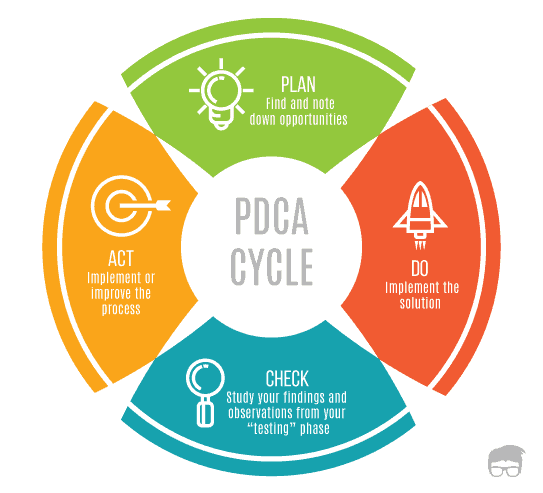
In continuous improvement, there is a tool called the PDCA (Plan, Do, Check, Act) cycle which is used as a way to find the root cause and then the solution to a complex problem.

Below are the details to each step:

Plan:

Spend some time thinking about what you want to achieve and ways in which you might achieve it. Create a plan of what you are going to try based on information you can gather at this stage.

Say you want to pick up a hobby, but aren’t sure where to start. Think of things you have enjoyed doing in the past, think about what specifically made those things enjoyable and create a list, then look for hobbies that fit some or all of your listed criteria.

Once you have your list of potentials, make a plan to try out one a week for several weeks.

(If you still aren’t sure where to start, pick up a copy of “How to be comfortable with being uncomfortable” by Ben Aldridge, he has plenty of ideas to get you started)

Do

Execute the plan.

Check

Check the results you achieved.

Did you enjoy the hobbies you had listed? If so, great! If not, you haven’t failed you just got different results to the ones you had planned on. Think about reasons why you may or may not have gotten the desired results.

Act

If the results were the ones you wanted, then stick at it. If they are totally wrong or not quite there, then go back through the cycle using your new found information and use it to make a more effective plan.

Stick at it

This is an iterative process, meaning that you may have to go around the cycle several times in order to find the solution you are looking for.

Put simply, all you really need to do is to try something, see if you like it and if it adds to your overall life / sense of happiness, and if it does, keep doing it. and if it doesn’t try something else.

If you never try then you will never know. Sure some stuff you do may put you out of your comfort zone, and force you to face up to some of your long held beliefs about yourself (which is scary) but it will absolutely be worth it!

For me, I decided that my life needed more adventure and mental challenge, so I decided to cycle the 20 miles to and from work twice a week (no matter the weather) and that for 6 months I would only get a hot shower once a week (yep the rest were on full cold!). I found that doing these things gave me more mental strength and resilience and I started to feel better about myself.

I ended up going out more, quitting my job, planning a whole new life for myself with my new partner and am happier and healthier than I have ever been.

Good luck and trust the process!

Oh and here is that book I was talking about:

Happy reading!

There are no shortcuts…

(So stop looking for them).

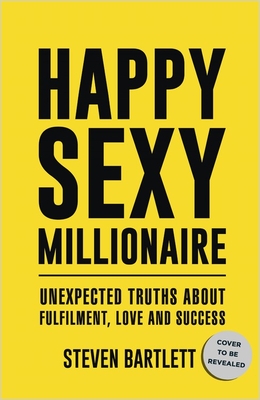
I recently picked up Steven Bartletts book “Happy Sexy Millionaire” and I must say I am thoroughly enjoying it; I am finding it refreshing, original and stands against a lot of what is considered conventional wisdom when it comes to happiness and fulfilment.

One section really stood out for me about the fact that a lot of us are looking for the “shortcuts” because we live in a world full of instant gratification. Shortcuts are so appealing because so much of what we get today (though very little of it meaningful at all), we get with such little effort, persistence and perseverance.

The truth is… there are no shortcuts.

And that’s it really…

Steven describes what he thought when he was asked what his top 3 secrets were for becoming a great public speaker…his mind told him that to get to where he is took him a combination of:

  • A decade of hard work
  • Failure
  • Luck 
  • Timing
  • Nature / nurture
  • Persistence

Anything worth having is worth working at and waiting for.

So stop wasting time on the supposed “shortcuts” because they distract you from the long-cut work you should be doing… you end up changing from shortcut to shortcut every 3 to 6 months and then 10 years down the line you realise you are always just at the stat of something new, and not well on your way be something truly fulfilling.

So… what to do now..?

  • Reach out to your network (or extended network) and try to reach someone who does what you want to do and ask them what you need to do to get you started.
  • Ask for low-cost ways to get an introduction to the subject
  • Ask what books you can read
  • Ask about how to get involved so you can start learning and gaining exposure
  • Ask for what courses you could take

And then… do it and stick to it.

The problem is that there is just so much choice… how do I know that this thing is going to be THE thing that ends up becoming this great thing that will make me happy?

Well… the truth is… you don’t.

However if you work at it and make sure to build up your career capital (Transferrable skills, Connections, Qualifications and your Reputation) then you may not have to start all over again if you decide that the path you originally chose is not exactly the right one for you.

Here is an example of how things worked out for me to help illustrate the points I have made.

My career story so far:

I chose to study Engineering because I was good at Maths & the Sciences and my Dad was an Engineer. (Nature / Nurture)

I became and Engineer because that’s all I thought I could do with my degree.

I had always wanted to help others, problem solve and lead others and didn’t feel like project Engineering was the right fit for me.

2 years in, I wasn’t performing in Projects and had been on and off a Personal Improvement Plan (Failure); but my Line Manager saw something in me that he liked and tried to find something that might be more suitable. He gave me the opportunity to go on shift to manage a team of reactive maintenance technicians (So using the Engineering skills I had gained over the previous 3 years along with the environment to learn Leadership Skills). I didn’t know this at the time but the role I had was only meant to exist for the next 12 months so neither he nor I had much to lose if I didn’t perform in that role (Luck + Timing).

This was to be the last placement on my Engineering grad scheme and the year I started reading books on Leadership, Business, Continuous Improvement, Failure and Mindset. As I couldn’t sign off my grad scheme in the role I was in, they failed me (Failure) but said I could apply internally to take a promotion to being a Shift Manager leading a team of factory operators.

It was around this time (at the age of 24) that I started reading books on Leadership, Mindset, Failure and Continuous Improvement as I learnt so much that I could apply to my life to be better at work and improve my quality of life (Better mindset, better sleep, lower stress etc)

I became an Operations Shift Manager at the age of 25 and thought that I was well on my way to being fast-tracked through the business to becoming a GM before my 32nd birthday.

Fast forward 3 years and I was still in that job, I lived in a part of the country I hated, I had spent 6 months in therapy to try and get my life back together after a string of awful relationships (therapy was the single best thing I ever did for myself) and my boss had just told me that he wanted to put me on a PIP for underperformance but failed to clearly articulate why. (Failure).

Oh and in the meantime I decided that Manufacturing wasn’t where I wanted to be so I “invested” over £20K of my savings in trying to start a property investment company which ultimately failed because I only wanted it for the money and not because I had much of an interest (or skills) in property investing as a career. (Failure)

I quit that job with no other work to go to and spent 6 months as an agency worker in a factory that made industrial printer heads. It took me 4 weeks from setting foot in the door to becoming their best performing operator and I was bored and unfulfilled. Taking this time away to work in a boring job allowed me to lick my wounds, mend my pride and create a plan of action for the following 2 years to get from where I was to landing my dream job.

(I did however meet the woman who is now my Fiancé 3 months prior to quitting my job so a definite win there).

I applied for multiple roles in Continuous Improvement because I had an feeling that that’s what I really wanted to do and would leverage all of my previous skills in to one neat role that was pretty much made just for me…

But it didn’t happen, I got some interviews but no one offered me a job.

I decided not to give up and to buy books on continuous improvement theories and to take an entry level course in Lean / Six Sigma as this was often a minimum requirement for the kind of jobs I wanted (Perseverance and hard work)

I managed to get another job on shift as a contractor for another large food company but it meant that I was working away from my partner and back to doing night shifts which wasn’t fun. However I met someone there who saw me working hard so he took me under his wing and taught me more in those 6 months than I had learnt from any line manager I had previously had (Luck & Hard work).

Those 6 months enabled me to save enough money to then spend the following 4 months travelling around Europe and another 2 months on a private game reserve in South Africa learning to be a wildlife nature guide with my soon to be fiancé (I planned the proposal while we were on our trip and proposed shortly after we got back).

Half way through our trip I got a call from a recruiter telling me she had just the job for me (I know they all say that but this time it was true!). They wanted someone with some CI experience and a lot of experience managing factory teams to be their head of operational excellence, reporting to the site manager. They were right, the job was right for me.

The interview was the easiest I had ever had and was more a conversation about what I had been doing over the 6 months I was travelling. I even asked if he wanted to ask about my CV at all and he said he trusted me and could clearly see from the little time we did spend talking about work that I knew what I was talking about. He said he would be happy to offer me the job based on that 30 minute conversation.

At the age of 30 I finally got the job I had actually wanted for over a decade and all it took was all of the things that Steven listed above.

Although luck and timing can influence the position you find yourself in, if you aren’t ready to take advantage of luck or timing then those things are meaningless. There are also ways to create your own luck by being involved, being curious, working hard and asking for advice from others. People will see this as your motivation to grow and learn which is incredibly valuable.

In addition, when you do fail, don’t use it as confirmation of your inadequacy but instead think of it as an opportunity to learn and grow from it. Sometimes you aren’t in the right place at the right time and you aren’t the right fit for the environment (something I felt in the 2 years before I left Mars).

Don’t be afraid to take a step back to re-evaluate your position and create a plan for the future. Spending 6 months in that boring job where overall I was just covering my expenses was a great, low stress way to take stock and had literally zero impact on my career prospects.

Lastly I am so grateful to have taken 6 months off to travel with my partner as it really put my life in to perspective and is definitely something we will be doing again. You can do a lot in 6 months when you aren’t working but how much do you really achieve, grow, learn and experience when you spend 6 months in your current life routine? That 6 month break taught me a lot about what I truly value in life and again had no negative impact whatsoever on my career (in fact I would say it had a positive impact because when I did get another job I had seemingly boundless energy to give to the work and to others thanks to the extended break).

So to become the person I am today and to be ready to take on this role that I had wanted for a long time I had to:

  • Work hard for about a decade (University included)
  • Fail repeatedly at many things and many jobs along the way (but each failure taught me something about myself)
  • Get a stroke of luck every now and again (but was ready to take advantage of it)
  • Be at the right place at the right time (again was ready to take advantage of that)
  • Benefit from both nature and nurture
  • Be persistent and never stop learning (So far I have read over 110 books spanning 1 month, 12 days, 2 hours and 14 minutes of total reading time)

The great thing about there not being any shortcuts is that you learn so much more along the way and you can improve not just on one aspect of your life but many things. There is no easy way around this… but if you work hard, keep learning and stay humble, you are likely to end up falling on your feet in the end.

As always I hope you enjoyed this and got some value from it. Any feedback would be greatly appreciated as I want to put out content that helps people.