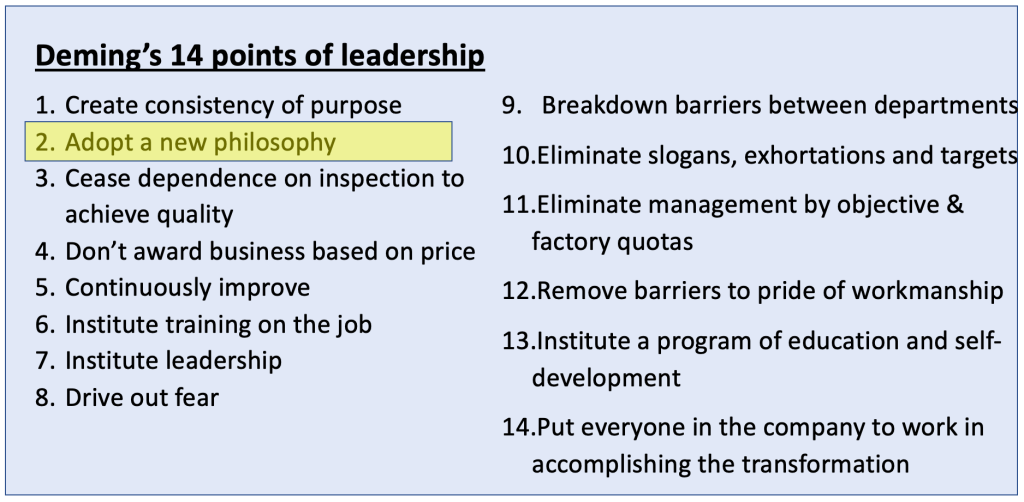
Deming’s 14 Points of Leadership – Article #5

Point #5: Improve Constantly and Forever the System of Production and Service

Kaizen means ongoing improvement involving everybody, without spending much money.” – Masaaki Imai

Where it came from

Post WWII, Japan’s economy and its infrastructure were in ruin; how were they supposed to re-build their economy with very limited resources? With available cash being a huge constraint, Japanese companies had to find ways to get cash back to their businesses in the shortest time so they could keep afloat. This forced them to get creative and to put focus on making their processes more efficient by reducing move, queue and process times to lower throughput. This, with the focus on delivering higher quality, meant they could delivery a higher variety of products, in small batch numbers at low cost.

Kaizen became a central part of Japanese business culture and this philosophy emphasises that everyone be involved in making small, incremental improvements to the process.

Some of the key concepts include having respect for people, managers who work on improving the system, the elimination of waste, variation and defects and the focus on small incremental gains.

This philosophy is not new… it has been around for over 80 years; so why aren’t we all working in businesses that are run like this?

How did we end up here?

Post WWII America wasn’t as financially constrained as Japan, and so they focussed on economies of scale to lower the manufacturing cost per unit rather than on economies of flow(1).

Henry Ford was able to bring cars to the masses by cheaply producing a single model of car. This brought huge economies of scale as he was able to produce more and in a shorter time than anyone else and thus was able to make a profit on a lower sale price. The only issue with Ford’s model is that he wasn’t able to offer the customer variation “You can have any colour you want as long as it’s black”.

As other businesses caught on to Ford’s model, they too employed economies of scale to reduce their cost per unit. However when the customers wanted more variation, they weren’t able to keep their cost per unit as low due to time spent changing over and dealing with more variety in their processes. To tackle this problem they simply kept the economies of scale, making different models in larger batches (whether or not they had been sold) and then changing over to make the next variation in a large batch.

As customers are demanding more and more variation, the old model is quickly becoming out-dated and many companies are ill equipped to deal with it because of a lack of understanding and implementation of lean.

Why people hate change

Wrong mindset and approach by management

“People hate change…”

I hear this all of the time… and I have found it to be true only when change is forced upon the people by management who make decisions far removed from where the work is actually done. In these cases, the benefits for the business are sometimes (but not always) clear to the people and often they actually make the work harder and not easier for the workforce.

Working in this way is not systems thinking (see Point #2) and is not what continuous improvement is about.

If you approach change in the right way and with the right mindset, then people will ask you for change rather than resisting it.

Peter Senge put it so simply by saying that “People don’t resist change. They resist being changed!

So rather than force change upon someone, instead ask them what changes would make their jobs easier and more efficient and then do those things. Helping the people by making their jobs less frustrating will make them more receptive to changes that you suggest in the future because you will have gained their trust and appreciation. A happier workforce will be safer, produce higher quality and be more efficient; eliminate day to day frustrations and constraints on them doing a good job and they will thank you for it.

Tool heads and consultants

Many people believe that continuous improvement or lean is just a set of tools that you can buy off the shelf and put in to your process. This couldn’t be further from the truth. Continuous improvement is first and foremost a mindset and work must be done to change your mindset from the old school thinking to systems thinking (see Point #2 for more detail on this)

As the Toyota Production System gained popularity in the West in the 1980’s it was pretty much inevitable that lean manufacturing “tools” would emerge as a way to emulate the processes used by the Japanese. The principle behind the creation of these tools was that you could get the desired level of improvement by blindly implementing the “lean tools” in your business… sounds simple and too good to be true right? Well that’s because it is!

Tools like 5S, TPM, Takt time, Value Stream Mapping etc. are often implemented irrespective of the true need for them which go against the core principles of CI.

These tools are at best an aid and can in some cases bring small benefits but they don’t tend to actually change the system at all. What we learn from both Deming and Seddon is that you must change the system for things to truly improve. Any benefit that you do get from the blind implementation of tools pale in comparison to the results you get from teaching others perspective and how to think about problems that need to be solved.

I’ve seen many “lean consultants” brought in to try and “fix” businesses and they all do as they have been taught and apply the tools in a blanket and unthinking way, rather than leading with the right questions.

Here is a question to ask yourself: What is the primary objective of a “lean consultant”? Is it to improve your business? Or is it primarily to sell you more of their time? I’ve seen consultants tell their customers that they won’t see any improvement from implementing their prescribed activities for over a year… a year?! So you have to pay for their time and pour resources in to something for over 12 months before you see any benefit? How is that lean?

At one of the plants I’ve worked at, we took things back to basics and took a systems approach to continuous improvement (see Freedom From Command and Control by John Seddon) rather than employing consultants to implement tools. In 4 months and with a spend of less than £10,000, we improved our overall factory output by 5%. That’s 5% extra product made with the same people and the same machinery, working the same shift pattern as before.

Consultants can cost over £3K per day for their time (and then you still have to pay their expenses)…. so for the cost of less than 3 days of consultant time, we saw a huge improvement in our output AND we did it in 1/3 the time.

What we created in the process was a continuous improvement framework that we continuously use and refine and that we have moved to other areas of the factory as they became the bottleneck process.

The small improvements we made were done at minimal or no cost. We did this by surfacing and eliminating the failures in the bottleneck process; and we did this by involving every person who worked in that area.

What can we do about it?

Know where you are going

If you haven’t already, go back to read Deming’s point #1 on creating consistency of purpose; if you don’t know where you are going as a business, how can you decide where to start making improvements?

Educate yourself in the principles of lean

Here are some must-reads if you want to gain an understanding of what true lean is:

-Freedom from Command & Control – by John Seddon

-Out of the Crisis – by W.Edwards Deming

-Beyond Command and Control – by John Seddon

-The Goal – by Eli Goldratt

-Better thinking, better results – by Bob Emiliani

-Real Lean – by Bob Emiliani

Mindset is more important than tools and techniques and the above books should start to shape your mindset

Instigate respect for people:

Respect for people is a key aspect of the continuous improvement process. Respect for people ultimately means creating a safe and collaborative environment where everyone is valued, empowered and supported to reach their full potential. In “old school” organisations, the “us and them” mindset is rife, people on the front line aren’t listened to or involved in decisions that are made by management. It is critical to create a culture where everyone works across functions and levels of seniority to improve the system.

Whether you are employed in a business that makes cardboard boxes or make cat food, you are all there to supply the product or service, safely, at the right quality & cost for a price that the customer is willing to pay. And irrespective of your position within the organisation, you are all there to play your part in delivering on that mission.

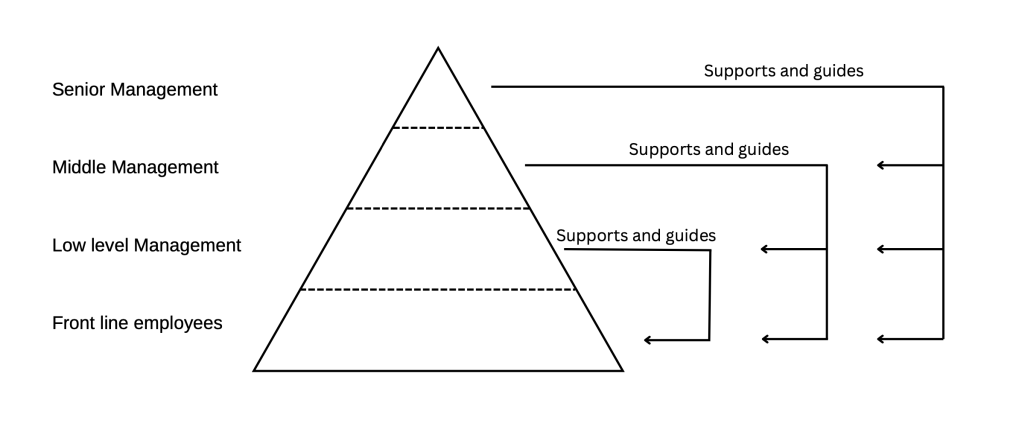
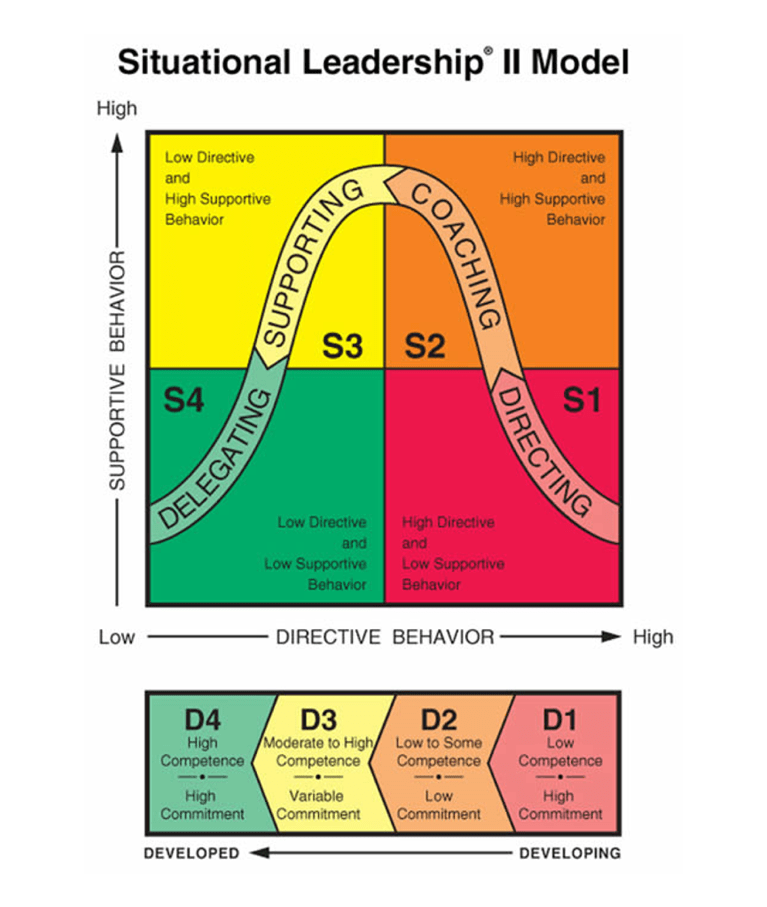
What this also means is that you need to trust the people in middle management and supervisory positions to make decisions. This means accepting that they may make mistakes from time to time and it’s your job to coach and guide them. Every time they make a decision, they will likely make an even better one next time.

Think about how you can:

  • Devolve more of the day to day decisions to people at lower levels within the organisation
    • What training and support would they need to do this effectively?
  • Give the people on the front line a voice to raise problems that they face each day which takes away pride of workmanship and makes their job harder?
    • How can you solve their problems as if they were your problems?

Where does data fit in?

Fomula 1 is a great way to illustrate progress that has been made through continuous improvement; 50 years ago, the pit stops alone were over a minute and now are under 3 seconds.

What data do you think the F1 teams had before they started to look at pit stops? Probably just the knowledge that the pit stops were a necessary process in the race, and reducing the time it takes to perform the process, means less time spent with the car stood still.

Back in the 70’s, the technology simply wasn’t available to get the thousands of data points needed to bring the pit stop to it’s current levels, but much progress was made by observing the process with stop watches and continuously finding and eliminating the slowest process.

You’d have teams of people with stop watches and clip boards watching the pit crew perform their process repeatedly, all the while making notes on what they saw. Once they’d done this several times, they’d likely have shared their observations with the crew and asked the crew themselves about their own experiences and what they found hard about the process they were performing.

Most businesses aren’t all the way back in the 70’s when it comes to the data but they aren’t advanced in their lean journey to be able to use the data they have in a meaningful way. A lot of businesses would benefit from the pit stop approach described above to make improvements in their processes.

This approach to problem-solving and continuous improvement has respect for people at its core. The opinion and experience of the pit crew is important and is a key source of data to help the improvement efforts.

  • Do you know what your slowest process is?
  • What observations have you made of that process which might be slowing it down or making it harder for the people to do their work?
  • What do the people think could be done to make their jobs easier?

Remember that you won’t necessarily be able to quantify the value of each improvement that you make. As long as you are taking actions by involving the people and that is based on the work that is done, then you will likely be heading in the right direction. If you make someone’s job easier, then you will likely be more efficient than you were and in many cases, you don’t need complex data systems, just spend time on the shop floor, making observations and speaking to your people.

In most cases you don’t even need any sort of sophisticated problem-solving tools beyond asking “Why” until you get to a root cause. Don’t over-complicate things and you will make it easier to involve more people in improvement.

Walk your process multiple times a week

Going to the place where the work is done and speaking to the people on the front line is critical to understanding what work is actually done and the problems that the team face in doing it.

Walking the process and speaking to the people builds trust and allows you to gain perspective and see first hand, all of the obstacles that hinder a great days work. Armed with this new understanding of the process and a better relationship with the people, you will be better able to make changes that help rather than hinder your team.

Level everyone up:

The Kaizen (or improvement flag) like the one displayed below, shows the primary focus of employees at each level of the organisation depending on how mature you are in your continuous improvement process.
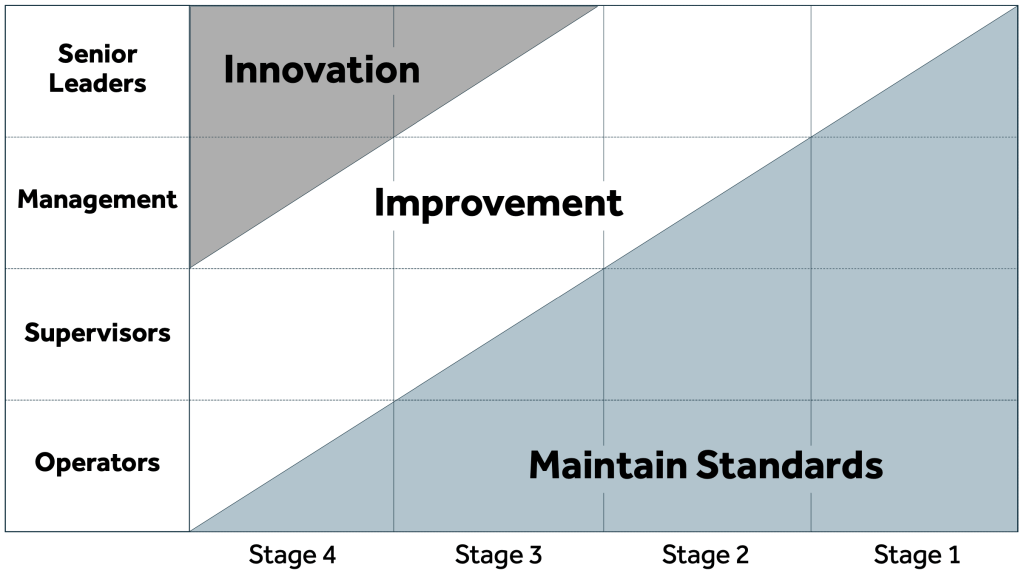
Stage 1 means that you are likely to be highly reactive, most people in the organisation are focussed on fire-fighting just to maintain the standards and only those in senior leadership have any time to make improvements.

In stage 2, your senior leaders are mostly focussed on improvement, the middle managers are involved in some level of improvement on the site, and everyone else just works to maintain the standards

In stage 3, your senior leaders work on improvement and innovation, your middle managers work on improvement, your supervisors are now involved in improvement and the workforce still mostly maintain the standards.

In stage 4, the senior leaders have the time to focus almost solely on innovation, your middle managers do innovation & improvement, your supervisors do improvement and your workforce take part in improvement and maintaining the standards.

How do you move up in maturity?

The process of levelling up the business is the same as levelling up the people and I’d say it’s all about time & focus. If you are constantly firefighting because your machines keep breaking down and you can’t maintain your quality, then what do you think you need to do to give yourself and your people more time to focus on levelling up?

You need to put focus on improving things or fixing them once and for all rather than simply fighting to get things back to how they were. This will free up more and more time to focus on ever more improvement activities leading to a positive loop.

You will need to trust your people and allow them to make decisions in the knowledge they will make mistakes from time to time but that they will also learn and make better decisions next time. You are there to guide them should they need it and you’ll be there to coach them and go easy on them when they make a mistake (which they invariably will).

Start by focussing your attention on the biggest issues in your bottleneck area, not just the one off spikes like the big breakdowns (special cause variation) but the smaller things that affect the day to day (common cause variation) and accept you won’t be able to fix everything all at once.

When you are faced with a problem think:

  • What are the symptoms of this problem?
  • What is the root cause of the problem? (use 5 whys)
  • What is the short term fix? (to get us back up and running)
  • How can we dissolve the issue so it never comes back?

It may seem painful at the start because you will be dealing with firefighting and with some level of improvement but before long, you can

A note on variation:

There are two types of issues that will cause variation in your system, common cause (the little things that happen frequently and cause minor stops) and special cause (the big, one off events that cause big stops).

People tend to focus a lot of their efforts on the special cause events because alone, they are painful and cause a lot of disruption to your process. However, the bigger loss comes from the common cause issues.

Focus on flow:

To achieve flow within a system means that product moves through uninterrupted with minimal move, queue and process time. The slowest process within a system is called the bottleneck. To achieve flow, you must focus on improving the queue, move and process time of the bottleneck.

To improve a process that is upstream of the bottleneck will just increase queue times and to improve the process downstream will just increase wait times for product as the bottleneck will still restrict flow within the system.

You don’t always need numerical data to find the bottleneck within your system; the bottleneck process will have WIP piled up in front of it and the processes downstream will be waiting for work. Which process / department has the most backlog in their work that is holding up the entire system?

I’ve seen places where they got artificial flow by restricting output of the process upstream of the bottleneck. In this factory, the true bottleneck was the finished goods process and the manufacturing process upstream would continuously experience down time as the product buffer had backed up all the way to the outfield of the machines (build up of WIP). Rather than focus efforts on improving the bottleneck process to achieve flow, they restricted the output of the manufacturing process (by turning off machines). This made it look like they had flow but ultimately the output of the factory remained the same.

Find the process that is restricting flow within your system and make that the focus point for your improvement activities.

Bringing it all together:

Below is an example of how we’ve brought all of the above together, to kickstart our improvement journey.

You’ll need to start by finding the bottleneck within your system (If you haven’t already, read article #2 to learn more about how to find it). Once you’ve established where this is, pick a small team to focus on improvement in that area (as a minimum, the person who is responsible for that process and a person who is responsible for maintaining it).

Next you need to decide upon what data you are going to record so you can track your improvement process. Article #2 has some useful information on data and process KPIs.

Next, you need to understand what all of the failures are within the process so you can prioritise which to tackle first. We’ve done this using post-it notes and some brown paper (it’s crude but having something you can visualise makes the whole process easier).

This is what each section does:

  1. Data sheet to show results and targets for your process (updated monthly at a minimum)
  2. The breakdown of your process in to it’s constituent steps
  3. The process, queue and movement time of product through your process
  4. The list of all of the issues at each part of your process – filled in on post-it notes by 100% of those who do the work in that process
  5. The action tracker with your live top 5 projects (identified and prioritised by your team)
    • Start dates of that project (you can’t know for certain when something will be fixed so you put on the start date to help hold you accountable to doing it as quickly as possible)
  6. The projects you’ve completed and the next highest priority projects to work on

The idea is that you keep this in a place where anyone can see it and where your team can add to it. The complexity of the issues you need to resolve will dictate how often you meet with your improvement team to update the actions. When I’ve wanted to spend time coaching the process owner on how to use the board, I meet them every day for 30 mins; as they get more comfortable with the process and with taking action, you can move this to 15 mins per week. The updates need to be short and snappy and must involve every person who has an action on the board.

It is the role of the improvement person to coach the process and that person should take minimal or no actions from the board.

By doing this, you are involving and developing your process owner and will involve 100% of the people who work in that process. This way, everyone has a voice and you are levelling up your process owner to focus on improvement activities rather than the day to day firefighting.

Now that you have this in place, you need to keep your finger on the pulse and your ear to the ground; you must walk the process several times a week so you can give and get feedback from your team as to how improvement efforts are working (or not working) for them. This is their opportunity to hold you, the leader to account on what you said you’d do to help them (and you should tell them that this is the reason for walking the process – and you’d better mean it!)

A final note on “Lean tools”

You can use the “lean tools” to help you make improvements but I have found that is just over-complicates things. Rather than spend time trying to understand how to “deploy” a tool by the book, learn about what the tool is trying to achieve and the reason that the tool exists. Then you will understand a concept that you can use much more efficiently and effectively than the tool.

For example, 5s is one of the go-to tools that people talk about when they think lean / continuous improvement; and nearly everyone gets it wrong! People think that it’s a workplace organisational tool but that almost couldn’t be further from the truth. 5s just means having the right tool in the right place that is ready for use when needed.

If you need to use a specific spanner to make adjustments and you use it multiple times per hour, then it needs to be placed near where it is to be used. As the frequency of use decreases, it can be placed elsewhere, further away from the point of use; otherwise it will clutter your workspace and will take up space for more commonly used things. Deciding on what needs to be closer or further away from the process is simple and can be done very quickly; sometimes in a matter of days.

If you were to take the “lean tool” approach to implementing or “rolling out” 5s, you’d spend a week red tagging, a month with a pile of things in your area, then you’d get rid of all the stuff you haven’t used and would invariably end up throwing out something that you in fact did need. Using the concept of right tool in the right place is way more effective and easier to teach to others than strictly adhering to the 5s tool process and you get better and faster results.

I don’t strictly deploy any tools, I just ask what we can do to resolve and then dissolve the problems and I ask the team what they think would do that. I’d say that 90% of the time, the team who do the work have the answers (or get very close to them).

References:

(1) – Beyond Command and Control – Second Edition, by John Seddon Published 2003

Deming’s 14 Points of Leadership – Article #4

Point #4: Don’t Award Business Based on Price

Price has no meaning without a measure of the quality being purchased” p.32- Out of the Crisis by W.Edwards Demming. MIT Press edition, Published 2000

Why is this important?

There are so many dimensions that can and should be considered when choosing a supplier, price is definitely one of them but by no means should it be the only consideration.

Shall we go car shopping?

A good way to illustrate the importance of considering total cost of ownership rather than initial price is to think about buying a car.

When you buy a car, do you just buy the cheapest one that suits your size and performance requirements? Or do you take other factors in to account like:

  • Reliability of the vehicle
  • Fuel consumption
  • Cost of ongoing maintenance
  • Cost of replacement parts
  • Insurance costs
  • Resale value
  • Depreciation

By doing this, you are taking in to account the cost of ongoing ownership as well as initial price; this gives you a total cost of ownership. In addition to these monetary costs, there are emotional cost to owning an unreliable car. This is in the form of stress, both while you are waiting for it to break and then having to deal with all of the things that go with having a broken down car.

Now let’s choose a supplier:

So if you’d consider total cost and the ongoing “emotional” cost of owning a car, why wouldn’t you do the same thing when choosing a supplier?

What other things are important beyond initial cost?

  • Reliability of delivery
  • Product quality
  • Defect rate
  • Quality of relationship
  • Customer service
  • Their commitment to continuous improvement

All of the above have direct costs and knock-on costs that are also important to consider, for example:

Say you go with supplier A who is 30% cheaper than supplier B. Things go well for a while after they won the tender but then you realise that they have a 15% defect rate.

You might still consider this “good value” as the price per useable unit is still less than supplier B. However, you need to consider the following hidden costs:

  • Cost of down time in your process when the defective parts go through your system
  • Cost and time to inspect the parts on arrival to mitigate the above
  • Cost and time to store and dispose of non-conforming parts
  • Cost of replacement and reputational damage if the defective parts make it to your customer
  • Cost of damage to your equipment by these defective parts and increased maintenance costs

Do you still think that awarding business based on initial price alone is a good strategy for long-term success?

Finally, beware the risk of cost-plus. This is where work is awarded to the cheapest supplier but when a change in specification is required because of something unforeseen the supplier doubles the cost…by now it’s too late, you already have the supplier contract in place and have likely already invested many resources to get to this point. This is one reason why many large infrastructure projects cost so much more than originally expected (Think HS2 & the Sydney Opera House).

How do we end up here?

So what’s at the root of this issue?” – I hear you ask…

The things is, the further away you are from the place where the work actually happens, the less detail you have to go with the numbers that you see on your balance sheet. When looking to reduce costs, those at higher levels of management who see numbers on a spreadsheet will look at the biggest numbers and ask for them to be reduced (usually labour, maintenance and raw material costs).

Once again, you need to consider the knock-on effects to doing this as we’ve discussed above. If you are far removed from the place where the work happens (or you simply don’t care for details) then it’s harder to consider those knock-on effects (see Deming point #2 for more on this change of mindset).

When cutting costs in this way, you rarely get the result you are looking for & often by doing this, your costs will in fact go up.

If you want to reduce your costs, work to improve quality and reduce variation throughout your business rather than setting arbitrary 5% or 10% reduction targets for your raw materials / headcount / maintenance budgets.

I was working at a large food company in Norfolk and the business went out to tender for its cardboard packaging supplier. We got 3x companies to tender for the work and we went with the cheapest one as the quality seemed comparable during the tender process. Lo and behold, no sooner had we awarded the work, the quality of the product dropped, our machines struggled to run it and the level of customer service was very poor. The consequences of this “cost saving exercise” was cheaper cardboard, poorly running machines and disengaged people in the factory. The one who awarded the work was not close to the manufacturing operation and thus didn’t have to deal with the consequences of choosing a cheaper supplier.

What can we do about it?

The best solution to improvement of incoming materials is to make a partner of every vendor and to work together with [them] on a long-term relationship of loyalty and trustp.43- Out of the Crisis by W.Edwards Demming. MIT Press edition, Published 2000

Aim to build long-term relationships:

What sort of things would you want from a supplier that you were going to have a long-term (say 10+ year) relationship with?

Here are some things that come to mind:

  • They frequently ask for feedback on the performance of their product
  • They would come to site when we experience big issues with their product
  • They attend site as a matter of course to do check-ins, even when there aren’t any problems
  • They actively work with us to find solutions to our problems
  • They take the time to truly understand our process and help to optimise it by making their supply fit seamlessly within our process
  • They are constantly working on continuous improvement within their own systems

If you always go with the cheapest supplier each time you re-tender then you will likely be a shorter customer. How is your supplier supposed to invest in their production process to better meet your needs if you are going to be a short-term customer?

Between you and your suppliers, who is likely to know more about the materials they sell? Don’t underestimate the power of building these relationships and offering the work to someone who will be your long-term partner, rather than someone who will sell you the cheapest product. Otherwise you may end up in a situation where the supplier just meets the specification, rather than actually offering you what you want.

We’ve seen this with so many of our customers at Smurfit Westrock, we want to build partnerships with our customers and have on many occasions, enhanced our offering based on what the customer actually needs rather than simply meeting the specification that they sent us. It is part of our operating model, that we do what we can to improve the performance at our customers sites with what we supply so we can grow together.

Have clear specifications:

It is likely that you already have specifications for the material that you can check verify upon delivery however, how many of you have specifications for how the material should perform within your process?

When going out to tender, take your potential suppliers to the place where the work is done and get them to speak to those who do the work so they can get an understanding of what is important to them within the process. You can then make these things part of the product specification and work with the potential suppliers to come up with the best solution. This way of working helps to build understanding between you and your suppliers.

What about continuity of supply?

Down time from lack of raw materials can be very costly to any business so it might seem prudent to have multiple suppliers for the same raw material “just in case”.

As a customer you will likely experience variation between batch numbers of the same product from the same supplier. Although the batches may well all be within specification but they won’t all be exactly the same as each other. If you receive variation from one supplier, imagine how much more variation you’d get from multiple suppliers offering the same product to you?

This is where you need to pick your sole suppliers carefully & be sure to enquire about their built in safeguards to ensure continuity of supply. For example, many larger companies will have multiple machines within the same factory and within a network of production facilities who can manufacture your product should there be an issue at the primary factory. You could also keep stock of your biggest runners just in case. Though stock building ties up cash and is effectively a waste within Lean, very few manufacturers are reliable enough to have just in time manufacturing so holding a small level of stock might be prudent.

Don’t forget to ask about the OTIF (On Time In Full) metrics of your suppliers, both as an average and for their customers of similar size and product portfolio as yours.

Talk to your suppliers about continuous improvement:

When choosing a supplier, make sure to talk to them about their continuous improvement strategy. You’d want your suppliers to be relentless in their pursuit of excellence through continuous improvement so that they become even better suppliers over time.

Deming’s 14 Points of Leadership – Article #3

Point #3: Cease dependence on inspection to achieve quality

Routine 100 per cent inspection to improve quality is equivalent to planing for defects, acknowledgement that the process has not the capability required for the specification” – W.E Deming – Out of the Crisis – Page. 28

Why is this important?

As Deming said, if you have to perform 100% inspection on your products then you are acknowledging that the process isn’t capable of achieving the required product specification.

This leads to the production of defects, some of which may be re-worked in to saleable product while others may just have to be scrapped.

There are huge costs to running your process in this way.

First, you buy and process raw materials in to things that the customer is willing to pay for. If you produce a defect then you will either have spent time and money on making something that will go in the bin and you may only get scrap value for (a tiny fraction of the resources spent on producing) or you’ll have to spend more resources in correcting the defect, thus increasing your production costs per unit. If your inspection is at the end of the process before the product is sent to the customer, you may have spend time processing a part that was defective from the start!

Second you have to employ & train people to perform the inspections. Do the inspectors add value in the eyes of the customer? Are inspections something that the customer would be willing to pay for? Spending time & resources on inspections is non value added and is a direct cost to the business.

Third, there is a morale cost to producing defects. No one comes to work and actively wants to do a bad job and people loathe spending time sorting or re-working defective parts because it feels like a huge waste of time (which it absolutely is). You may ask why they should care what they spend their time on as they are getting paid no matter what but money only fulfils a basic need… having pride in the work that you do contributes towards the need for self-esteem and thus to the overall engagement of the workforce.

Note: There may be certain industries where quality control is critical and must be done on 100% of the parts produced (like the blades in aircraft engines).

How do we end up here?

We can end up in this situation when our process has so much variation that we produce high levels of defects and then we don’t take the time to understand and reduce the variation back to acceptable levels. If your focus is on output rather than quality, you are likely to end up in this situation.

If you do decide to implement high levels of inspection, then do so consciously and only for a limited amount of time while you sort out the true causes of variation.

What can we do about it?

Getting to the root cause of variation can be difficult, time-consuming and has a cost associated with it, but that doesn’t mean you shouldn’t do it. The cost of not doing it is far greater than the cost of doing it so having a focus on producing quality is a must.

Collect some data

In an ideal world, your process would be so robust as to not need any inspection whatsoever, but seeing as many companies aren’t at that stage, most will need some sort of routine inspection in place whereby X number of parts per batch are inspected.

This routine inspection data can be used to plot control charts of your process to determine whether you are drifting out of control.

This data from routine inspections and any feedback you receive from customer complaints help build a picture of what your defects are, which occur most frequently and in which part of your process. It is important to keep track of this data and to use pareto charts to highlight which ones you should focus on tackling first.

Understand the nature of the defect

First, you need to understand what types of defects you are creating and where they are likely to be coming from. If you show the defect to those who do the work, they will likely be able to tell you how it is produced and at the very least they should be able to tell you which part of the process the defect is coming from.

Here are just a few ways defects can be produced:

  • Poor machine maintenance
  • Poor tooling maintenance
  • Badly designed processes
  • Poor training
  • Inadequate raw material quality / standards

Don’t forget to use technology to your advantage! We implemented iPads in our factory in 2025 and gave the operators ways to feedback on quality issues & their causes whereby the relevant people were automatically notified of the defect

Fix the cause of the defect

This can be easier said than done as there can be a multitude of things that influence the process at the point that the defect is produced.

If the defect is caused by poor reliability of your machine, you may need to call in the equipment manufacturer to diagnose and fix the problem (at the very least you’ll get a list of things you can do yourself to get the machine back to a low-variation state).

The tooling is the next thing to consider; if your tools (jigs, dies, print plates etc) are not kept in good condition, these can cause quality defects in your process. You’ll need a robust system of inspection, upkeep and storage in order to maintain their quality.

Poorly designed processes can make it easier for mistakes to be produced. The Japanese practice of Poka Yoke (mistake proofing) is a concept whereby you design your process in such a way that making a mistake is not possible. What if the shape of car fuel tank openings were different shapes and corresponded only to one type of nozzle for petrol or diesel? If one was round and the other was square, you physically couldn’t put the incorrect fuel in your car.

Training is usually done on the job by someone who already works in that process, but just like driving, a person can pick up bad habits over time that make their results more variable and will then pass these on to the trainee. Over time this can erode performance and understanding of the employees and lead to higher variation and poorer quality. We will look at training in point #6 but take a look at TWI (Training Within Industry) in the meantime.

Defects can come from a poor process or training within your own system as described above but they can also come from the supplier of the raw material itself. This is why you need to have KQAs (Key Quality Attributes) on the materials you are receiving, have close partnerships with your suppliers and not award work solely on the basis of price (we’ll explore this last point more in Deming’s point #4). Make sure that your raw materials are fit for purpose and don’t cause unnecessary variation within your own processes.

Note that trying to fix a defect by telling your team to simply “Do better” is the least robust way to ensure that you don’t make the same mistake again. Take some time to really think about the problem, go & see where the defect is produced and ask the team what they think.

Make sure you always ask yourself: What changes need to be made in order to prevent this mistake from ever being produced again?

Some questions to ask yourself:

Here are a few questions to ask yourself to help you think about your quality and your inspection practices:

  • What is the current level of defects picked up during routine inspections?
  • What defects are picked up by customers?
  • Where are most of my defects produced?
  • What are the top 3 defects produced? (by number and also by cost – these may not be the same)
  • What can be done to eliminate the causes of these defects so they never occur again?

Deming’s 14 Points of Leadership – Article #2

Point #2: Adopt a New Philosophy. Western management must awaken to the challenge, must learn their responsibilities, and take on leadership for change.

What is the new philosophy?

The new philosophy refers to a style of management that encompasses respect for people and taking responsibility to work on the system rather than the people to drive change within the organisation.

When we Deming and Seddon talk about improvement and managing change, they are talking about improving every aspect of the business, including (but not limited to):

  • Safety
  • Quality
  • Leadership
  • Sales
  • Customer focus
  • Operations
  • Design
  • Employee engagement
  • Supply chain
  • etc

Until the management teams are ready to challenge the old ways of thinking about people, systems and change, the cycle of the “old philosophy”, where employee engagement and performance are well below where they could be, will continue.

Why is it important?

One simply has to look at the first few months of President Trump’s second term in office to see why adopting this new philosophy is so important. Trump’s administration has been focussed on tariffs to encourage US consumers to buy American-made products by making foreign-made goods more expensive.

Wouldn’t it be better to improve the quality of American-made goods while reducing their price so that they are more competitive on the global market and people actually want to buy them?

This is exactly what Japan did post WWII. Through the teachings of Deming in the 1950s, Japan shifted it’s focus on cheap, low-quality goods, to making high quality goods more cheaply than anywhere else in the world by focussing on improving every aspect of their businesses and supply chains.

Japan is now one of the globally dominant countries for manufacturing.

It is possible for a company to achieve best in class results, even when starting out as the worst in class. But before you can embark on this long journey, you will first need to adopt the new philosophy, just as the Japanese did, and then take actions every day that get you closer and closer to your goals.

Where did the “old philosophy” come from?

Ever heard of this quote by Henry Ford?

Any customer can have a car painted any color that he wants so long as it is black.

Ford didn’t invent the production line, he improved upon existing models of mass production and elevated them to a whole new level. At the time, cars were expensive and Ford wanted to make them affordable and accessible to the masses; his success in achieving this goal was done through standardisation which is where the above quote comes from.

This model of standardisation works well if your customers aren’t bothered about the variety of your offering; in the case of Ford’s Model-T, people just wanted a car and weren’t bothered about it’s colour.

As time passed and customers wanted more variety, the Americans created the “old philosophy” of management to keep costs down and provide variety to customers. This “old philosophy” was centred around controlling as many aspects of their organisations as possible. This intense focus on control, meant that people and the process became cogs in a machine to be controlled and managed. Decisions about how the work should be done was made at high level, far away from where the work was actually done by the people.

What can we do about it?

Making the shift to the new philosophy is no mean feat; it will take time, belief that nothing is ever perfect and that everything can be improved upon (including your own knowledge and understanding).

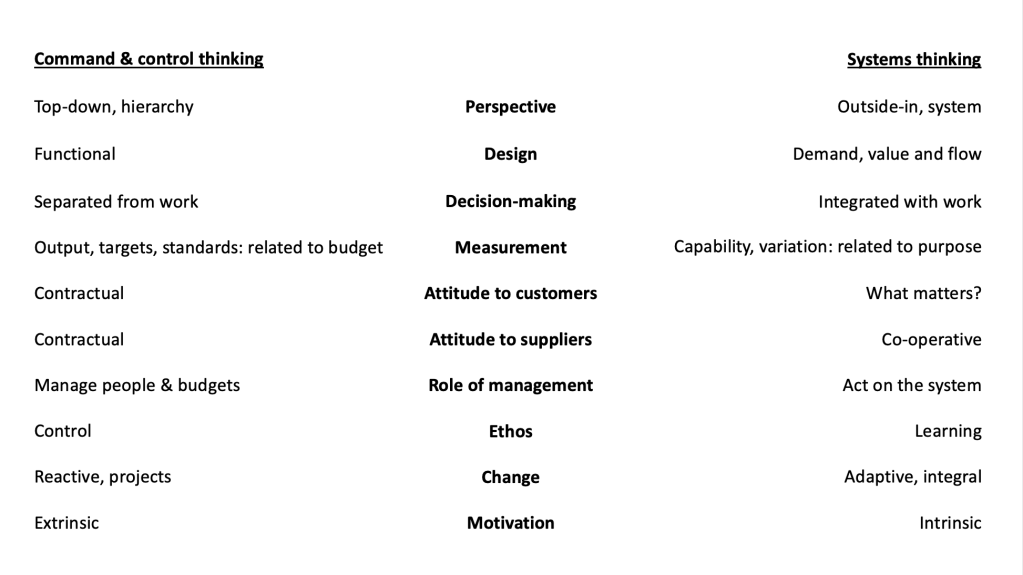
Luckily, this process doesn’t have to start at the top of an organisation; anyone can start adopting the new philosophy within their own teams. Below is a table from John Seddon’s book – Freedom from Command & Control: a better way to make the work work. p.2005 which illustrates the key differences between the old philosophy (command & control thinking), and the new philosophy (systems thinking).

(For more great book recommendations click here.)

If you are serious about improving your understanding of the new philosophy, then Seddon’s book is a must!

I’d like to focus on respect for people and three key areas of systems thinking to elaborate upon in this post to get you started:

  1. Respect for people
  2. Design: Demand, Value & Flow
  3. Decision making: Integrated with work
  4. Role of management: Act on the system

Respect For People:

Respect for people is a core pillar of the new philosophy which emphasises teamwork across departments and levels to solve problems and to realise the potential of the people within the organisation. To do this, you need to hold positive beliefs about people and what they are capable of.

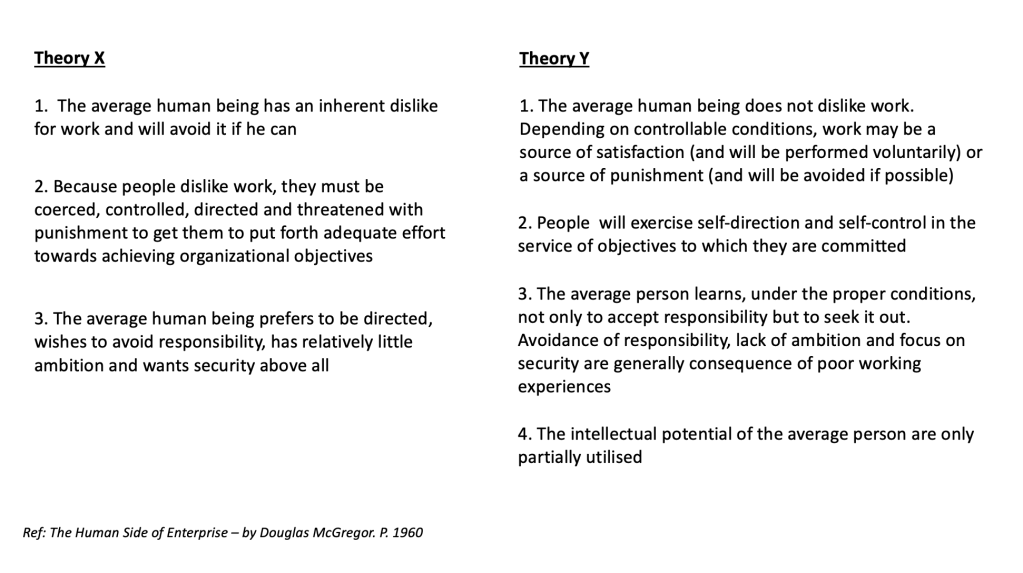
Douglas McGregor talks about Theory X and Theory Y in his book The Human Side of Enterprise p.1960. The table below shows the contrasting views of people between theory X and theory Y:

Which of these statements rings true for you?

I once went for a job interview and was asked how I would “deal with awkward people” because, the operations director said “we have difficult people at our factory”… my response was that in my experience, people aren’t awkward, they are just frustrated and disengaged.

Do you think that operations director would have agreed more with the statements of Theory X than Theory Y…?

You can think of “respect for people” in the context of Maslow’s hierarchy of needs and the people within your organisation may find themselves at different levels along the hierarchy.

What are you going to do, to help more people get out of the lower levels and up towards self-actualisation within your team or your business?

Design: Demand, Value & Flow

Demand: Failure & Arrival

In a system, there are only two types of demand: arrival and failure

Arrival demand is demand placed on your system by your customers; they place an order with you for your goods / services which takes up available capacity in your system.

Failure demand is placed on your system when things well… fail. Think of machine breakdowns, waiting time, poor & time-consuming processes etc. All of these take up valuable capacity in your system that could otherwise be used to service arrival demand.

How do you work out your failure demand & your theoretical capacity?

You don’t need any fancy data collection systems; all you need are two values:

  • How much you are currently producing (your current capacity)?
  • How much can the slowest part of your slowest process produce? (your theoretical capacity)?

What is the value of this failure demand I hear you ask?

We found that failure demand accounted for over 40% of the demand we placed on the despatch area in a factory that I was working in. Imagine if half of that failure demand was turned in to arrival demand… you’d be able to increase your output by 33%!

Value (From the customers perspective):

“There is a systemic relationship between purpose (what we are here to do), measures (how we know how we are doing) and method (how we do it).” – John Seddon – Freedom from Command and Control

If you were a manager in a factory and your purpose was to “make product” then you’d probably measure total output alone. For the manager of a service centre you may think your purpose is to “answer calls and manage agent activity” so you’d measure time taken to answer calls and time taken on each call.

With these as your targets, it is in everyone’s interest to protect themselves by working towards hitting those measures. Factory workers can produce defective material and pass it on to the next process just to hit their output numbers and the customer service agent can answer calls and leave customers on hold and end calls prematurely to make their calls times look low.

Instead, how different would things be if the purpose was to “serve customers”?

In manufacturing, your customers may value quality of product in the quantity they ordered delivered on time. Now what would you measure? Defective units, customer complaints & OTIF (On Time In Full).

In service centres, your customers may value that their problem be sorted quickly. What would you measure now? How long it takes for the problem to be resolved (from their perspective) which is from the time they had the issue to the time they are satisfied that it has been resolved and

These measures are a much better reflection of the value that you bring to your customers and you can start analysing failure from their point of view. This failure analysis allows you to highlight and resolve issues thus directly and positively impacting your customers in a way that they value most.

Flow:

Generally speaking, the system is designed for work to move through multiple different stages of processing before being delivered to the customer. When this is done efficiently and smoothly, you can say that the system is flowing.

Acting on improving flow through the system has a huge impact on overall performance.

Lack of flow can occur if the system is not designed with flow in mind and if you have high amounts of failure demand within your system.

Flow in manufacturing – theory of constraints:

To better understand flow in manufacturing, we need to talk about the theory of constraints (TOC), developed by E.M Goldratt. The TOC focusses on identifying and addressing the biggest limiting factor (constraint) within your system to improve overall performance.

Below is a representation of how work moves through a system with flow.

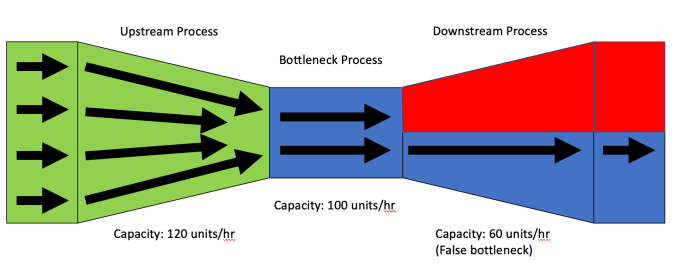
The bottleneck process here is in the middle and has the lowest capacity of the system at 100 units per hour. The processes upstream and downstream of the bottleneck are overcapacity which allows product to always be available for the bottleneck process to use, and there is always room for the product to go once it has been process by the bottleneck. Having your production line set up in this way allows you to “make up time” if either of your upstream or downstream processes experience down time.

Note: A “balanced” system where every process has the same capacity is inherently inefficient because it doesn’t allow you to catch up if your upstream or downstream processes have delays.

The figure above shows the theoretical ideal set up for your system to achieve flow but, “false bottlenecks” can appear if any process which feeds or is fed by the bottleneck has enough failure demand that it becomes the bottleneck.

In the figure below, the downstream process is the bottleneck whereby it has lost half of its capacity to failure demand. Thus the system’s actual output is now only 60 units /hr.

To regain flow through the system, you need identify and eliminate the failure demand in the downstream process.

For a more in-depth look at the theory of constraints, see Eli Goldratt’s book The Goal .1984.

Decision making: Integrated with work

Have you ever been in a team meeting where you’ve heard your boss tell you they’ve made a decision about the work that you do? And upon hearing the decision you and you all collectively roll your eyes because you know it’s not the right decision because they lack understanding of what truly goes on?

Yep, me too.

And so have many many others.

The lesson is, don’t be that type of manager!

Decision making must be integrated with the work that is actually done and should come from a place of understanding of the real work that goes on, rather than being done far away from it.

This means that you must know how the work is done (I mean actually done… not what your SOPs say should be done, but what your people actually do) and this involves spending time with your people at the place where the work is done. There is no substitute for this.

When you spend time with your people, observe what is going on around them, what things don’t work smoothly, what failure demand is being placed on them, what is causing them frustration and interrupting flow.

Now that you have information that directly relates to the work that is being done, you can make decisions that are directly integrated with the work.

Making decisions in this way builds trust and confidence with your team and delivers better value for your customers.

Role of management: Act on the system

Old philosophy management that came from the 60s is one where the role management is to manage people and budgets. This attitude puts focus on people being the main cause of variation in your system and a focus on controlling costs.

Did you know that the system itself is responsible for 90% of the variation in your results & not the people? Would you still think that managing people is the best approach to improving your system if this was the case?

While managing costs can seem like a worthwhile endeavour, you are better off working to improve quality and making it easier for your team to do the work rather than arbitrarily setting cost reduction targets for your departments. If you improve quality and flow through your factory, your costs will come down.

The role of management is to act on the system.

Most people in management positions don’t see the system as their responsibility… but who writes the work standards? Who is responsible for investment decisions? Do the people have total control over what work gets done and how it is to be done, or is their job to do the work in the way that has been prescribed?

Take responsibility as a management team over the system and take steps to act on the system to improve your results rather than managing the people and budgets.

Putting all of this Together:

Here is how we implemented these things collectively to achieve flow in our factory:

The flow through our factory looked like the figure below, with the process downstream of the bottleneck as the “false bottleneck”.

As we learnt above, the thing to do here would be to look at the failure demand in the area and eliminate it to get back to a flowing system.

Before we started looking at the failure demand on this area, the business was looking to spend £100,000s on new machinery to improve capacity (this would have taken at least 18 months to design and install to gain any benefits) which is a trap that many companies fall foul of.

This is what we did instead:

Instead of pursuing the additional machinery, we spent time doing the following:

  • Understand what was a value and non-value added task [Understand value from the customer’s perspective] – time taken: 1 week
  • Work with he people to understand the causes of failure in their process [identify failure demand] – time taken: 4 weeks
  • Ask the people to choose what causes of failure demand should be worked on first [Decision making integrated with the work] – time taken: 1 week
  • Spend time on fixing those things for the people [Management acting on the system] – time taken: 3 months

This whole process from start to finish took about 5 months at a total monetary cost of £10,000. The vast majority of the value we provided and the capacity we unlocked came from time and focus on solving problems and making the most of service contracts that were already in place.

What was the result of our efforts? A decrease in failure demand in the system from 40% to 20%, a much happier workforce, a factory that flowed and no need to install new machinery.

Deming’s 14 Points of Leadership – Article #1

Point #1: Create consistency of purpose toward improvement of product and service with the aim to become competitive and to stay in business, and to provide jobs.

Breaking down Deming’s definition, we pick up on the following key items:

  • You need a purpose for everyone to get behind

Having a clear purpose means that management are thinking not just about the problems of today, but are also focussed on the problems of tomorrow and on long-term future of the organisation. This future focus gives people confidence that the business will continue to exist and that their efforts are less likely to be wasted by the company going under.

  • Continuously improve your product and service

We live in a fast-paced and constantly changing world where the expectations of our customers increase every year. Businesses can not rest on their laurels and rely on today’s product, service and process to deliver long-term value for their customers. Therefore, continuous improvement should be a core area of focus in every department of the business.

  • The overall aim is to stay in business to provide jobs

This is achieved by becoming and remaining competitive. How would you feel if your efforts to drive improvements to product, quality and productivity meant a higher chance of you losing your job? How hard would you work to drive improvement? Thus management need to leave no doubt in the minds of their teams, that no one will lose their jobs for contribution to quality and productivity.

This sentiment about having an eye on the future is the core theme of Simon Sinek’s book The Infinite Game. It is all about playing the game of business not to “win” the next quarter, next year or next 5/10 years but to ensure that you stay in the game for the long-term future (think the next 200 – 500 years).

What is consistency of purpose?

Consistency of purpose means that the work of everyone in your organisation is fully aligned to achieve the same specific goals and objectives. For this, you need to have goals and objectives in the first place.

Why is it important?

It’s important because if you don’t know where you are going, how are you going to plan your route to get there? 

Moreover, if you think of your organisation as a row boat, you can only be successful if everyone is rowing in the same direction and that the direction you are all rowing will get you to where you want to be. 

Having consistency of purpose ensures that you are all working together to get to a common destination.

I’ve worked in 10 businesses and so far only a small minority had clear goals and objectives, that were simple and easy to communicate and that were rolled out to every person within the business.

It was no coincidence that those organisations systematically improved the engagement of their people and improved their service to customers year on year.

Once you have created a clear vision for the future, you then need to ensure that it is cascaded down to everyone in the organisation at a level that is relevant to the work that they do (see Deming’s point #14).

Everyone must be able to directly relate the work they do, back to the overall purpose of the organisation. 

How do you create consistency of purpose?

The leadership team within the organisation set the tone for what needs to be achieved (the objectives)and how to achieve it (the goals). 

For most organisations, you will have a mix of KPIs in Safety, Quality, Customer service, Customer satisfaction, Colleague engagement, Financial return and overall Output (be it in number of services or products delivered); these are the objectives.

Try these exercises at your next off-site meeting with the rest of the senior leadership team to get the ideas flowing:

What are your KPIs and what should their targets be?

Imagine that you are sat having dinner at a fancy restaurant in 5 to 10 years time; you’ve had your best year in business yet and are the best company in your division / market.

What KPIs would you have achieved to hit this level of success?

When you have your list of KPIs and their targets, review them and ask whether hitting these would truly mean that you are the best in your division / market. If you are all satisfied then put them up on the wall so you can all see them.

If you get stuck, take a look at the paragraphs below on The surrounding KPIs and on The 10 year objectives.

Now think about culture:

The KPIs are the “goals” part of your goals and objectives. The objectives part is a group of aspirations and mindsets that will contribute towards hitting your KPIs.

Spend 5 minutes thinking about what sort of things you need to put in place in order for you to hit those aspirational KPIs.

Here are some things to get you going

  • You can’t get to that 10 year plan on your own; how do you need to support everyone in the business to want to and be capable of working with you towards this plan?
  • Growth over time can only be sustained if it’s profitable
  • How developed are you in continuous improvement? Long-term success comes from small & continuous improvements as well as big leaps in innovation.
  • What do you need to do for your customers to make sure they keep coming back to you, and tell others to buy from you as well?
  • Strong leadership throughout the organisation ensures you remain focussed on the 10 year plan even though some members may move on Ensure clarity of vision and strong leadership capabilities

Time for a good old fashioned SWOT analysis:

Now that you know what KPIs you need to achieve and you are clear on some key areas of focus within the business, it’s time for a SWOT analysis.

For this, put the questions below on the wall and give everyone a bunch of post-it notes; take 10 minutes to sit in silence and ask that everyone comes up with things relating to each question.

Perform the SWOT analysis with the 10 year goals in mind & make sure to highlight the following:

  • What are the current strengths of the organisation that already support the 10 year vision?
  • What weaknesses exist that need more development and focus?
  • What are the opportunities on the horizon which you need to take advantage of?
  • What can you see that might threaten (or is threatening) your ability to put your 10 year plan in to action?

Feedback in turn what you have written for the SWOT analysis – note that the most senior leader always gives their opinion last.

Review and write up:

Go back to the start of the exercise and repeat the initial thought exercise.

Look over the work that you’ve done; are you satisfied that by doing all of the things that you’ve written, you’ll become the best in your division / market?

Make tweaks as necessary before wrapping up and sending all of the details out to your team.

Be sure to put some time aside at your next team meeting to go over the work that you’ve just done and ask for any more thoughts on it before settling on this plan.

How to represent your goals and objectives:

The clearest way I’ve seen the goals and objectives laid out in using the house model which is based on the house of Lean:

The house broadly consists of 3 to 4 layers:

1. The foundations – the things that ensure your business continues to exist.

2. The pillars – the things that you will do or the attitudes you aim to develop.

3. The roof – what that growth delivers i.e the reason for the organisation to exist beyond profit. For us, it’s about the benefits both to the current and future employees and customers of the business. 

The Roof:

It may seem counter-intuitive to start building your house from the roof down but there is method to this madness and it is called “Right to Left Thinking”. You start with the end in mind and work backwards to where you are now.

The roof of your “house” should be your reason for existing. What is the “why” of your organisation? If you are a subsidiary of a larger organisation, this could be cascaded down from the parent company or you can create your own.

Think of the roof as your mission statement beyond profit and is fundamental to the identity of the organisation.

Consider the following to help create and shape your “Why”:

  1. What impact do you want to make on the world / community / your stakeholders (including your customers and your people)
  2. What do we want to be known for as an organisation (to your people, the community, your customers)?
  3. Your “Why” statement should help you make the right decisions in tough times
  4. Think of your company as a vehicle to accomplish a purpose – what is that purpose?
  5. Is this something that you’d feel proud aligning all of your efforts towards achieving?
  6. Is this a finite objective or something that you will forever strive for but will never be fully accomplished (note: it’s better that it be the latter)
  7. Think about your ideal company culture, what message would motivate everyone to work hard towards achieving?

Remember that this process is meant to take time and is meant to involve multiple people in the organisation. It might take you several weeks of thinking and observing before you land on something you are truly proud of.

Some examples include:

  • Mars Petcare – “Making a better world for pets”
  • Patagonia – “We’re in the business to save our home planet”
  • Tesla – “To accelerate the world’s transition to sustainable energy”
  • Smurfit Westrock Global- “To be a globally admired business, delivering sustainable and superior returns for all stakeholders

If you are stuck finding your “Why” – pick up Start with Why, Find your Why & The Infinite Game– all by Simon Sinek.

The Ceiling:

You can not achieve your overall goal as an organisation without the help of your people.

Clients do not come first. Employees come first. If you take care of your employees, they will take care of the clients” – Richard Branson

Placing your people at this level of the house is no accident because it shows a clear hierarchy of care: The business takes care of it’s people through support and development who in turn will take care of customers.

The ceiling should contain a statement of your commitment to care for and develop your people.

The Pillars:

Next are the pillars. Think of these as the prevailing attitudes and mindsets that you’d like within your organisation. These should be the things that ensure you continuously grow and adapt to a changing environment so that you can continue to strive for your mission.

Pull out your notes from the “culture exercise” above; these are the things that go in to your pillars as they support the ceiling and roof of your house.

Some examples include:

  • Profitable growth – why grow for the sake of it and be busy fools?
  • Continuous improvement – always strive to get better each day
  • Growing the capability of your leaders – better leaders will take better care of your people
  • Training and empowering employees – the better equipped your people will be to make the right decisions without the need of management which makes you more agile
  • Building a great place to work – happier people are safer, deliver better quality and are more efficient
  • Working as one team – you are all employed in to deliver the product to the customer at the right time and at the right quality in a safe manner and can not do this without the people to your left and to your right

The Foundation:

The foundation of your house, should be the critical few things that ensure you can continue to be in business. Poor financial management is probably the highest on the list but it can include other things like not harming your people. This is because, if you continuously hurt people at work and don’t make any money, you will go out of business.

What elements are key to ensuring you stay in business?

Can you articulate the elements of the foundation of your house in this way: “If we didn’t have [insert foundational elements] we will go out of business”.

These should be fundamental standards that you want to adhere to that support the continuation of the business. These could be safety related, financial, regulatory etc.

The Surrounding KPIs:

Each of the surrounding KPIs need to be specific to your organisation and to what you want to achieve. It’s a good idea to have two sets of the KPIs within your house model; one that remains unchanged as the longer term, 10 year objectives and one that you update yearly for the focus over the next 12 months.

Each yearly goals and objectives becomes a stepping stone towards the 10 year goals and objectives.

Most organisations will have a similar mix of KPIs that cover Safety, Quality, Customer service, Customer satisfaction, Colleague engagement, Return on sales and overall Output (be it in number of services or products delivered).

Once again you need to use right to left thinking here to come up with the 10 year objectives and work backwards to where you are today.

For the 10 year objectives – Why not strive to be world class?

No matter your starting point, if you are diligent you should be able to achieve world class results in 10 years, so why wouldn’t you make that your aim?

Safety: 0 harm in the workplace should be the objective here

Customer service: Best in class organisations hit 99%+

Quality: this will depend on your industry but you should have a stretch target for your DPPM (# of defects per million units produced)

Colleague engagement: Engagement scores at +80% are considered excellent

Customer satisfaction: World class is +9/10

Return on sales: Overall you’d want to make a higher return than if you just invested your money in any high return investment vehicle + a bit extra for it to be worth the hard work and risk involved (somewhere around 15% would be a good benchmark but this will vary by industry).

For the yearly objectives – what would be a meaningful and achievable step in the right direction?

For these, you will likely have to look at where you are tracking now and decide what push targets you’d like to set in the business. Don’t just look for an arbitrary reduction like 5% or 10%… because what if you could actually get 20% better if you tried?

Have a think about what would be a meaningful step in the direction towards your 10 year vision. Note that the KPIs don’t always have to improve year on year (as much as we’d like them to). Sometimes they are good enough to be maintained for now while you focus on improving other, more critical areas of the business.

Finally – display and communicate

The final thing to do with your goals and objectives is to put them up in places where you and others will see them and cascade them down to everyone in the business; this is the first step in getting everyone aligned to the 10 year plan.

Humility builds trust

The Oxford English Dictionary defines Humility as “the quality of having a modest or low view of one’s importance.”; A definition I found surprising as it wasn’t what I thought of at the mention of the word.

For me (and many of the people I asked), humility is the ability to admit when you are wrong, not take yourself too seriously or over-inflate your importance over others.

In my experience, having humility helps to build trust with others whereas a lack of humility, drives people away and is a surefire way to destroy trust.

As with many things, being in a position of leadership inflates the effects of many character traits as what you say and do are more visible and have a higher impact on those around you.

My first days as a line manager

I was on my final placement of the engineering graduate program with Mars in their petcare factory in Melton Mowbray, UK and on September 18th, 2017, after a 5-day handover, I became a line manager for the first time at the age of 24.

I had moved from working on engineering projects to managing a team of 7 maintenance technicians on shift in the factory. It was our job to deal with mechanical and electrical breakdowns and to keep the factory running.

At the time, I wasn’t performing as a project engineer and was fortunate that my boss at the time saw something in me that no one else did; he gave me the opportunity to try something else that might be better aligned with my strengths rather than fire me.

My team consisted of 4 mechanical and 3 electrical maintenance technicians, 6 of whom had children who were older than me, meaning that I was by far the youngest and least experienced on that team.

“you need to be humble…”

I was feeling very nervous in the days leading up to my first shift as a line manager and spent my whole week end thinking about how best to approach my new team.

Luckily for me, this wasn’t the first time I had joined a new team in a factory environment so knew that some people would trust until you gave them reasons not to, some would trust you over time and some probably won’t ever trust you.

Even with the above in mind, the steps I planned to take would be good, no matter the starting trust position of anyone on my team.

Here are the things I came up with when reflecting ahead of starting work on the Monday:

Assumption 1: This guy will think he knows it all

What this means: He will make bad decisions, he won’t listen to what we have to say and won’t respect our experience.

My action plan: Be open on day 1 about the following:

  • I don’t know anything about their jobs
  • I don’t have much experience in leading a team
  • I will need their help for us to be a successful team
  • I will take the time to help them in any way that I can

What this shows: I recognise my current limitations, I am not afraid of asking for help, I want to help and am open to listen and feedback.

Assumption 2: This guy is young and will want to show us who is boss

What this means: He is going to be a real hard ass who won’t like to be told he is wrong

My action plan: Ask clarifying questions when someone tells you that you are wrong so that you learn where your blind spots are and gain more information so next time you can make better decisions. Don’t be unreasonable with people and apply the learnings next time.

What this shows: I am keen to learn, I have no interest in being a dictator, I will listen and improve my decisions for next time.

Assumption 3: This guy doesn’t know the first thing about my job

What this means: He is going to make me do things that don’t make sense and I am just going to have to do what I am told.

My action plan: Be humble at all times. Recognise that you don’t know the first thing about their work but make a commitment to learn from them and then honour that commitment. If you aren’t sure, tell them you aren’t sure and ask them what they think or what they would do. Several brains are better than one and asking their opinions and actively involving them in decisions builds trust.

What this shows: Shows that you aren’t afraid of not knowing what to do and that you are a team player. You also show that you are OK to be told that you are wrong which in turn contributes towards building trust.

Assumption 4: this guy doesn’t know the first thing about reactive maintenance.

What this means: I can easily lie to him and he know know it.

My action plan: Be endlessly curious and use what you learnt at university and in your work so far. Don’t walk away from any situation without fully understanding what has been said, what the implications are and what the underlying facts are. Sense check everything you hear and keep asking questions until you are satisfied you are happy that the information checks out. Make sure that you understand everything to the point where you can explain what you have been told to a layperson.

What this shows: This will show them that they can’t lie to you just so you leave them alone AND you learn a lot in the process which in turn speeds up your development and understanding of the role.

Assumption 5: this guy is young and won’t know how to be be challenged

What this means: all I have to do is puff up my chest and he will back down

My action plan: be ready to have disagreements and stand firm on things that you believe in, no matter how uncomfortable things feel.

What this shows: You won’t be bullied in to compromising on what you believe is right and makes it less likely that they will try it in the future.

Assumption 6: he is young and young people are lazy and never want to get their hands dirty.

What this means: he is going to sit on his ass in a nice climate controlled office and bark orders at us while we work in a hot, humid, smelly factory.

My action plan: Spend as little time in the office as possible and as much time as I can out on jobs with my team. There may be times that we are short on staff from holidays and sickness so make sure I can do various tasks to help the team out. Learn what tasks they hate doing and what tasks can be done by anyone with some light training and learn how to do them yourself.

What this shows: That you want to help, you aren’t afraid of getting your hands dirty and your desire is to support the team rather than focus on your own comfort.

How to avoid some pitfalls

Work on your self awareness and think about how others might perceive you and judge you even before you say or do anything. As humans, we are all wired to make snap judgements of others based on a myriad of inputs (first and second hand experiences, rumours etc) and being conscious of these will help you avoid certain pitfalls.

Think about what your fears are before you join any new team and be careful of how those fears will manifest themselves in the ways you react to situations that arise. The better you can understand these the easier it will be to overcome them.

Sometimes it can be hard to know what our blind spots are or how our fears drive us to act in certain ways. A mentor or a coach can help you uncover your blindspots and fears. I have worked with people who react aggressively out of fear that they won’t be taken seriously but all this does is have the opposite effect; and others who try to minimise mistakes by having a zero tolerance towards them but all this does is create more anxiety and increases the likelihood that mistakes will be made.

Ask yourself (or get someone else to ask you the following questions:

  • What are you most afraid of going in to this role?
  • What situations do you find the most stressful?
  • In these situations, how do you think you would react?
  • What impact could your reactions have on those around you?
  • How would you like to be treat in these situations?
  • Do you think it would be fair to be treat that way?
  • Do you treat others in the same way?
  • Do your actions align with the way you’d like to be treat?

Remember to remain humble and you won’t go far wrong.

Spend more time at the Gemba!

Gemba: Japanese word meaning “the actual place”. For a business, the Gemba is where the work happens to drive the economic engine of the organisation. For a factory, it’s the shop floor and for a sales team it’s on the sales call or the office of those who buy from you.

Seniority vs. improvement

The position you hold in you organisation should determine how much of your time you spend focussing on maintaining or improving standards.

This graphic broadly represents where you should put your focus for each stage of seniority within a company hierarchy.

Take a look at where you are, and think about how much you adhere to this model.

Figure 1: Seniority vs. improvement focus (Graphic taken from Gemba Kaizen by Masaaki Imai)

I believe that the above graphic should be used with this one in mind. Managers at each level need to spend time at each Gemba at the lower levels.

Figure 2: Seniority vs. support

There are a lot more front line employees than there are managers and each level of management should support and guide all levels below them. Ultimately, the culture of the organisation is built through a lot of factors including (but not limited to):

  • The minimum acceptable standard at each level of leadership
  • The self-discipline of employees
  • The standards that are set and how well they are adhered to
  • Attitude of managers at every level

As a leader you are responsible for setting an example for those who work within your area of responsibility. The more senior the manager, the more people fall within their area of responsibility and thus the more accountable they should be for the standards set within their area.

Iceberg of ignorance:

The iceberg or ignorance illustrates the problem that most organisations face when trying to drive improvements.

Figure 3: Iceberg of ignorance – sourced form https://kathleenallen.net/insights/the-iceberg-of-ignorance/

Only a tiny percentage of problems faced by organisations are known to senior level managers because of the over reliance on hard data filtered upwards from performance tracking.

In order for organisations to get the best results and work as per figures 1 & 2, more time needs to be spent at the gemba.

Front line employees:

Maintaining standards for front line employees is critical as they tend to be the ones who have the most contact with the product or the customer and thus have a huge impact on the quality and consistency of the product or service you provide.

The next thing to consider are the safety implications of not maintaining standards. Many front line employees in construction, agriculture or manufacturing, use or are exposed to machinery or work environments which, if not treat correctly, can lead to serious injury or death.

The aim of the front line employees should be to spend 95% to 99% of their working time maintaining current standards. The remainder of their time should be spent working with all of the support functions and managers to highlight areas where improvements in standards are required.

At the level of the front line employees there needs to be focus on addressing all of the small inefficiencies at the gemba that together build up to cause serious performance impact on the whole organisation.

Low level management:

The low level management team are responsible for ensuring the correct standards are in place and that they are followed by the front line employees. This is arguably one of the hardest areas of management unless your organisation truly understands and applies the concepts in Figures 1 & 2.

The Low level managers should open up communication pathways with their teams, outside of the daily performance meetings to highlight minor inefficiencies to them. Once these managers are aware of these issues, they can empower their them (and give them the time) to make improvements themselves on a smaller scale before rolling out the new standard to the rest of the front line workers or garner support from other functions to improve the standards.

My recommendation here would be for the low level managers to purposefully spend time, walking around their gemba, speaking to members of their team to understand what they need further support or help with that will improve conditions and standards.

Middle level management:

The overall vision and purpose of the organisation should come from the top levels and this direction should help prioritise the work that is required at the lower levels. The best organisations not only put focus on the big projects that will help improve performance (Driven mainly from the top) but also on all of the small inefficiencies in the work of the front line employees.

This is where the middle level management come in.

Their focus should be supporting the lower level management and the front line employees to drive improvements based on information they gather from walk arounds, coaching sessions and the system of daily performance meetings common in most organisations.

In my experience, where most companies get it wrong is that they rely solely on the data they get from the daily performance meetings but nothing beats performing walk arounds and speaking to the front line employees to understand directly from them what they need further support with.

My recommendation would be for Low and Mid level managers to perform walk arounds and speak to front line employees at the gemba minimum 3 times a week (outside of the daily performance meetings). Then each manager can put focus on solving one problem for the front line employees, very quickly you will see a huge uplift in engagement and performance often with little to no spend.

Senior level management:

Senior managers set the direction, vision and purpose for the site / organisation. They tend to use top level information delivered through the various performance meetings of the company to make decisions.

Although making decisions in this way can be very efficient, it becomes more likely to miss a lot of the key information and context behind the numbers that will help make the right decision.

Once again nothing beats spending time at the Gemba.

I have seen senior level managers spend millions of dollars on huge projects to improve performance to only see a small shift in the bottom line.

The devil is in the detail as they say and sifting through pure data at a high level only gives you part of the picture. You can get the top level view of where you need to improve by looking at the top level numbers, but the people at the lowest levels are the ones who work to make poorly made decisions and poorly designed systems deliver an saleable output.

The best organisations use hard data from numerous and the data they gather in person at the gemba to make the best decisions on where to spend money AND time to improve performance.

Become the most curious person in the room

The Oxford English Dictionary defines curiosity as: “A strong desire to know or learn something”

If you develop curiosity in your day to day and your work life, your learning speed, ability to deal with ambiguity and your creativity will all increase.

You can develop your curiosity simply by questioning things that you are told, by asking “why?” because context matters. Understanding the context as to why things are done the way that they are is critical to gaining a fuller understanding of a process. You will discover that sometimes accepted norms made sense in times gone by, when the context was different but may not actually make sense in the current context.

Here are a few stories that truly illustrate why curiosity is so important.

How do you thaw your frozen turkey for thanksgiving?

It is November 22nd and Jenny is preparing her first thanksgiving dinner. All of her close friends and relatives will be arriving the following day to enjoy this yearly tradition together. As she wants everything to run smoothly on the 23rd, she makes sure to do as much prep as she can ahead of time. She takes the frozen turkey out of the fridge and puts it in the sink to let it finish thawing overnight. After carefully placing the large semi-frozen bird in the sink, she is careful to remember to put a dish rack over the top.

Her husband walks into the kitchen and sees the turkey in the sink and asks her what the dish rack is for.

She tells him that her mother had always done that when thawing the turkey in the sink.

The following morning, Jenny’s mother arrives early to help with the final dinner preparations for the day and asks her daughter how things are going.

Jenny says, “Fine mum; I have everything ready to go in the oven. I even remembered to put the rack over the turkey last night.” 

Her mother looks back at her, a confused look on her face. “What are you talking about?” she asked.

Jenny replied “You always made sure to put the dish rack over the turkey when it was thawing in the sink so I did the same

Her mother laughs and says “Yes but honey, we had cats!”

So you can see how norms and practices that once made sense within the original context in which they were made, but when removed from that context, make no sense at all. In today’s world, where progress and change are happening at ever increasing speeds, norms formed by the contexts of todays world will soon become irrelevant as well.

This is obviously a light hearted example where the cost of low curiosity has little impact, however there are times where low curiosity can cost people their lives or make someone a Billionaire!

I think you should start washing your hands:

Ignaz Philipp Semmelweis was born in Hungary on July 1st 1818. Semmelweis received his Medical Degree from Vienna in 1844 and became the maternity ward assistant at the local Hospital.

Although at the time many mothers delivered at home, one in 4 of those who had to come to the hospital to deliver due to complications, poverty of illegitimacy lost their lives to a condition known as childbed fever.

He found this mortality rate deeply unsettling as the hospital was the place where people were supposed to come to be healed by doctors trained in the latest medical practices of the time.

The experienced doctors and indeed the chief medical officer at the hospital seemed unperturbed by the high mortality rates of the new mothers because they believed that the disease was unpreventable.

Semmelweis, unsatisfied by what he was being told, took it upon himself to investigate the deaths even after receiving strong objections from the chief medical officer.

He observed a huge difference between the mortality rates of mothers delivered by the doctors versus those delivered by the midwives. He conjectured that the doctors must be doing something differently than the midwives during delivery but he observed broadly the same practices.

During his investigation, he scrutinised everything he could think of in an attempt to explain the difference but none yielded a definitive answer.

It wasn’t until the death of a fellow doctor, who died of what appeared to be childbed fever that he found what he was looking for. The doctor had cut himself on a scalpel he was using to dissect a woman who had died of childbed fever. This lead Semmelweis to realise that it was the doctors themselves who were infecting the patients as they would conduct autopsies in the mornings and then deliver babies in the afternoons, often without washing their hands or changing their clothes.

At the time bacteria were unknown but Semmelweis theorised that the doctors must be carrying invisible particles of decaying organic matter on their hands from the mornings autopsies. He immediately required that anyone coming to examine the women on his ward wash their hands with chlorinated lime before doing so.

This simple solution reduced the mortality rate to under 2% on his ward.

Unfortunately his solution was met with a lot of resistance because it implied that the doctors were themselves killing the patients.

This story highlights the importance of staying curious and using experiments and data to learn more about the current situation in order to derive theories about what might be a better way of doing things.

An experiment born of Curiosity sold for $1.2 Billion

In 1999, Nick Swinmurn was shopping at a San Francisco shopping centre looking for a pair of brown Airwalk Desert Chukka boots. One shop had the right style, but not the right colour, another had the right colour, but not the right size. After spending hours searching for the pair he wanted, Nick went home empty-handed and frustrated.

Nick’s frustration at not being able to easily and efficiently buy the shoes he wanted turned to curiosity as he wondered whether it would be possible to purchase the shoes online (it wasn’t). Realised that there may be an opportunity here to give customers like him what they wanted (to save time and energy finding shoes).

At the time, online shopping was in its infancy and people told him that no one would want to buy shoes on the internet. So Nick set out to test that theory.

He went in to local shoe shops and asked whether he could take photographs of the shoes they had, with the promise that if the shoe sold online, he would return at a later date and purchase the shoes at full price from that shop.

Many of the shop owners agreed and he proceeded to test whether people would indeed like to buy shoes online. Shoesite.com was born and in 2006 was acquired by Amazon.com for $1.2 Billion.

Now that is a huge return on curiosity!

Develop your own curiosity

So curiosity and the desire to not accept the norms of the time are critical to the improvement of any system or practice.

Sometimes you can get the answers that you seek by asking one or several people and sometimes you need to dig deep and perform simple experiments that test assumptions.

My rule of thumb is that before accepting something as being true or a constant, make sure you ask enough questions (and conduct enough tests where required) to learn enough about it so that you not only understand what is done, but also why it is done. Armed with this knowledge, you can then go on to make it better than it was before.

How to run an effective brainstorming session

Brainstorming sessions can be a very powerful tool to gain deeper understanding of problems and finding solutions but only if they are done in the right way.

Many of the brainstorming sessions I have attended follow a similar format:

  • The leader stands up and lays out the agenda and what problems we are going to disucss
  • They tell you they have spent time thinking about it
  • They voice their opinion on what the issue is and what to do about it but want your opinion as well
  • The floor is given to anyone who wants to stand up and raise an issue
  • Those issues raised are usually in line with the opinions of the leader
  • The leader believes there is consensus in the room as to what needs doing
  • Actions are taken based on the leaders original thoughts opinions

There are many issues with this format as it is open to bias in two key areas:

  1. Extrovert bias
    • Extroverts will more readily speak up and share their opinion than introverts
  2. Speaker seniority bias
    • Seniority of those voicing opinions can sway opinions in the room
    • The opinion of the leader can have the biggest sway on opinions in the room

Why is it important to remove bias?

Bias in any data set means that the results (and thus how you interpret those results for decision making) are skewed one way or the other.

This is a challenge when collecting any sort of data and efforts must be made to eliminate or reduce bias as much as possible.

Let’s say you wanted to uncover the most important issues faced by people in your country, but you only asked middle-aged, male, white collar workers in leadership positions within food manufacturing companies, then your results would only reflect the opinions of those individuals (who aren’t likely to have a very diverse view of the world).

The same goes for any team or brainstorming discussion, you have to be aware of how the chosen methods can bias the answers and opinions you get towards a subset of the people.

Extrovert bias:

Generally speaking, those with a preference for extraversion will be more comfortable and are more likely to voice their opinions out loud during a brainstorming session. Conversely, those with a preference for introversion are less likely to speak up during a group discussion.

In any group discussion we can only discuss the points that are raised by those in the room. If those who feel comfortable enough to talk aloud are the only ones to raise discussion points (generally those with a preference for extroversion) then your ideas and discussion points will be biased towards their perspective.

What you then have is a situation where those who raised points felt listened to and like their opinions mattered and those who didn’t feel comfortable raising points out loud

Thus to ensure everyone in the session has a voice, it is important to run the session in a way that isn’t biassed towards those who talk the most or the loudest.

Seniority level of any speaker:

Hierarchy plays a significant role in what elements are discussed and ultimately the direction which is taken by the team during a brainstorming session. If the leader voices their opinion before everyone else, then you will generally get consensus around that opinion. This may seem on the surface like everyone is on the same page but in actual fact you won’t be addressing any of the blindspots of the leader.

As much as many businesses say that they don’t have a hierarchical structure, the structure still exists and where you sit on that hierarchy drastically affects how you perceive it. It is easy for the CEO, who has the most control over their time and what others do to believe that there is a flat hierarchical structure, but do you think that the least senior person feels the same way?

Often we believe that there is a good reason why someone was promoted to a leadership position, that they know things and see things that we don’t; so if they haven’t talked about a specific point, it is probably because they thought about it and disregarded it because they know more than we do. So what do we do? We say nothing and miss out on an opportunity to learn and an opportunity to come at the problem from a wider perspective.

It took me a while to learn this but now I will ALWAYS ask the “stupid question”, the thing that seems obvious to me because either way I will learn.

  1. If my question is very basic and has already been considered, then I can learn more about why it was disregarded.
  2. If my question was a good one, generally others may have been thinking of it but weren’t comfortable in raising it (for all of the reasons discussed above).

So in any team brainstorming session, it is important to remove the effects of seniority bias.

How to conduct a great brainstorming session:

To recap, we need to run our brainstorming session so that everyone has a voice, feels comfortable to contribute and that eliminates bias from the senior members in the room.

Step 1: Give everyone 5 post-it notes

Step 2: Take 5 to 10 minutes of quiet contemplation for everyone to write one thing on each of their post-it notes

Step 3: Ask one person to read what they have put on one of their post-it notes and then ask them to stick it on the wall (If they aren’t comfortable talking aloud then they can give one post-it note to someone else to read aloud)

Step 4: Everyone who has the same post-it note, gets up and sticks their’s to the original one

Step 5: Move on to the next person and repeat steps 3 & 4 until there are no post-it notes left

Step 6: Senior team members can now stick their post-it notes to those on the wall (they go last to minimise influence on others in the room)

Step 7: Count how many post-its are in each cluster and write this number on a flip chart

It will now be clear to see which are the top issues that most people face and can easily pick the top 3 to put more focus behind.

The next stage depends on the complexity of the things you are facing but one good way forward would be to have small cross-functional teams use a PDCA to solve each of the top problems highlighted by the team.

Situational Leadership

As a team member and a line manager it is important to understand situational leadership as it forms a common language that you can both use to very quickly understand where you are and what you need from each other.

For the team member, it means that you are better able to communicate what your level of proficiency is in carrying out a task and are thus better able to communicate to your line manager what you need.

For the line manager it means being able to offer the right level of support for your direct reports.

Where did situational leadership come from?

Situational Leadership was developed by leadership experts Paul Hersey and Ken Blanchard and was (put to the audience) in their 1969 best-selling book, “Management of Organizational Behaviour: Utilizing Human Resources”.

It was one of the first models I learnt when I became a line manager.

The situational leadership model:

The image below shows the following things at once:

The development levels of the direct report (D1 to D4) and the corresponding leadership styles (S1 to S4) that are best suited to each of those development levels.

This is how it works:

D1: The direct report is new to the task and thus (generally) has high enthusiasm (High commitment) but low knowledge (Low competence) on how to conduct the task. They are excited to start something new but don’t know what they don’t know.

S1: To get the best out of your direct report, you will need to be highly directive; that is very prescriptive in the process steps that they need to take to begin the task (High direction) but you won’t need to give them lots of energy to get going (Low support).

D2: Now the direct report has begun the task, they realise that it’s perhaps harder than they had originally anticipated and they now understand just how much there is to learn / do in order to become proficient at this task. As a result their energy drops (Low commitment) and they also still don’t really know how to perform the task (Low / Some competence).

S2: The leader now needs to encourage the direct report more (High support) while still being very descriptive about the tasks that need doing in order to complete the task (High direction).

D3: The direct report now has some knowledge on how to complete the taks, they have grasped more than just the basics. They will now have some idea on how to conduct the task (Moderate to high competence) but their level of confidence in themselves will waiver; sometimes they will have good confidence, but other times this may dip (Variable commitment).

S3: Here the leader won’t necessarily have to give the direct report much in the way of direction (Low direction) but as a result of their wavering levels of confidence, they will need more energy and encouragement from the line manager (High support).

D4: The direct report has done the task and many other like it before, they know what they are doing (High competence) and they are confident in their abilities to get it done to a high standard (High commitment).

S4: The leader now adopts a Low support & Low direction approach, and can now just delegate the tasks to the direct report knowing that they won’t need much from them and the job will be done to a high standard.

The Dunning-Kruger Effect:

The Dunning-Kruger effect shows how a persons confidence and competence vary over time when faced with a new task.

The D-K effect can broadly be split in to four stages:

Stage 1: High confidence, Low competence

Stage 2: Low confidence, Low competence

Stage 3: Moderate confidence, Moderate competence

Stage 4: High confidence, High competence

You may remember that these stages perfectly match the stages in the situational leadership model (D1 to D4).

This is what the D-K effect looks like once we overlay the development stages from the situational leadership model:

This combined model of the D-K effect and situational leadership shows just how someone goes through the various stages of D1 to D4 and broadly shows how long each stage lasts relative to the others.

It is important to remember that the direct report may start back at a D1 level if the task they are performing is different in some way to ones they have done in the past. Think of an experienced football coach for early years now coaching individuals in their late teens. The task (coach kids football) is basically the same but the difference will be in the needs of the kids and thus it is technically a totally different task. As such they may still go through all of the development levels from D1 to D4 but the process may be sped up as they can draw on previous experience.

Image sourced from: https://situationalandcontingencyleadership.weebly.com/situational-leadership-theory.html on 30th Nov 2023.