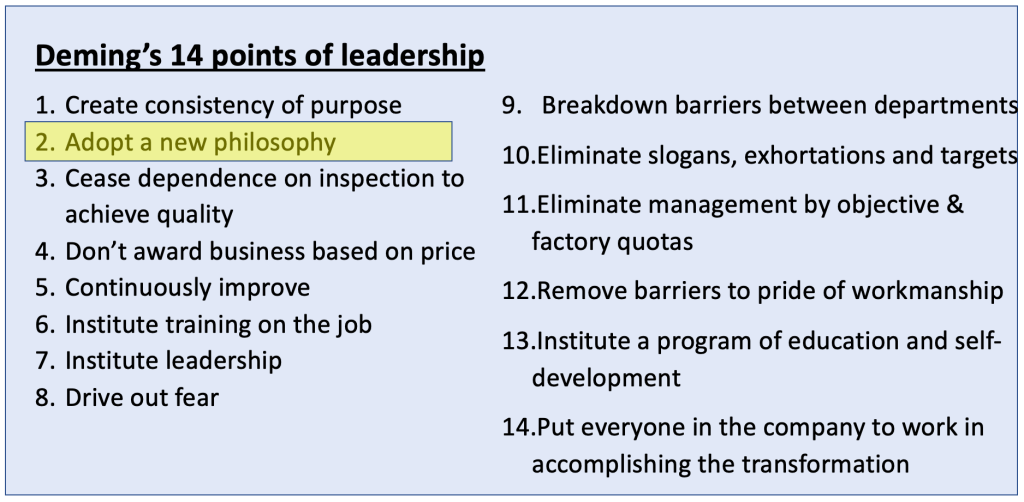
Point #2: Adopt a New Philosophy. Western management must awaken to the challenge, must learn their responsibilities, and take on leadership for change.
What is the new philosophy?
The new philosophy refers to a style of management that encompasses respect for people and taking responsibility to work on the system rather than the people to drive change within the organisation.
When we Deming and Seddon talk about improvement and managing change, they are talking about improving every aspect of the business, including (but not limited to):
- Safety
- Quality
- Leadership
- Sales
- Customer focus
- Operations
- Design
- Employee engagement
- Supply chain
- etc
Until the management teams are ready to challenge the old ways of thinking about people, systems and change, the cycle of the “old philosophy”, where employee engagement and performance are well below where they could be, will continue.
Why is it important?
One simply has to look at the first few months of President Trump’s second term in office to see why adopting this new philosophy is so important. Trump’s administration has been focussed on tariffs to encourage US consumers to buy American-made products by making foreign-made goods more expensive.
Wouldn’t it be better to improve the quality of American-made goods while reducing their price so that they are more competitive on the global market and people actually want to buy them?
This is exactly what Japan did post WWII. Through the teachings of Deming in the 1950s, Japan shifted it’s focus on cheap, low-quality goods, to making high quality goods more cheaply than anywhere else in the world by focussing on improving every aspect of their businesses and supply chains.
Japan is now one of the globally dominant countries for manufacturing.
It is possible for a company to achieve best in class results, even when starting out as the worst in class. But before you can embark on this long journey, you will first need to adopt the new philosophy, just as the Japanese did, and then take actions every day that get you closer and closer to your goals.
Where did the “old philosophy” come from?
Ever heard of this quote by Henry Ford?
“Any customer can have a car painted any color that he wants so long as it is black.“
Ford didn’t invent the production line, he improved upon existing models of mass production and elevated them to a whole new level. At the time, cars were expensive and Ford wanted to make them affordable and accessible to the masses; his success in achieving this goal was done through standardisation which is where the above quote comes from.
This model of standardisation works well if your customers aren’t bothered about the variety of your offering; in the case of Ford’s Model-T, people just wanted a car and weren’t bothered about it’s colour.
As time passed and customers wanted more variety, the Americans created the “old philosophy” of management to keep costs down and provide variety to customers. This “old philosophy” was centred around controlling as many aspects of their organisations as possible. This intense focus on control, meant that people and the process became cogs in a machine to be controlled and managed. Decisions about how the work should be done was made at high level, far away from where the work was actually done by the people.
What can we do about it?
Making the shift to the new philosophy is no mean feat; it will take time, belief that nothing is ever perfect and that everything can be improved upon (including your own knowledge and understanding).
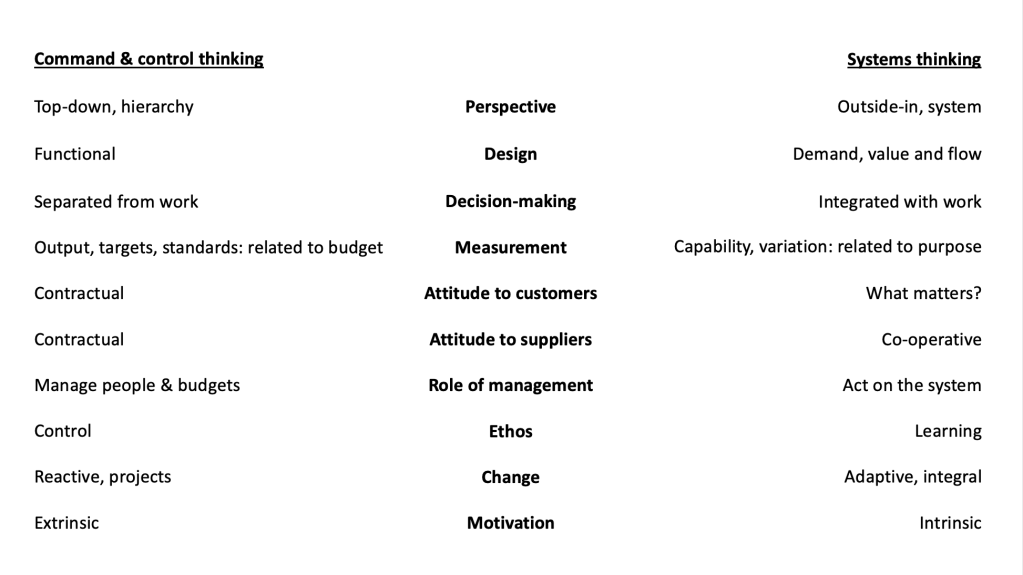
Luckily, this process doesn’t have to start at the top of an organisation; anyone can start adopting the new philosophy within their own teams. Below is a table from John Seddon’s book – Freedom from Command & Control: a better way to make the work work. p.2005 which illustrates the key differences between the old philosophy (command & control thinking), and the new philosophy (systems thinking).
(For more great book recommendations click here.)
If you are serious about improving your understanding of the new philosophy, then Seddon’s book is a must!
I’d like to focus on respect for people and three key areas of systems thinking to elaborate upon in this post to get you started:
- Respect for people
- Design: Demand, Value & Flow
- Decision making: Integrated with work
- Role of management: Act on the system
Respect For People:
Respect for people is a core pillar of the new philosophy which emphasises teamwork across departments and levels to solve problems and to realise the potential of the people within the organisation. To do this, you need to hold positive beliefs about people and what they are capable of.
Douglas McGregor talks about Theory X and Theory Y in his book The Human Side of Enterprise p.1960. The table below shows the contrasting views of people between theory X and theory Y:
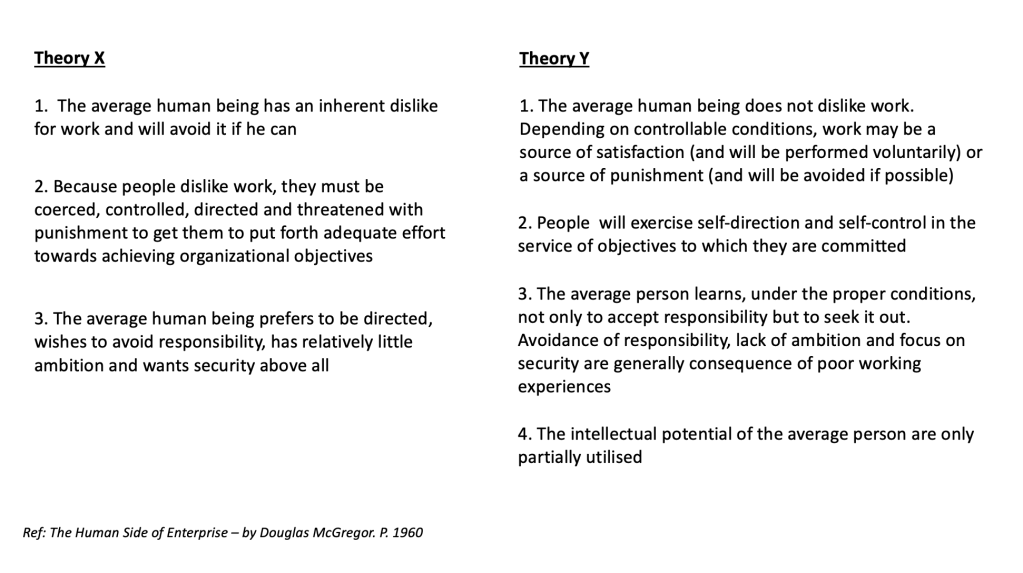
Which of these statements rings true for you?
I once went for a job interview and was asked how I would “deal with awkward people” because, the operations director said “we have difficult people at our factory”… my response was that in my experience, people aren’t awkward, they are just frustrated and disengaged.
Do you think that operations director would have agreed more with the statements of Theory X than Theory Y…?
You can think of “respect for people” in the context of Maslow’s hierarchy of needs and the people within your organisation may find themselves at different levels along the hierarchy.
What are you going to do, to help more people get out of the lower levels and up towards self-actualisation within your team or your business?

Design: Demand, Value & Flow
Demand: Failure & Arrival
In a system, there are only two types of demand: arrival and failure
Arrival demand is demand placed on your system by your customers; they place an order with you for your goods / services which takes up available capacity in your system.
Failure demand is placed on your system when things well… fail. Think of machine breakdowns, waiting time, poor & time-consuming processes etc. All of these take up valuable capacity in your system that could otherwise be used to service arrival demand.
How do you work out your failure demand & your theoretical capacity?
You don’t need any fancy data collection systems; all you need are two values:
- How much you are currently producing (your current capacity)?
- How much can the slowest part of your slowest process produce? (your theoretical capacity)?
What is the value of this failure demand I hear you ask?
We found that failure demand accounted for over 40% of the demand we placed on the despatch area in a factory that I was working in. Imagine if half of that failure demand was turned in to arrival demand… you’d be able to increase your output by 33%!
Value (From the customers perspective):
“There is a systemic relationship between purpose (what we are here to do), measures (how we know how we are doing) and method (how we do it).” – John Seddon – Freedom from Command and Control
If you were a manager in a factory and your purpose was to “make product” then you’d probably measure total output alone. For the manager of a service centre you may think your purpose is to “answer calls and manage agent activity” so you’d measure time taken to answer calls and time taken on each call.
With these as your targets, it is in everyone’s interest to protect themselves by working towards hitting those measures. Factory workers can produce defective material and pass it on to the next process just to hit their output numbers and the customer service agent can answer calls and leave customers on hold and end calls prematurely to make their calls times look low.
Instead, how different would things be if the purpose was to “serve customers”?
In manufacturing, your customers may value quality of product in the quantity they ordered delivered on time. Now what would you measure? Defective units, customer complaints & OTIF (On Time In Full).
In service centres, your customers may value that their problem be sorted quickly. What would you measure now? How long it takes for the problem to be resolved (from their perspective) which is from the time they had the issue to the time they are satisfied that it has been resolved and
These measures are a much better reflection of the value that you bring to your customers and you can start analysing failure from their point of view. This failure analysis allows you to highlight and resolve issues thus directly and positively impacting your customers in a way that they value most.
Flow:
Generally speaking, the system is designed for work to move through multiple different stages of processing before being delivered to the customer. When this is done efficiently and smoothly, you can say that the system is flowing.
Acting on improving flow through the system has a huge impact on overall performance.
Lack of flow can occur if the system is not designed with flow in mind and if you have high amounts of failure demand within your system.
Flow in manufacturing – theory of constraints:
To better understand flow in manufacturing, we need to talk about the theory of constraints (TOC), developed by E.M Goldratt. The TOC focusses on identifying and addressing the biggest limiting factor (constraint) within your system to improve overall performance.
Below is a representation of how work moves through a system with flow.
The bottleneck process here is in the middle and has the lowest capacity of the system at 100 units per hour. The processes upstream and downstream of the bottleneck are overcapacity which allows product to always be available for the bottleneck process to use, and there is always room for the product to go once it has been process by the bottleneck. Having your production line set up in this way allows you to “make up time” if either of your upstream or downstream processes experience down time.

Note: A “balanced” system where every process has the same capacity is inherently inefficient because it doesn’t allow you to catch up if your upstream or downstream processes have delays.
The figure above shows the theoretical ideal set up for your system to achieve flow but, “false bottlenecks” can appear if any process which feeds or is fed by the bottleneck has enough failure demand that it becomes the bottleneck.
In the figure below, the downstream process is the bottleneck whereby it has lost half of its capacity to failure demand. Thus the system’s actual output is now only 60 units /hr.
To regain flow through the system, you need identify and eliminate the failure demand in the downstream process.

For a more in-depth look at the theory of constraints, see Eli Goldratt’s book The Goal .1984.
Decision making: Integrated with work
Have you ever been in a team meeting where you’ve heard your boss tell you they’ve made a decision about the work that you do? And upon hearing the decision you and you all collectively roll your eyes because you know it’s not the right decision because they lack understanding of what truly goes on?
Yep, me too.
And so have many many others.
The lesson is, don’t be that type of manager!
Decision making must be integrated with the work that is actually done and should come from a place of understanding of the real work that goes on, rather than being done far away from it.
This means that you must know how the work is done (I mean actually done… not what your SOPs say should be done, but what your people actually do) and this involves spending time with your people at the place where the work is done. There is no substitute for this.
When you spend time with your people, observe what is going on around them, what things don’t work smoothly, what failure demand is being placed on them, what is causing them frustration and interrupting flow.
Now that you have information that directly relates to the work that is being done, you can make decisions that are directly integrated with the work.
Making decisions in this way builds trust and confidence with your team and delivers better value for your customers.
Role of management: Act on the system
Old philosophy management that came from the 60s is one where the role management is to manage people and budgets. This attitude puts focus on people being the main cause of variation in your system and a focus on controlling costs.
Did you know that the system itself is responsible for 90% of the variation in your results & not the people? Would you still think that managing people is the best approach to improving your system if this was the case?
While managing costs can seem like a worthwhile endeavour, you are better off working to improve quality and making it easier for your team to do the work rather than arbitrarily setting cost reduction targets for your departments. If you improve quality and flow through your factory, your costs will come down.
The role of management is to act on the system.
Most people in management positions don’t see the system as their responsibility… but who writes the work standards? Who is responsible for investment decisions? Do the people have total control over what work gets done and how it is to be done, or is their job to do the work in the way that has been prescribed?
Take responsibility as a management team over the system and take steps to act on the system to improve your results rather than managing the people and budgets.
Putting all of this Together:
Here is how we implemented these things collectively to achieve flow in our factory:
The flow through our factory looked like the figure below, with the process downstream of the bottleneck as the “false bottleneck”.
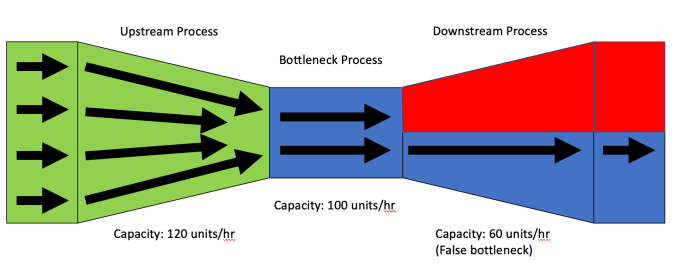
As we learnt above, the thing to do here would be to look at the failure demand in the area and eliminate it to get back to a flowing system.
Before we started looking at the failure demand on this area, the business was looking to spend £100,000s on new machinery to improve capacity (this would have taken at least 18 months to design and install to gain any benefits) which is a trap that many companies fall foul of.
This is what we did instead:
Instead of pursuing the additional machinery, we spent time doing the following:
- Understand what was a value and non-value added task [Understand value from the customer’s perspective] – time taken: 1 week
- Work with he people to understand the causes of failure in their process [identify failure demand] – time taken: 4 weeks
- Ask the people to choose what causes of failure demand should be worked on first [Decision making integrated with the work] – time taken: 1 week
- Spend time on fixing those things for the people [Management acting on the system] – time taken: 3 months
This whole process from start to finish took about 5 months at a total monetary cost of £10,000. The vast majority of the value we provided and the capacity we unlocked came from time and focus on solving problems and making the most of service contracts that were already in place.
What was the result of our efforts? A decrease in failure demand in the system from 40% to 20%, a much happier workforce, a factory that flowed and no need to install new machinery.
 Alex Devereux
Pingback: Deming’s 14 Points of Leadership – Article #4 | Alex Devereux
Pingback: Deming’s 14 Points of Leadership – Article #5 | Alex Devereux