Gemba: Japanese word meaning “the actual place”. For a business, the Gemba is where the work happens to drive the economic engine of the organisation. For a factory, it’s the shop floor and for a sales team it’s on the sales call or the office of those who buy from you.
Seniority vs. improvement
The position you hold in you organisation should determine how much of your time you spend focussing on maintaining or improving standards.
This graphic broadly represents where you should put your focus for each stage of seniority within a company hierarchy.
Take a look at where you are, and think about how much you adhere to this model.

Figure 1: Seniority vs. improvement focus (Graphic taken from Gemba Kaizen by Masaaki Imai)
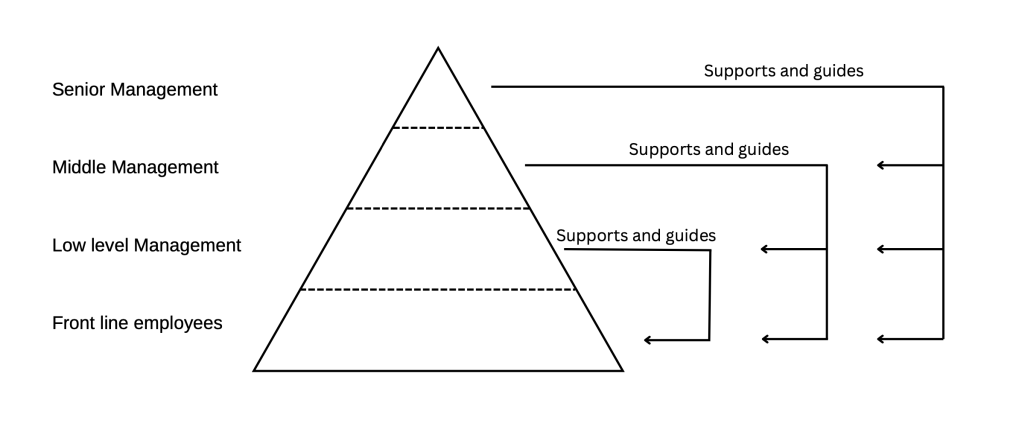
I believe that the above graphic should be used with this one in mind. Managers at each level need to spend time at each Gemba at the lower levels.
Figure 2: Seniority vs. support
There are a lot more front line employees than there are managers and each level of management should support and guide all levels below them. Ultimately, the culture of the organisation is built through a lot of factors including (but not limited to):
- The minimum acceptable standard at each level of leadership
- The self-discipline of employees
- The standards that are set and how well they are adhered to
- Attitude of managers at every level
As a leader you are responsible for setting an example for those who work within your area of responsibility. The more senior the manager, the more people fall within their area of responsibility and thus the more accountable they should be for the standards set within their area.
Iceberg of ignorance:
The iceberg or ignorance illustrates the problem that most organisations face when trying to drive improvements.

Figure 3: Iceberg of ignorance – sourced form https://kathleenallen.net/insights/the-iceberg-of-ignorance/
Only a tiny percentage of problems faced by organisations are known to senior level managers because of the over reliance on hard data filtered upwards from performance tracking.
In order for organisations to get the best results and work as per figures 1 & 2, more time needs to be spent at the gemba.
Front line employees:
Maintaining standards for front line employees is critical as they tend to be the ones who have the most contact with the product or the customer and thus have a huge impact on the quality and consistency of the product or service you provide.
The next thing to consider are the safety implications of not maintaining standards. Many front line employees in construction, agriculture or manufacturing, use or are exposed to machinery or work environments which, if not treat correctly, can lead to serious injury or death.
The aim of the front line employees should be to spend 95% to 99% of their working time maintaining current standards. The remainder of their time should be spent working with all of the support functions and managers to highlight areas where improvements in standards are required.
At the level of the front line employees there needs to be focus on addressing all of the small inefficiencies at the gemba that together build up to cause serious performance impact on the whole organisation.
Low level management:
The low level management team are responsible for ensuring the correct standards are in place and that they are followed by the front line employees. This is arguably one of the hardest areas of management unless your organisation truly understands and applies the concepts in Figures 1 & 2.
The Low level managers should open up communication pathways with their teams, outside of the daily performance meetings to highlight minor inefficiencies to them. Once these managers are aware of these issues, they can empower their them (and give them the time) to make improvements themselves on a smaller scale before rolling out the new standard to the rest of the front line workers or garner support from other functions to improve the standards.
My recommendation here would be for the low level managers to purposefully spend time, walking around their gemba, speaking to members of their team to understand what they need further support or help with that will improve conditions and standards.
Middle level management:
The overall vision and purpose of the organisation should come from the top levels and this direction should help prioritise the work that is required at the lower levels. The best organisations not only put focus on the big projects that will help improve performance (Driven mainly from the top) but also on all of the small inefficiencies in the work of the front line employees.
This is where the middle level management come in.
Their focus should be supporting the lower level management and the front line employees to drive improvements based on information they gather from walk arounds, coaching sessions and the system of daily performance meetings common in most organisations.
In my experience, where most companies get it wrong is that they rely solely on the data they get from the daily performance meetings but nothing beats performing walk arounds and speaking to the front line employees to understand directly from them what they need further support with.
My recommendation would be for Low and Mid level managers to perform walk arounds and speak to front line employees at the gemba minimum 3 times a week (outside of the daily performance meetings). Then each manager can put focus on solving one problem for the front line employees, very quickly you will see a huge uplift in engagement and performance often with little to no spend.
Senior level management:
Senior managers set the direction, vision and purpose for the site / organisation. They tend to use top level information delivered through the various performance meetings of the company to make decisions.
Although making decisions in this way can be very efficient, it becomes more likely to miss a lot of the key information and context behind the numbers that will help make the right decision.
Once again nothing beats spending time at the Gemba.
I have seen senior level managers spend millions of dollars on huge projects to improve performance to only see a small shift in the bottom line.
The devil is in the detail as they say and sifting through pure data at a high level only gives you part of the picture. You can get the top level view of where you need to improve by looking at the top level numbers, but the people at the lowest levels are the ones who work to make poorly made decisions and poorly designed systems deliver an saleable output.
The best organisations use hard data from numerous and the data they gather in person at the gemba to make the best decisions on where to spend money AND time to improve performance.
 Alex Devereux