As a team member and a line manager it is important to understand situational leadership as it forms a common language that you can both use to very quickly understand where you are and what you need from each other.
For the team member, it means that you are better able to communicate what your level of proficiency is in carrying out a task and are thus better able to communicate to your line manager what you need.
For the line manager it means being able to offer the right level of support for your direct reports.
Where did situational leadership come from?
Situational Leadership was developed by leadership experts Paul Hersey and Ken Blanchard and was (put to the audience) in their 1969 best-selling book, “Management of Organizational Behaviour: Utilizing Human Resources”.
It was one of the first models I learnt when I became a line manager.
The situational leadership model:
The image below shows the following things at once:
The development levels of the direct report (D1 to D4) and the corresponding leadership styles (S1 to S4) that are best suited to each of those development levels.
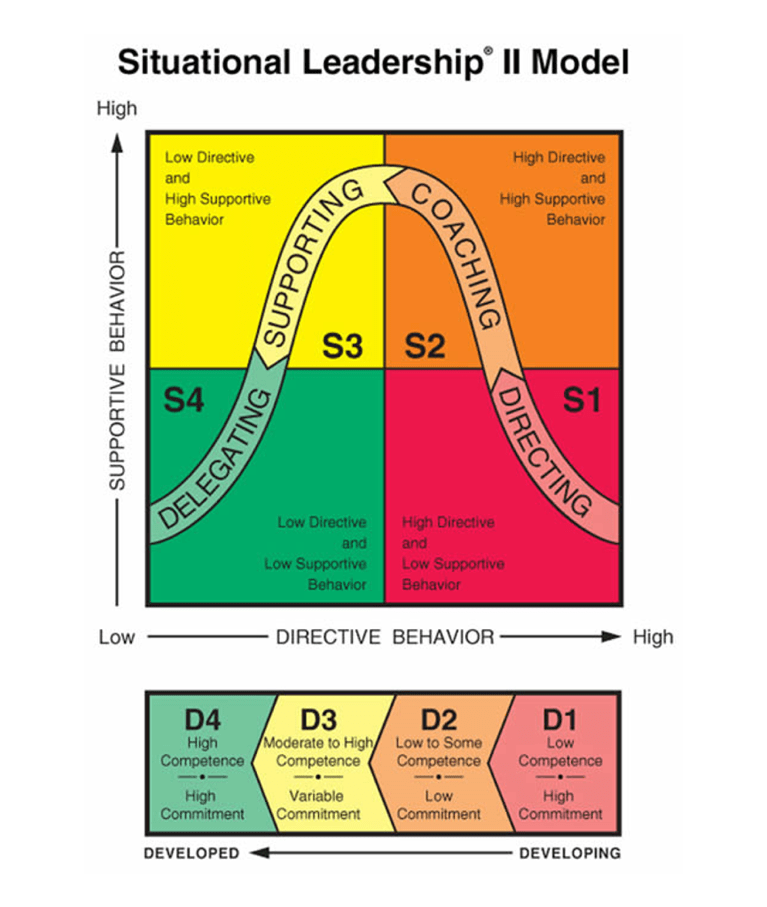
This is how it works:
D1: The direct report is new to the task and thus (generally) has high enthusiasm (High commitment) but low knowledge (Low competence) on how to conduct the task. They are excited to start something new but don’t know what they don’t know.
S1: To get the best out of your direct report, you will need to be highly directive; that is very prescriptive in the process steps that they need to take to begin the task (High direction) but you won’t need to give them lots of energy to get going (Low support).
D2: Now the direct report has begun the task, they realise that it’s perhaps harder than they had originally anticipated and they now understand just how much there is to learn / do in order to become proficient at this task. As a result their energy drops (Low commitment) and they also still don’t really know how to perform the task (Low / Some competence).
S2: The leader now needs to encourage the direct report more (High support) while still being very descriptive about the tasks that need doing in order to complete the task (High direction).
D3: The direct report now has some knowledge on how to complete the taks, they have grasped more than just the basics. They will now have some idea on how to conduct the task (Moderate to high competence) but their level of confidence in themselves will waiver; sometimes they will have good confidence, but other times this may dip (Variable commitment).
S3: Here the leader won’t necessarily have to give the direct report much in the way of direction (Low direction) but as a result of their wavering levels of confidence, they will need more energy and encouragement from the line manager (High support).
D4: The direct report has done the task and many other like it before, they know what they are doing (High competence) and they are confident in their abilities to get it done to a high standard (High commitment).
S4: The leader now adopts a Low support & Low direction approach, and can now just delegate the tasks to the direct report knowing that they won’t need much from them and the job will be done to a high standard.
The Dunning-Kruger Effect:
The Dunning-Kruger effect shows how a persons confidence and competence vary over time when faced with a new task.

The D-K effect can broadly be split in to four stages:
Stage 1: High confidence, Low competence
Stage 2: Low confidence, Low competence
Stage 3: Moderate confidence, Moderate competence
Stage 4: High confidence, High competence
You may remember that these stages perfectly match the stages in the situational leadership model (D1 to D4).
This is what the D-K effect looks like once we overlay the development stages from the situational leadership model:
This combined model of the D-K effect and situational leadership shows just how someone goes through the various stages of D1 to D4 and broadly shows how long each stage lasts relative to the others.
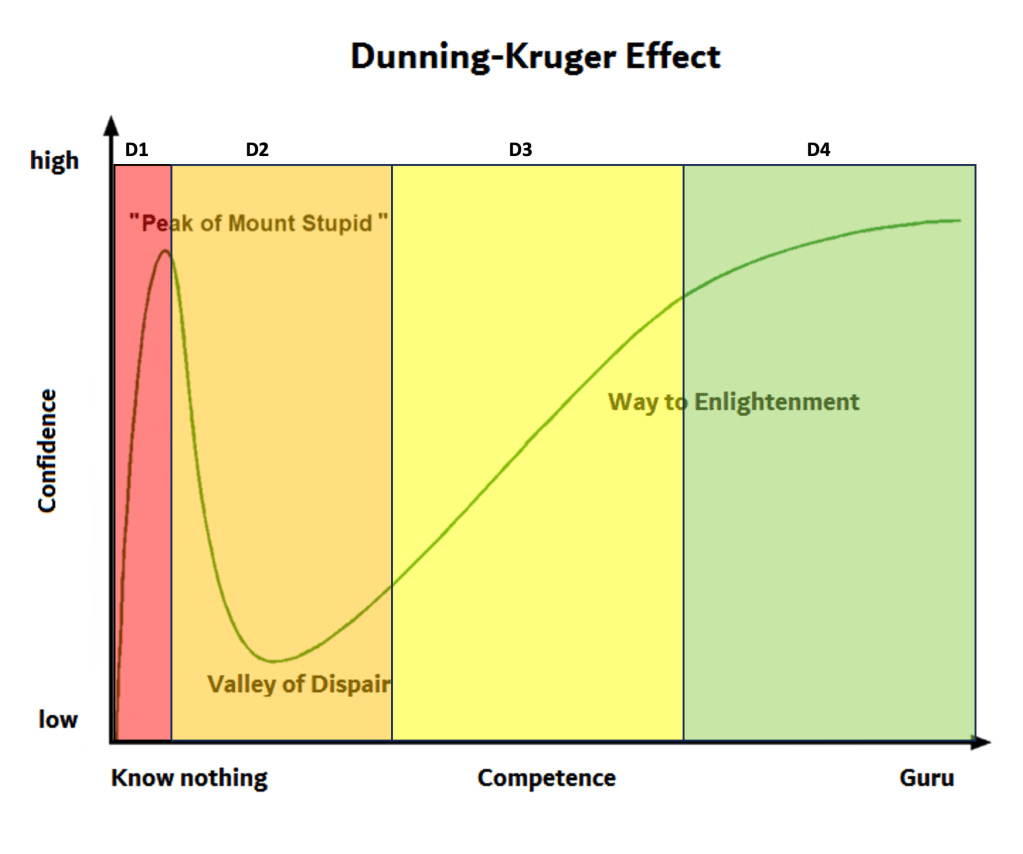
It is important to remember that the direct report may start back at a D1 level if the task they are performing is different in some way to ones they have done in the past. Think of an experienced football coach for early years now coaching individuals in their late teens. The task (coach kids football) is basically the same but the difference will be in the needs of the kids and thus it is technically a totally different task. As such they may still go through all of the development levels from D1 to D4 but the process may be sped up as they can draw on previous experience.
Image sourced from: https://situationalandcontingencyleadership.weebly.com/situational-leadership-theory.html on 30th Nov 2023.
 Alex Devereux
Pingback: Using Situational Leadership to develop direct reports | Alex Devereux